
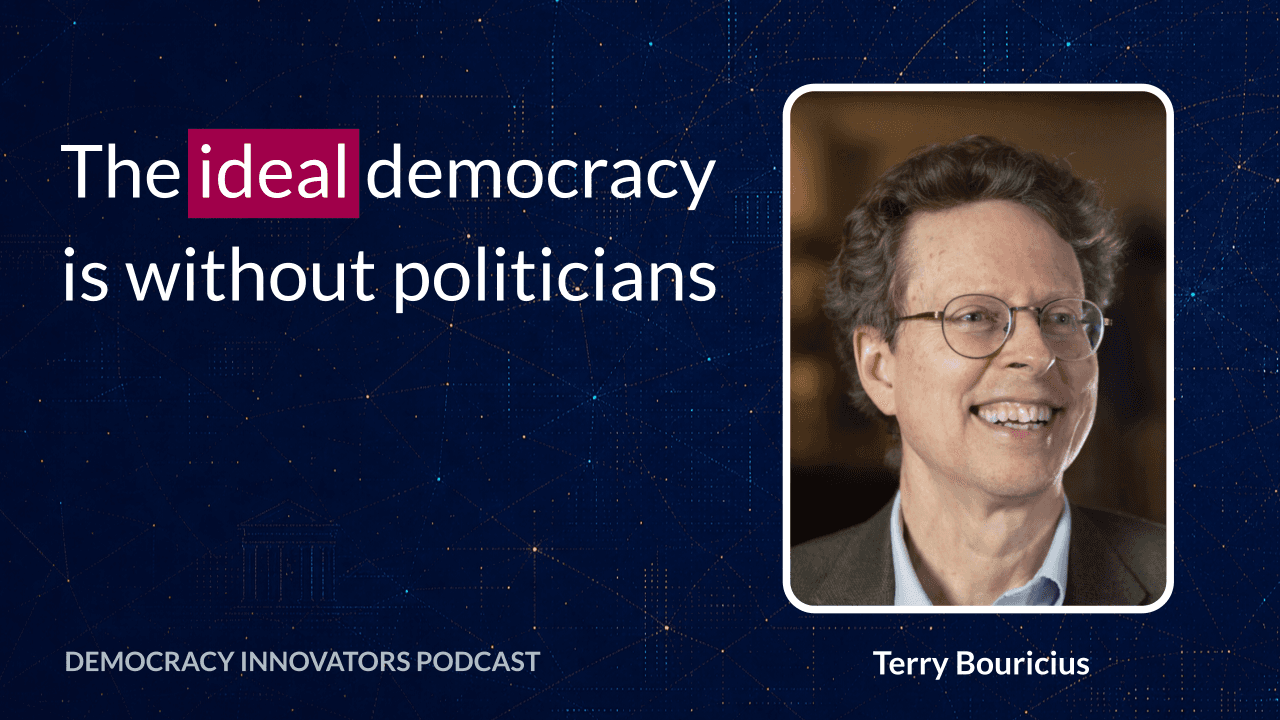
This episode was automatically transcribed, there could be errors.
Terry Bouricious00:00Selecting your officials by lottery is democratic and selecting them by election is oligarchic. The founders of The United States did not want a democracy. They were very, very open that they feared democracy. I've had a lot of experience with politicians where as a politician, a bill would come forward from the other other other parties. My first instinct as a politician, my goal was to find what was bad and horrible about it so I could attack them. Let's see what we can where we have common ground here and how we can we can craft this and add other things to make it so that we all agree on it. That was of no interest to the politicians.
From politician to democratic reform
Alessandro Oppo00:00Welcome to another episode of the Democracy Innovators Podcast.
Alessandro Oppo00:49My name is Alessandro Oppo, and, our guest of today is Terry Bouricious. Thank you for your time and for being here. Glad to be here. And, I mean, the first question is, would you like to say something about you, your experience?
Terry Bouricious01:06My work on democracy reform came in a nonstandard way. I'm not an academic, although I've written a lot of journal articles and and books and so on. But I was a politician. For twenty years. I was a lawmaker in The United States, in Vermont. In fact, I was elected along with Bernie Sanders, who some people will know of, to city government in 1981, served ten years in the city council, then got elected to the state legislature, served another ten years as a legislator. And I realized that my elected legislative bodies, they were not very representative of the population in a lot of ways. They were sort of off the mark. And so after I left elected politics, I went to work for an organization called FairVote, the center for voting and democracy that worked on election reform, to do things like get The United States to adopt proportional representation, ranked choice voting, other kinds of reforms. And in that role, I did it internationally, but mostly in The United States. In that role, I was invited to give testimony to the British Columbia Citizens Assembly in Canada. They had been charged by the legislature to devise a new voting system for the province because they were having just ridiculous outcomes, just wild swings in party control and so on. And I I obviously recommend they use a a proportional representation system. But this body, it was selected by random lottery. No politicians. It was one man, one woman from each legislative district, a 160 people in all. And they a light bulb went off over my head that this is what democracy looks like. They they had no hidden agendas. They had no campaign donors to satisfy. They weren't trying to smear each other for the next election. They were just learning and doing the work. And they became more competent than any elected legislature I know of on the issue they were dealing with. And that was in 2004. And so ever since then, the focus of my political reform work has been on what's called sortition, use of random lottery selection to form democratic bodies. And so that's how I got here, and I've been working on it for a long time now. And I just recently have also published a book.
Alessandro Oppo03:29Yeah. Exactly. That was my question about the book. So politician without democrat I mean, democracy without politicians.
Why elections are oligarchic
Terry Bouricious03:38Yes. Yeah. The the book the book, the title is Democracy Without Politicians: Government by the People. And the basic theme is that elections are inherently problematic and they're not very democratic. They are they are oligarchic. In fact, Aristotle, talking about the Greek systems throughout ancient Greece, said that selecting your officials by lottery is democratic, and selecting them by election is oligarchic. And that was understood for thousands of years that elections, because of the principle of distinction and so on, it will naturally select people who are different. The idea was Aristocracy, they'd be better than, but looking at my raft of politicians, I I wouldn't say they're better than, but they are different than the population. They're they're an elite. That it's an oligarchy.
Alessandro Oppo04:39Yeah, this is very interesting. I also remember like when a few people have the power, they can be an aristocracy if they are the best of the people or oligarchy. So if they are just few people, but it's very interesting how the concept changed during time. Yeah.
Why politicians reject citizen deliberation
Terry Bouricious04:56It's amazing that for thousands of years, it was understood that democracy required the use of lottery selection as a fair way of getting a diverse group of people who were representative of the of the people and that elections were the natural tool of an aristocracy. And so when The United States was leaving great the Great Britain empire, the founders nowadays, people say, well, democracy means elections, but that wasn't what they thought. They thought elections were the proper tool for an aristocracy. And the stunning thing a lot of people don't realize is they the founders of The United States did not want a democracy. They were very, very open that they feared democracy. It was a threat to property rights, and they thought that the opulent wealthy landowners and slave owners should run society, and that they thought that the proper tool was elections. Now, to be fair, at that time, were limited to other property owning white men. But but even when they expanded the franchise to allow women to vote and former slaves and general population to vote, still the people who got elected tended to be pretty much the same. They were the well connected celebrities with great wealth or at least, attachment to great wealth.
Alessandro Oppo06:25And, what what is or what was the reaction, among, like, your former colleague politicians. So people that are elected.
Effects of citizens' assemblies
Terry Bouricious06:39It's it's interesting. When I talk about sortition, the use of lottery selection of everyday random people to form bodies that will then listen to expert testimony, have staff draft bills. Another body might be a jury that just listens to the pro and con arguments and votes to approve or reject the new bill, the new law. When I explained to people initially, their first reaction in The United States where nobody has heard of sortition. In Europe, there's a lot of places, Belgium, Germany, Denmark, a lot of places where it's very well known, but in The United States, nobody the initial reaction was always people would give a little chuckle, random everyday people making policy. What a ridiculous and then I talk about it for two or three more minutes and they start nodding their head. And the capper is, I say, it couldn't be any worse than what we have right now with these politicians. And they all say, yeah. And they recognize that they only think this is proper because it's what they grew up in. It's an insane system for a democracy. It doesn't work as a democracy. And in fact, it's worth noting that the system of having an elected chamber, it was not designed for a democracy. It was designed in an, in a monarchy so that the, the elite aristocracy could monitor, initially advise the king and then later control the king, but it was never intended to be a democratic tool. It is not inherently a democratic tool. And so when I try explaining to regular people, they generally said, yeah, that makes a lot of sense. But when I try and explain it to politicians, oh no, no, no, no. Or, or, or lobbyists. No, that's, that's a horrible idea. Because the fact is you realize that the only everyday normal people that politicians ever come in contact with around a policy matter are either people who know nothing about it. You know, I'll call them idiots, people who know nothing or fanatics who are on one side of an issue or another and are just and so their experience of everyday people is not people who have gone into a deliberative body, spent weeks learning about the issues, listening to expert testimony, and becoming virtual experts themselves on the issue. Politicians have never seen everyday people like that. So it's not surprising that they reject the idea because they can't imagine the everyday people that they come in contact with making policy decisions because they're either idiots or fanatics.
Alessandro Oppo09:23And, how do you think that, this kind of experiments in relation to sortition could be made and so then introduced in our world?
Terry Bouricious09:33Well, there are a lot of, there have now been over a thousand citizens' assemblies convened around the world, and every continent except Antarctica. Maybe they've had one there too. I don't know. But the point is that, use of random lottery selection to form deliberative bodies that tackle really thorny issues is now throughout most of the world becoming a standard, tool of of of government. But in The United States, it's we're not there yet. There've only been a handful of citizens' assemblies here. But almost all of these citizens' assemblies have been advisory. They come up with a policy, a list of policy recommendations that they hand over to the politicians. And then the politicians, sometimes they just shelve them. Sometimes they cherry pick particular issues that are politically palatable for the party in control. But there are very few that have been really decisive. There have been some that have been virtually decisive. In Ireland, the politicians there were looking at the issue of same sex marriage and later looking at the issue of abortion. And being a Catholic country, the politicians didn't wanna tackle those issues. They were afraid of them. So they agreed to set up a constitutional convention of randomly selected citizens, everyday people. And that body took a lot of testimony, learned a lot, did deliberation, and two different two different randomly selected constitutional conventions made recommendations. One, to allow for same sex marriage, and a few years later, to remove the abortion ban that was in the Irish constitution. And those went to referendum, and they were approved by large, huge majorities of the everyday people in the country. Politicians did still have their their finger on it because they decided whether the issue would go to the people for vote. But the politicians intentionally wanted to keep hands off. So it's sort of interesting. And also in places like, oh, in Melbourne, I think it was Australia, they had they're looking at their capital budget, ten year capital budget, very expensive, and they realized they didn't have enough money to do all the things that they wanted to do. And the politicians were afraid to either raise taxes or cut some programs that were some some investments that were were popular. So they agreed to set up a a citizen assembly, 43 everyday people randomly selected. They deliberated, and they came to a unanimous conclusion, recommendation about what should happen. So there are places where decisions are almost actual decisions by the people, but my goal is to get there so that the politicians are not in the mix at all. And I even have a strategy.
Alessandro Oppo12:27The strategy
Terry Bouricious12:29is what I call a peeling strategy. I want to try and get one policy domain at a time removed from politicians and given to a jury like process. And you we'd probably start with issues where either the politicians have a clear conflict of interest, like an ethics panel that oversees the ethics performance of legislators, maybe you'd say, yeah, we don't want other politicians controlling it. Maybe we should have everyday people decide whether they were ethical. Or issues where politicians this is to get started. Issues where politicians don't mind giving that over to the people. In my city in Burlington, like, there's some talk about, well, maybe we could move zoning decisions about changing the land use regulations from the city council to a jury like process. The planning department would come up with recommendations. A jury would be pulled, let's say, 30 randomly selected people. They would listen to pro and con arguments about the proposed change and then simply vote. So my idea is to peel away one policy domain at a time so that we eventually get to the point where maybe a Congress or parliament still exists, but most of the important decisions are being made by everyday people in jury like process.
Alessandro Oppo13:50So this seems a very like a bottom up style process. They wonder how to
Conflict incentives and false accountability
Terry Bouricious13:58It's both. I mean, right now, there have been a lot of citizens assemblies that have just been spontaneously organized by civic organizations with no government, license at all. They just organize, but obviously they have budget constraints. And so sometimes in a good jury process, the jurors, the members of the citizens assembly, whatever would be paid for their time. There'd be childcare, there'd be various benefits. When it's self organized, often they don't have the budget to do that. Then some have been organized a lot in parts of Europe and Australia and in Japan, where they have been called by the government itself. They've initiated the creation of a citizens' assembly to deal with some thorny issue, in which case they have a little bit of a better budget. So trying to get politicians to do it is an important first step, but also having civic organizations just doing it on their own. But the key problem is if you have a mini public, a citizens' assembly, a sortition body, and they do a lot of work and they come up with a plan and the politicians say, no, we're not going to do that. That's going to, that's going to be more harm than good because people say, well, why bother? What's, what's the point if it doesn't have any effect? It has to have a result that people can see. But one of the goals is to have a lot of citizens' assemblies just so that people say, you talk about it and say, oh yeah, I heard about that. They had one over in Milan recently or whatever. Need to have some, even if they're only advisory, so as sort of a proof of concept. So people see that everyday people can become well informed and make really good quality decisions. And here's another point that I often talk about. Politicians have a vested interest in not seeking win win solutions. In other words, politicians want issues that they can use to demonize the other party or other parties. They they like the conflict. The conflict, they're evil. They're bad. We have to stop them. We need to vote them out of office. Fear and hatred are very effective and important campaign strategies. So if you say, well, here's a here's a proposal that everybody could get behind this. This makes a lot of sense and everybody supports it. Politicians basically aren't interested in that. That doesn't help them win power in the next election. So I've had a lot of experience with politicians where when I was a politician, a bill would come forward from the other other other parties. And my first instinct as a politician, my goal was to find what was bad and horrible about it so I could attack them. That's what politicians want to do. It wasn't my natural instinct. It was, let's see what we can where we have common ground here and how we can we can craft this and add other things to make it so that we all agree on it. That was of no interest to the politicians.
Alessandro Oppo17:20And, yeah, this, this issue about commitment I mean, in relation to the, let's say, the output of a citizen assembly and then the implementation has been an issue. And, also, it's very interesting what you point out, like the sort of conflict of interest that can have a politician because polarizing people and trying to to attack another party is probably more effective in term of the campaign of the party or the politician. Yeah. It's not painful. Yeah. Now like, so I wonder, how could we change this? Because it seems to me that, probably like a new party or a new class of politician should emerge and the politician that are interested in sortition and are interested in implementing new a new methodology.
Technology and the Athenian model
Terry Bouricious18:19So Well, yeah, there's a lot of people who brainstorm ways to transition and I've settled on the peeling strategy because I'm concerned that when people get into a legislative framework, I don't want to say they get infected, but there are there are logical reasons. Whenever you have an election system in any society, there is an impetus to form political parties, to work together with colleagues, to gain power. When you're in an a some people say, well, we'll have a political party that will just be committed to this kind of reform, sortition, and we'll get them into office. And then the thing is once they're in office, they also wanna get reelected. And also, there the other parties will try and, oh, come on. Come over to join our caucus. And because those guys are real bad. And so there's all these dynamic. And the fact is that some people say, well, we'll have citizens' assemblies outside and they'll make rec they'll make a decision. And then the legislator elected from this special party will, will do the work that the, that our citizens assembly has said they should do. This, this is the way they should vote on this issue. But that's not the way legislatures work. 90% of the important work is not the roll call votes. It's not the floor debate. It's not the votes that are recorded. It's the behind the doors secret deals. You scratch my back. I'll scratch yours. This is this is bill's gonna come forward. I promise I'm not gonna raise, an issue about that. It's that negotiating that is invisible, that voters never see. And having people that are committed to sortition in that legislative framework, they're not going to be able to do much there. And and the fact is that that within the legislative body, it's almost impossible for voters to know what their elected legislators are actually doing. I mean, it's the economists use the term rational ignorance. If you have an election with millions of people voting, and most of what politicians are doing is behind closed doors and secret, The idea that the voters would be well informed to know which which way to vote, it's sort of it's it's it's a showmanship. It's it's a performance art of politicians. It's not the reality. In fact, I've argued that it's basically impossible for voters to use the election tool to hold politicians to account. There's a couple of wonderful stories that that that show this. Back in The United States, it was in early in the twentieth century, president Wilson was in office. And in New Jersey, there was a spate of shark attacks at the coast in the ocean, and the people were avoiding going to the tourist industry, which was in the coastal area of New Jersey. And the economy of Coastal New Jersey crashed because all of the tourist industries were were suffering. And so there's some a couple art political scientists, Bartels and Achen, who looked at the vote totals for president Wilson's reelection campaign in the next election and found that in the counties right on the coast where the economy was suffering, Wilson's vote total dropped precipitously because the notion was we throw the bums out. If things are going bad, we throw the current politicians out. In inland, away from the coast, there was no change. So nobody said Wilson was responsible for shark attacks. The point is when things go bad, you vote the incumbents out. And you look at the great depression in The United States, they voted out president Hoover and brought in Roosevelt who in The United States was considered a somewhat pretty much on the left. He wasn't a socialist, but he was left of the other parties. And so so a lot of Americans said, see, accountability works. But the same great depression in other countries also caused incumbent governments to be thrown out. And in Germany, the center left government was thrown out and eventually Hitler came in. So it's like throwing the incumbents out is really crude sledgehammer tool that has no idea of what caused the problems, what the other parties will do to fix it. Throwing the bums out is a stupid way of having accountability. It simply doesn't work.
Alessandro Oppo23:01And in relation to citizen assembly, I was wondering how do you imagine them like also supported by technology? Because this is something, or like, I don't know.
Terry Bouricious23:15Well, there are a lot of experimentation with using I hate to use the word AI because AI means a lot of different things. There's large language models. There's things that create videos. There's dozens of different kinds of large data systems. And some people are using them to do things like keep a record of, in a in an assembly who has spoken how many minutes, so and so hasn't spoken yet to help the facilitators sort of manage the thing. There's other things where they at the end of the day, they use an AI to draft summaries of each of the speakers and what was said, and the speakers get to review it and say, yeah, that, that summarizes me fairly or to correct it. But there's things which are just clerical tasks, which can be made a lot more efficient and a lot less effort to do to help citizens' assemblies function as they exist right now. But but you don't really need any of those to do this. It can be done completely. And in fact, in ancient Greece, in Athens, after the reforms of four zero three BC, they first off, before 403 BC, they they what we learned in school is about the assembly, the large mass assembly, and and that was the idea. That was the image of democracy. And, you know, people speakers would get up, demagogues or whoever, and they would speak and people would vote. But the fact is that the agenda was controlled by a randomly selected council of 500, the Boule. Now other city states also had assemblies like Sparta that were not democracies at all. So the assembly was not the defining feature of Athenian democracy because the aristocracy controlled Sparta also had the assembly, but the agenda was controlled by the aristocracy. They would decide what what things they would put in front of the people. And so after the reforms of four zero three BC, when democracy was reinstated in Athens, the assembly gave all lawmaking authority away from the mass assembly to the nomothetai, which were randomly selected jury of 500 or a thousand everyday, Athenian citizens, they would listen to pro and con arguments on a proposed new law and then vote. That was the only way that laws were established in the reformed democracy of Athens. They didn't need any AI. They just had five speakers in favor, five speakers against. They could ask clarifying questions perhaps, and then they would vote. So the idea of using special technology, yeah, we can do that, but it's absolutely not essential.
Alessandro Oppo26:20And something interesting from ancient Greek history is that also people were compensated when they were participating in their political
A multi-body sortition system
Terry Bouricious26:31There was a point in the early days of the assembly, they were not paid. And then they said, you know what? At some point they actually had a difficulty getting the quorum that they required. I don't if it was 6, 000 people or whatever. There was some quorum it's very I mean, the democracy lasted for two hundred years, so policies changed. But anyway, they started paying them for attending and also for serving on other bodies. And, yeah, it was recognized that this is, this is important work. Making democratic decisions is important work. They wasn't, they weren't paid handsomely, but they were paid. Yeah. And in fact, some of the people, the anti Democrats, and there are people who wrote, historians and so on, who were, who wanted an oligarchy of aristocrats. That's what they thought was good government, who didn't like democracy. They complained that you have all these pensioners, if you will, people, elderly retired people who didn't have work anymore, filling up the, the assembly because they're being paid. You know, it's true. But if you look at the age of, of, in The United States of, of the senators and congressmen, you know, the average age is up in the sixties, seventies, eighties. I don't know. I mean, couple of people just got renominated who are who are past 80 years old. So the gerontocracy is not a curse that elections overcome. Even though they complained about the anti democrats complained about it in Athens.
Alessandro Oppo27:57Oh, yeah. I I was thinking if, like, there is a democracy without politicians and so people participate in the political life, that also mean that they could receive a sort of compensation because maybe
Executive power without elected "kings"
Terry Bouricious28:11Yeah. Yeah. Maybe there there's a lot of ways you could design a democratic system without having elections at all. My idea is with a piecemeal strategy, elections would probably persist. But the idea is I wanna have some policy domains where it's the politicians have no say about it. They have no interest in it. It's like they don't argue with the citizen assembly because they're making all decisions about, let's say, taxation is being decided by everyday citizens in assembly and politicians. What I want to avoid is politicians and in other words, I'm opposed to what's called a bicameral system where one chamber is elected like the current ones and one, another chamber is selected by lottery. I think that's problematic because the chamber that's elected is full of narcissistic sociopaths, not all of them, but a lot of them are. And, and they are skilled at public relations. They have power at stake. They have their careers at stake. The random group, they're there for a short duration. Maybe it's, maybe it's weeks, maybe it's months, maybe it's a couple of years. It depends on how the design is set up And then they're gone. So they have no career path there. So the politicians, if the two bodies are butting heads on some policy decision, the elected politicians know how to use the media. Say, you want a bunch of hairdressers and plumbers making decisions about taxes? We are the spokesman for the people. We've been selected by the people. Politicians know how to play the game, and they'll they'll destroy the sortition body. So I want to not have them butting heads. I want the elected politicians to deal with their issues and the citizens to deal with their issues. That's in the transition phase. And then eventually the elected body gets smaller, fewer and fewer issues until they become irrelevant and the sortition bodies, everything. My vision is that even if the elections still exist, it's sort of like the monarchies of Europe that, you know, they exist, but they don't have any power. I want maybe politicians still exist, but I don't want them to have any power. And I have a whole scheme, which I've written paper about, and I talk about it in my book about multi body sortition, because quite frankly, it doesn't work to have a single chamber of randomly selected people doing the entire legislative process. In fact, it doesn't work in the elected chambers either. But that's just what we have because that was what was passed down from the advisory bodies to the king. But what you really need is an agenda body that just says, these are the issues that we need to deal with. Because right now, agendas set by politicians, they put a lot of things on there that that are good for the next campaign, issues where they can attack the other party. There might be other issues that are really important that just get ignored. Like, climate change was understood to be a very important issue for about forty years. Forty, fifty years, it has been understood that we really need to deal with this. But politicians just continued to kick the can down the road and ignore it until it started to become a crisis. And The United States, they're still pretty much ignoring it. In some parts of Europe, they're actually dealing with it now. But the point is that because the politicians were setting the agenda, they were choosing agenda items in a in a foolish way, a way that was not good for society. So I think we need a randomly selected body that all they're doing is listening to a bunch of experts and deciding these are the issues we need to deal with. And then you'd have a maybe you'd say you put out a general call to the entire society saying, anybody have policy ideas? You form a group of 10 of you can come together, work up a a draft bill. There might be dozens or a 100 of these bodies that are just anybody in society who wants to be involved. They can help craft a bill and they submit it. And then there would be a randomly selected review panel that would look at all this raw material and say, this this one's nonsense. This one's stupid. Oh, this is pretty good. Oh, this one's pretty good. Maybe we could meld these two together. We'd send it back to them and say, can you guys work together and work out a combined version? Cause we like both of these bills. And then you come up with a final bill. The review panel would would craft a final bill on the topic. And then my idea is the problem is once you've crafted something, you become incompetent to judge your own handiwork. There's a a pride of authorship. There's there's there's a there's a group think that can set in, or a particular member who's really articulate and leads the body astray. So I don't want the body that crafts that final bill to then say this is approved. I want a jury, a separate jury, randomly selected people, very large, statistically representative of the population. I want them to come together and listen to the pro and con arguments just like the nomothetai did in ancient Athens. Listen to the pro and con arguments, ask clarifying questions, and then vote to adopt or reject the law. So it is a relatively involved process. The point is having a single chamber, whether it's randomly selected or elected, is a bad design for democracy.
Alessandro Oppo33:27And in relation to, I mean, your vision, how do you imagine democracy? How it could be, let's say, if sortition is adopted, yeah, how it could work? Like, like, democracy could have no one elected?
Terry Bouricious33:51Well, I I refer to this as I used to call this my two hundred year project because it's it's not gonna happen immediately. But there have been so much progress in citizens assemblies around the world. Now it's my twenty year project. But, so so I can talk about the end point, the my vision of how because you need sort of a north star saying, this is the direction we wanna go. So so that's what I'm doing there is I'm saying this is the the kind of system that I would like. There might be one of the things that I didn't mention in my my grand design with all these different bodies, one of the bodies we would also want is a randomly selected group, maybe of people who had previously served on some other citizens' assembly, some other body as a rules committee, which would be constantly looking at the performance of all these bodies and making recommended improvements, changes to the rules. Like we, the term of office is too long. People are becoming like, they're getting like politicians because they're serving too long. We need to shorter terms or, or we need to use AI this way or get rid of AI or whatever. So a rules body, which would be constantly perfecting and changing the design. I'm just proposing an initial design that I think makes sense. But one of the key things that in my design is a rules body that will constantly be evaluating things and making improvements. Also, we'd want an oversight body randomly selected that would evaluate the performance of the staff for this body because there's always the danger of capture by the bureaucracy. You have random people come in, the bureaucracy is there permanently. They could, they could steer things. So you need an oversight body that is randomly selected and they can fire members, the facilitators, the staff, if they get too many complaints that they're behaving in a way that's manipulative, etcetera, etcetera. So there's a lot more to the design, but, Oh, I got off track there. Your question was about, can you rephrase the question? I because I I I I went off on a side path there.
Alessandro Oppo35:57No. No. No. It was a was a little like a how do you see, like, democracy in the future? Let's say if sortition is used.
Terry Bouricious36:04There's a thing I'm really sorry.
Alessandro Oppo36:10No, you go ahead. Okay. No, I was also wanted to ask you about a possible timeline, but you replied with the 200.
Wealth, power, and political alliances
Terry Bouricious36:19One important thing that when I wrote my paper on multi body sortition lessons from the Athenian democracy for the modern day and in my book, it's mostly focused on the lawmaking side. And then people go, well, what about a president? What about a prime minister? What about a governor? You wouldn't select them by random lottery. Yes. You would not select a single individual by a lottery selection. Although you actually could, if you had a narrow pool of people who are all great and you could pick one of them randomly from that pool. That that's a possible scenario, but it's not what I'm advocating. But the executive in my notion is the executive needs to be removed from policy making role. The executive needs to be an administrator. They faithfully execute the law that the legislative branch, the democratic branch has enacted. The problem we have is that we inherited our system. It's basically passed down of the king and the parliament in Britain and so on. And there's the executive who has a lot of authority and how much authority the two have. But the model has always been, whether it's the prime minister or president, it's sort of like, it's, it's like a slightly reduced king or queen. And that is a really bad design because you can, I mean, I, I don't wanna get partisan here, but you can see what happens when a member of parliament who's elected prime minister or a king or a president, excuse me, in The United States decides that they want to exercise king like power, having an executive who also is engaged in policy generation and issuing edicts and resolutions and directing things is incredibly dangerous to democracy? So my idea, you know, in my ideal democracy with sortition, a multi body system for enacting laws is you would probably have a randomly selected body. It's a hiring committee. They would recruit an executive. It would ideally be somebody who was not seeking the office. Because if you're seeking power, that's almost a sure sign that you're a narcissistic psychopath and you should not be in that position. Now I don't want to imply that all politicians are psychopaths and narcissists. There are some wonderful politicians, people who are honorable, great, fantastic human beings. But as a group, politicians are far more likely to be narcissists and psychopaths than the general public. So my idea is that this randomly selected body, they would recruit, they would seek out people and they'd find people who were willing to do it, but had not maybe even considered it. President of a university, somebody who runs a business, somebody who's the head of a union, whatever. They would seek out people who would be good in the job and would understand that their job was to be an administrator, not a policy generator. And the idea that once they hire the person, so there would be no mass election for this person. They would simply be a hiring committee. And then every, every six months, every year, whatever duration the rules committee thinks makes sense, there would be a review panel that would be pulled together, a jury, like randomly selected people that would review the performance of the executive, listen to pro and con arguments about their performance, hear complaints from the staff, from the bureaucracy, from lay people, people in the public saying, I saw them do this and they did this and they manipulated the assembly this way, and they could then fire the executive, opening the seat for a replacement. But there again, you don't want the body that fires them to also be the body that replaces them. You'd want a new body, a recruitment body to go out and find a replacement because you don't want people, who run this to have an incentive to be dishonest, Hey, no, if we get rid of this guy, we can pick the person we want. And then that person would be beholden to us and we're gonna, you know, whatever. You want to have a separation of powers. That's one of the things that is in The US constitution that is important. Separation of powers. It's not working in The United States because political parties have merged so that when the Congress and the president and the Supreme Court are controlled by the same party in The United States, there is no separation of powers. They all become one unified effort. And other countries often that's true too, particularly in parliamentary systems where the executive is in the same party that controls the legislative branch. They that's a unified thing. And that quite frankly is a very dangerous design. It can easily lead to authoritarianism and even eventually to totalitarianism. And we've seen that in several European countries that have come dangerously close and are some of them are still on the precipice of becoming fully, you know, authoritarian.
Alessandro Oppo41:30Mhmm. Yeah. Separation of power is super important. And I was thinking that, usually we do not consider also informational power and economic power that can interfere
Sanders, Landemore, and Terry's book
Terry Bouricious41:44The a whole issue of economics, you know, in my book now I individually, I will confess that my politics are very much on the left, farther left than almost any politicians in The United States. But in my book, I studiously avoided any left, right. And so therefore I also avoided a lot of talk about the other angle of oligarchy, which is the billionaires and the super wealthy. So I focused on the structure of the government because my feeling is that to get sortition democracy, we need to have people of all political stripes working together, recognizing that politicians are the problem of whatever political stripe. And I have talked to right wing libertarian groups. And when I start talking about the problem of politics and politicians, even though I'm on the left, these right wingers are nodding their head. Agree. Yeah. And and and the idea is here's the funny thing is those of us who are deeply involved in policy matters, economics, social issues, whatever, we tend to believe that we since we figured out our position based on information around us, we tend to believe that if we could get a room full of everyday ordinary people and just explain all the things that we have come to understand, explain to them, they'd agree with us. Ordinary people, they'd agree with us if we could just explain it to them. And that is a very powerful reason why I think people on both the left and the right can be persuaded to push for sortition reform because they see the politicians are problematic and they have a belief or at least a hope that ordinary people would agree with them. Now eventually, once we get sortition democracy, we'll find out where the population actually goes, what a democracy would actually decide. Quite frankly, different societies, the same structure of democracy will make different decisions based on the culture, the thought leaders in community, etcetera. They're not gonna be a monolith where all democracies are gonna do the same policies. They're gonna do different things based on the society they're in. But I think that it is very true that the the political, the economic aspect, I don't wanna belittle it because quite frankly, it in many ways may may be more crucial than the governmental structure. But my book is about the governmental structure, but I don't want to act like, oh, that's just economic sense. No. No. I agree. The the power of great wealth and it comes right into the elections too. I mean, not all countries have as corrupt a system of election finance as The United States. But in The United States, it's just monumental where one individual can spend $230, 000, 000 to help get Trump. I was at 250, whatever, million dollars to help get Trump elected. That is just insane that that kind of wealth first off, that they can do it in the electoral system. You wanna make sure that in the jury system, a sortition system, it's more like a court jury where there's no campaign donations. There's no, there's no, outside influence. There's corruption. There's there's bribery laws, etcetera, etcetera. But the fact that the money can influence elections, I mean, it does. It simply does. In every society, people with great wealth shape the the debate, if not the exact election outcome. So but my notion is that with a true democracy, a sortition, that they might everyday people, according to polls right now in The United States, say that they think that this level of wealth and income inequality is unacceptable. They think maybe rich people should have maybe 10 times more wealth than ordinary people, but not millions of times more wealth. So I think my idea, again, I sense that we all tend to think that every day people would agree with us. I think every day people would agree with my economic analysis of the problem of wealth inequality. But maybe I'm wrong, but it's I believe in democracy and what they say, what the people believe and agree to democratically through a sortition process, I I would accept.
Alessandro Oppo46:24It's it's very interesting what you say that that, I mean, you can be leftist or, I mean, right wing, and, they both agree about, politicians being the problem. And so I wonder if this could be a sort of alliances between, who is a left and who is a right wing.
Terry Bouricious46:47It's not a it's not a coincidence that I titled my book as I did, Democracy Without Politicians. I I could have said without elections, but then people go, what? It doesn't make any sense. Democracy requires elections. They it just the title doesn't make any sense to them. I mean, it makes sense to me because I think elections are undemocratic. But but by by making my foil, if you will, my enemy politicians and and as I say, I'm a recovering politician myself. I was a politician for twenty years. I I helped organize political parties. I I was involved with founding three different political parties in my time. So I was fully committed to the political party structure. And it was an experience in British Columbia, a citizens assembly and everyday people that made me realize that last, you know, thirty years of my political effort was a mistake. That, building a political party was not the path to democracy, just a path to future battles with other parties. So yeah, it's, politicians can be a focus of, I believe ultimately a left right, unity. I mean, I think there are, there are, there are plenty of people in The United States. A lot of my book, I use examples from The United States. Although 90% of it is is relevant to people in any country, any place that has an election system, you don't have to although I use a lot of examples from US elections, are particularly horrible, but still most of the book is relevant to anybody. But the fact is that the people who voted for Trump, people on the right, a lot of them did it simply because they were disgusted at the status quo of politics. And there are some people, big name people who were like one of the biggest podcasters in the world, Joe Rogan. He was a big Bernie Sanders supporter. And when Bernie Sanders was was knocked out of the race by Hillary Clinton. Hillary Clinton, she's an elite, corrupt, horrible person. He went for Trump to shake things up. So the point is there are big name people who are neither left nor right. They're just anti corrupt politics as usual.
Alessandro Oppo49:11And have you received any feedback from send from Sandy from Bernie Sanders?
Terry Bouricious49:20Bernie Sanders did blurb my book. In other words, on my website, I have a quote from Bernie Sanders saying something like, the book is this is a well researched book on potential future of democracy. Basically, saying that it's without him actually saying, and I endorse its thesis. In other words, he's just saying, this is a this is an important good book about a potential future for democracy. But the truth is, I know Bernie. I I I've I've known him from long before. I in fact, I first I used to live with Bernie on I stayed on his couch for two months back in the nineteen seventies while I looked for an apartment because we were friends in, in a third party, minor, tiny little political party. So I've known Bernie for, for a long time and we're friends. But the fact is everything in his life has shown him that one politician can have a major influence. So although in his campaign for president a few years ago, he did say, it's not me, it's us. Still, I'm I'm not sure if he would fully endorse the idea of getting rid of elections and politicians because he's so deeply immersed in that. I I I've actually avoided asking him point blank. He likes my book. He he he blurbed my book. He thinks that it's an important book, and I'll just leave it at that.
Alessandro Oppo51:04And a quite famous professor, Helene Landemore, also she wrote a book that has a similar title to yours. Yes.
The myth of founding democracies
Terry Bouricious51:13Helene's book is Politics Without Politicians. I like mine better, Democracy. But yes, in fact, she and I have had email exchanges for years and years. I've read her book, several of her books. In fact, I just saw her a few days ago. I went down to Connecticut to be an observer at a citizen's assembly that she organized, a statewide citizen's assembly looking at an election reform issue, property tax reform issue that she organized. And so I asked her, can I come be an observer? And so I didn't have a lot of time to chat with her because she was really busy, but we touched base and we compared notes a little bit. So yes, she and I have a very similar analysis. My, my recipe for a final solution is a little bit different than hers. She she's avoided saying, and this is what we need to have. She's basically said, and this is why what we have right now doesn't work. And we need to use sortition. So, so I don't know if she embraces my full thesis about how we would reform the system, but she did do a lot of good work to help try and get my book published. So, so I, but, yeah, she's great. I, I, I, I, I'm just really impressed with her, both her writing and her organizing.
Alessandro Oppo52:41I was wondering if maybe I didn't ask you something that you wanted to talk about.
Final message: Read the book
Terry Bouricious52:50Gosh. Well, I just I'll just do a little bit more about couple of things. One one one little piece of history is people talk about today about democracy, and they mean elections. In fact, I think even in the UN charter, the declaration of human rights, it talks about the right to elections and so on. And it's so ingrained. And so people assume that the founders of The United States were supporters of democracy, which they were not. They ardently opposed it. And also in France, the French Revolution, they say, oh, it's a democratic, the rising of democracy. No. They did not want a democracy. The French revolutionaries also wanted an aristocracy. They even had a two tier election system. Only certain people they, they, in fact, they talked about, was it active citizenship and the passive citizenship? If people didn't own property, then they shouldn't really be voting. And they had a system where they would have an assembly, a mass community meeting, and only certain people were allowed to be in that meeting. And they would elect people who were not going to the legislature. They were electing people who would then go to a regional meeting of other people who had been elected by these local municipal subgroup meetings and that group group, which would have filtered out the rabble and would be the lawyers, the merchants, the articulate people, they would elect from their small group people to go to the legislatures. They had a two tier election system to filter out any working class people. Now there were a handful of people who were ardently pro working class, but the French system was carefully constructed to prevent any risk of democracy. And people don't know that either. They don't know about the Americans. They don't know about the French. They assume that these no, they, these were aristocratic revolutions against the monarchy. And even in The United States, it wasn't really even against the monarchy. They used King George in The United States as their foil, as their enemy. But just ten years earlier, the continental Congress had sent a letter to King George asking him to exert more authority over parliament because the taxes that they were objecting to were being passed by the parliament in London. And they wanted they thought they said, King George, you're being misled by your advisers. You need to stand up to parliament. And then when that didn't work and King George dismissed the letter, they said, okay. Well, we'll use King George as the enemy because a king is a better enemy than an elected parliament. And so in The United States, they started using King George, but he was symbolic. Basically they wanted to have a system almost the exact same system that Britain had, but transplanted The United States where they, the local ruling elites, aristocracy would be in charge instead of the aristocrats back in England. They wanted the British system. They wanted a king. In fact, they said, all right, we'll have an elected king. And they said, well, we shouldn't call him a king because we were attacking King George and so on. So we'll call him a president. But they still wanted an executive, who could veto things and who could make appointments and so on. So they used the model of the aristocracy of Britain to make the aristocracy, the oligarchy of The United States. And it did change over time. Expanding the voting rights did democratize it to some extent. But if you look at the people who get elected, yeah, there are some token working class people. There's, you can probably count on one hand how many genuinely working class members of Congress there are. And even in, in, in countries like Italy or Denmark or Sweden, there are a handful of working class people, but mostly they're professionals or business owners or wealthy. I don't want to dismiss the fact that there are working class allies on some of the, in some of the political parties, but the body as a whole is an aristocratic body. I don't know if that's exactly what I wanted to say, but that's something that occurred to me. Have this false notion that we have a democracy, and The United States say we need to defend the democracy from Trump. And I say, that's not gonna work because we don't have a democracy. Going back to the old way of a way it was before Trump was elected, we'll just invite another Trump because it's not democratic and people can see that. They think it the establishment bureaucracy of politicians is so corrupt that it needs to be overthrown. And so I tend to agree. I overthrown nonviolent. Have to be very clear. I'd never advocate any violence.
Alessandro Oppo58:15Yeah. It seems like we need a new design of democracy. Yeah. And, and do you have, let's say a final message for all the people that are working?
Terry Bouricious58:29Well, yes. A good thing is my book is because there's a person in The United States who thought my book was so important in terms of challenging the problems of climate change, AI, income and wealth inequality. He thinks my book is incredibly important. So he has paid a large fee to Routledge, which is this large, the one of the largest academic presses in the world that published my book. But they priced the paper book and the hardcover sort of like a textbook. It's very expensive. So he paid a large fee to Routledge to make the ebook version, whether it's Kindle or EPUB or a PDF version of the book free. So people can go to, you can go to Amazon and download the book for free, or you can go to my website, terrybouricious.com. There's other ways you can access it too, and just download the book for free. I think it's a very important book and our goal is not for me to make money from royalties, but to get it as widely read as possible. So I encourage everybody to go to, to, you can also get it at Routledge, I believe. To their open access books section or Amazon or something like that. Go to terrybouricious.com and you'll see a link there to download the book for free.
Alessandro Oppo59:46Thank you a lot, Terry.
Terry Bouricious59:49All right. It was very good to talk with you. Have good day. Thank you. All right. Bye bye. Bye bye.
Discussion
Continue the conversation
Loading comments…