
This episode was automatically transcribed, there could be errors.
From poetry to civic tech
Alessandro Oppo00:01Welcome to another episode of the Democracy Innovator podcast, and our guest of today is Malik Lakubay. So welcome, and thank you for your time.
Malik Lakoubay00:09Thank you, my friend. Thank you, Alessandro.
Alessandro Oppo00:12And as the first question, would you like to tell us something about you?
Barcelona, Platoniq, and open technology
Malik Lakoubay00:19Yeah. Absolutely. No. Of course. Listen, first of all, thank you. I've following your podcast for a while and I've seen a bunch of friends of the community, personal friends as well coming on as guests, so it is an honor and I hope I'll, happy to follow in their footsteps as well and hopefully you're surviving that fifth hit wave in Europe at the moment, as you were telling me. I sit here on the other side of the ocean for once, I'm normally based in Europe, but I'm in The States for part of the summer. Yeah, mean, listen, we can start a little bit where the journey is sort of like taking us and when you first asked me this, when we spoke a few weeks ago, thought about that question, what's the background, what's the journey and how does it relate to democracy? So I come from a family of immigrants. I think that's the main things for the past, I think five generations. Each generation was born in a different country from India with my grandparents. My parents were born in Madagascar in Africa, I was myself born in France where I grew up and then I immigrated to The States where my kids were born. And so I think that journey is also a journey of when you're an immigrant, you're looking for economic and political empowerment, I think a development, when you're always trying to find maybe a better place for you, for your family. And when it relates to that question, I think democracy and collective urgency, self empowerment, ability to make decision together, the freedom that comes with it as well, the representation that comes with it, I think is a major driving force for immigrants around the world. And my family was definitely part of that. I had the chance of growing up in the Western world, in France, so far a relatively stable democracy. I know you're based in Italy as well. And so I think part of that early journey was understanding that in order to settle somewhere, democratic conditions have to exist, right? And they comes with the rule of law, with peace, but also self empowerment and political empowerment. So that I wanted to share a beginning. Then, the background is relatively classic, I would say growing up in Europe, I followed a traditional path of studies, etcetera. I ended up working in finance for a long time. Think, I mentioned earlier empowerment, I think the economic empowerment is also part of the immigrant journey. Working in finance for me was probably part of that. And so I ended up in The States, worked in traditional finance, impact finance as well for the past, more or less two decades. I had a chance along the way to meet great people that have also opened my eyes in the way that a citizen can interact with the system, interact with institutions, can interact with their community and how to help, right? As people have been, Audrey Tang with whom I've worked, Glenn Wall, Matt Pruitt, Andy Jorr, who I joined recently at Dark Matter Labs and all these folks along their journey, Alessandro, your community, you're part of that as well. And I'm happy to share a little bit more on that journey and the different organizations I've had the chance to join, but happy to give you by the mic and let me know if you wanna pursue a little bit more of that path or we dig into other things as well.
Alessandro Oppo04:47I was curious, because here we are also talking about democracy and often in relation to maybe, let's say technological innovation. I mean, I also think that innovation can also come without technology in relation to democracy. But I was wondering, like, if you remember, like, if there was something that for you was, like a moment that you thought, okay, technology can be helpful for
Goteo and crowdvocacy
Malik Lakoubay05:18Yeah. Yeah. I think beyond technology, it was also just the system thinking, right? When I first joined radical exchange foundations back in the day, was early on, we were talking about quadratic voting, now that we call plural voting, and it was a different way to think about democracy and citizen participations. And one of the ways to test out that hypothesis and sort of like roll it out and be able to experiment with it was actually building the technology that goes with it. For me, technology early on was an enabler of these new systems that we were thinking about. So going away from just maybe one vote, one person, the sort of like old school way of thinking about democracy, because this we know can be corrupted in one sense. Right. And I've always trying to think about fairer ways to represent people's views and build consensus. One of the, one of these ways was, you know, Glenn's thought around, okay, how do we build these new age, you know, consensus building, you know, systems and tools, right? And quadratic voting was one of them. And one of the ways to easily implement that at scale was using technology, decentralized technology as well was part of the conversation. And we experimented with that with RXC Voice, what we called RXC Voice in different places in Colorado, in Brazil and in New York State as well. Early on as well, I had the chance to get in touch with the folks building POLISS that now is very well used, they're same thing as a consensus building tool and a dialogue building tool. And I think same thing, their starting point obviously is this, you know, system thinking idea, but underneath is a very strong open source software and technology, right? So I think these moments for me were super important because I realized that technology could be an allowing mechanism for us to implement these new systems. And as I dug deeper, got to work with Audrey as well and understood what was going on in Taiwan with Gov. Zero and these different platforms as well. I think, you know, it opened my eyes on the fact that more often than we say, oh, we, you know, there is a default in imagination, I think. And these technologies, these builders as well, were able to offer a new path, I think. And that's for me, I think what was super exciting.
Alessandro Oppo08:24And before you mentioned, I mean, some organization that are well known and active in this space. And I was wondering on which project did you work with them or like on other projects that you worked on?
Civic tech growth and sustainability
Art-based participation and political UX
Malik Lakoubay08:41Of course, of course. I think early on when I joined Radical Exchange, I think the idea was to scale these experiments to different places, right? So back then I was based in Latin America in Buenos Aires, first in New York and then in Buenos Aires and the idea was really find the places where the conditions existed for us to be able to experiment, build the community work, right? It's always been about how do you push the boundaries of imagination so people can see for themselves that by building collective intelligence, for example, we can really improve the way we do things in our economic life, in our political life, social interactions as well, but there needs to be manifestation of that, right? And I think that's the power of radical exchange communities, having those practitioners around the world experimenting, building. And so one of my first roles was working with that global network, was also pushing a number of these efforts in Europe, as well as in Latin America. Very early on as well, I think the question around online rights, data ownership, how do we think about representation online, regulation of these platforms? This is late 2010s, this is where we start thinking about, okay, how do we recapture, how do we retake agency and ownership of our data, for example, and so we happened to do a lot of work around that and what it means to build these proper sort of like, I remember you had a guest talking about, you know, data spaces, spaces, but data unions, right? And we worked a lot with, you know, the European union back then as well to think about these new forms of, you know, organization as well that could help citizens retake ownership of their data. So besides the sort of like participation, citizen empowerment, there was also this strain of work around data. And the third one, I think led me to where I'm at right now was thinking about, okay, how do we rewire the political and economic system of our world, right, to face the challenges, to come up with the responses to the risks we're facing, which are existential risks, right, beyond climate, also institutional erosion and others. And one of the ways I love doing that is thinking about the rewiring of a system, right? What does it mean to paying something? So ownership, currency, capital deployment, value creation, all these concepts that we take for granted, all these tools that we take for granted. I think in one sense, we are prisoners of these own systems and these own mechanisms. And if we don't challenge them, if we don't rewire them, as I said, I think it's a missed opportunity to go beyond and be able to come up with the right answers. And so that has led me to the past to make that, you know, system builders, system thinkers community as well, which my friends at Dark Matter Lab sit and in particular in the JOR and the team. So that's how I sort of came to join Dark Matter Labs doing different things. I'll come to it in a second, but what's extraordinary with DML is this ability to push the boundaries of imagination, right? We have the specific name of dark matter. What does he mean? And he's really exploring that matter, that substance that you know, allows us to live together, rely on different systems being natural or social interactions or technologies, not necessarily questioning them. Right. And that's, I think our role and not only questioning, but also being able to build new forms of interactions, right? And what I think defines us at Dark Matter Labs is this ability to bring people together, funders, technologists, researchers, artists, and being able to manifest the type of change that we think is required, that deep change through projects, through labs, and always trying to concretely show what it means to rethink food systems, to rethink built in environment, to rethink you know, democracy, etcetera, etcetera. And so there are a number of projects that we work on specifically for my part, I co run an initiative called the civilization options or expanding civilization optionality, ex CEO, I know it's a mouthful, but it's an initiative that is basically a formation studio to fund the responses to the systemic risks that we're facing, right? And so in that capital deployment initiative, one of the verticals that we look at, there is climate resilience, there is planetary ecosystems, etcetera. One of them is institutional erosion. It is critical to think today that we live in a very volatile world. We live in a world that needs us to come up with collective responses and collective agency. This is precisely the moment where our ability to make decision together or ability to gather and think collectively is actually more under pressure. And been maybe in a century, right? And so how do we come up with new ways, new vehicles, new funding mechanisms as well to make sure that we keep these institutions and our ability to collectively decide together. We can dive into that. At Dorek Matalabs, there are other initiatives around democracy and civic tech that I want to come back to a little bit later. So that gives you a little bit of a picture. But you tell me where you want to go next. We can dive a little bit into that,
Alessandro Oppo15:58the civic infrastructure that we're working on, but please go ahead. I'm gonna take a sip of water and you tell me. Sure. Both are super interesting to me also because, I mean, I'm very interested in civic tech and at the same time, I know that also founding is something very interesting for all the people because so I think we can touch both of them. Feel free to
Enclave deliberation and citizen-led agendas
Scaling and institutional commitment
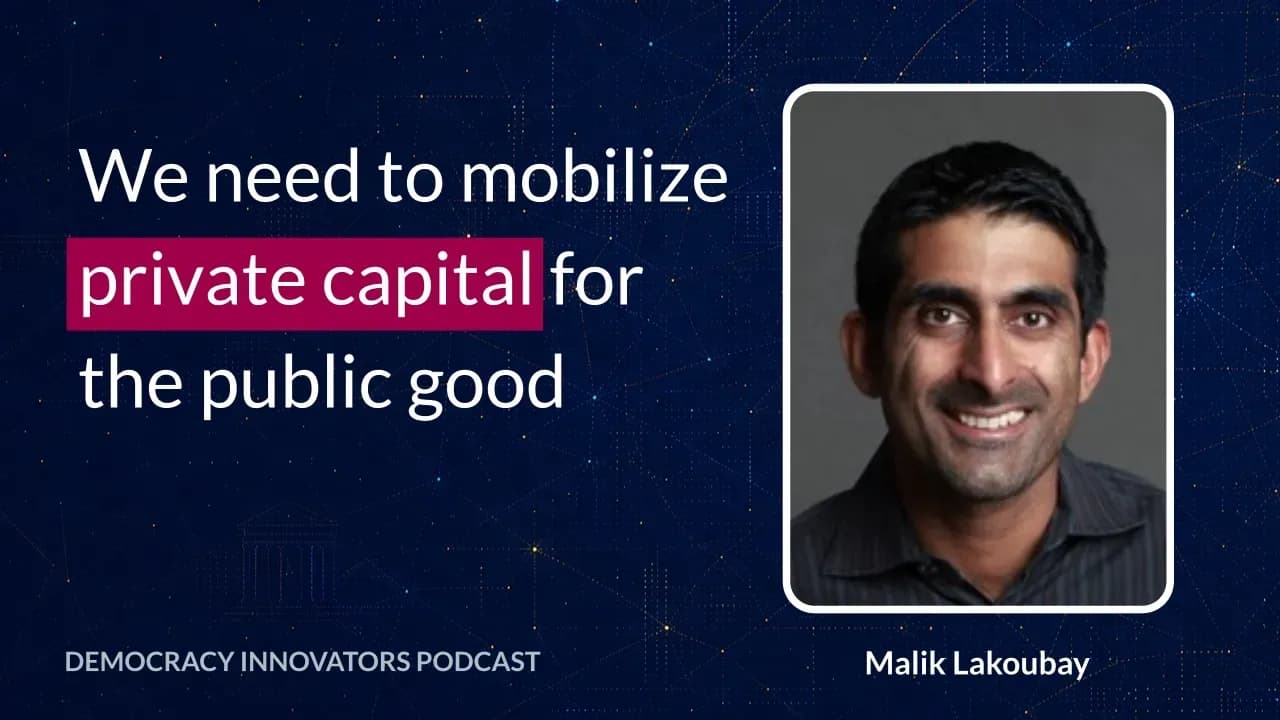
Malik Lakoubay16:21Yeah. Yeah. Yeah. Absolutely. And and and it's true that I think, yeah, both of them are needed and they probably also join in a number of ways. Right. Sorry. And I've been a little bit under the weather this past couple of days, so I apologize if at one point my voice or my noise get a little bit caught up. So the funding part, I think is very interesting and this is something, and I remember when I first joined DM, called Dendi and I said, Listen, I have an idea. I want to launch a VC fund, or I want to launch a fund for democracy, right? Like a civic fund. That wouldn't be philanthropy, wouldn't be re granting, that wouldn't be, but it would be with the goal of generating return value, but investing in my mind, what is crucial at the moment, which are civic infrastructure, right? And that was the starting point of one of the verticals we invest in now. And so let me backtrack for a second because obviously the funding mechanism that exists today to support civic organizations, support citizen engagement, support citizen assemblies, support community engagement, etcetera, etcetera. All the work that is needed at the local level, but not only, but at citizen level, I would say I'm not necessarily talking about institutions, right? It's under attack, right? I mean, every organization out there is being defunded. I think the last sort of budget that I looked from philanthropy was divided by four or something in these areas, right? And we know the reasons, right? Because of the situation in The US and other places, and it's becoming really harder and harder for funders to continue to fund that work, right? And so that's the general premise. Our view and my view is that in order to continue to fund this work, we need to think about these structures and these infrastructures, the civic infrastructure as an asset class. Okay. And I know maybe on this podcast or people listening, they're going to say, okay, we're poisoning democracy with capitalism, like what we've done before. I know it is a little bit contentious, but I think the point here is to say that in the democratic system, and when we have the, or ability to make collective decisions is actually benefiting to all the actors in the ecosystem, right? If you think about a company investing in a territory, right, or you know, a municipality building a project, right? Or any type of investment. If you don't have the conditions to be able to engage with the citizens, get the feedback, make sure that the community is on board, make sure that all the stakeholders have been consulted, that project is more likely than not to fail, right? And so thinking about civic infrastructure as an asset class means to be able to invest in those infrastructure in, you know, it could be companies, it could be projects, it could be structure that allow for citizen engagement, participation, collective decision making is going to help to create value for the entire community. Right. And so that's our goal. That's something we've been working on with the World Bank and others around the world is how do we come up with the vehicles, the instruments with which we are able to fund these infrastructure, these civic assets, so that they benefit the investors, they benefit the communities, and they are able to create that positive feedback loop. Right. And one of the early concepts that exist are the democracy bonds. Right. And I think the democracy bonds are very, very interesting because what you're doing is basically a municipality, it's like a mini bond but for democracy, right? And we call it a civic bond, you can call it a democracy bond. What does a democracy or civic bond does is basically when a municipality is going to issue this bond to fund community organizing, community sensing, community representation as well as citizen empowerment, they're able to tap into an institutional market because the result of the bond, so the positive externalities that the bond is going to generate is going to help generate return for these investors. So for example, you're in the municipality, you issue a bond to fund a community center, for example, right? Where people can come in, they can, you you can run citizen assemblies, you can run, community schools, you can run a number of community led projects, right? By doing that in the neighborhood, by doing that in a specific place, what are you going to do? You're going to generate value for the citizens, also for the community and the actors around it. Think about it, you may be lowering crime, maybe increasing the value of, you know, the assets and the real estate. You also gonna help train better, you know, people, right? That can go back to the workplace and the workforce and benefit all the actors around it. So by investing in democracy, you're actually creating economic value for the entire ecosystem and the entire neighborhood. And we all know this, this is quite straightforward. We all have a hunch by investing in democracy, you are able to generate the conditions for better economic conditions, right? The question is, what are the instruments, what are the vehicles and the onboarding rails that exist or that you can create that will help to manifest that positive feedback loop. One of the ways is a civic bond, right? Where you're asking investors to fund this work because you can demonstrate that this is going to help the economic conditions in a specific place. And not only that, you can also ask the local actors to pay back or help you pay back the coupon on that bond. Right? Because if you think about it, you can, you know, talk about any type of bond, resilience bonds, social bonds, green bonds. But at the end of the day, if these are only funded by the municipal tax base, then, you know, what's the point? What we're looking at is a way to make sure that the economic actors that benefit from the investment in democracy can also, help you pay for that investment. Right. And one of the ways to do that is a civic bond, but you a number of other ways as well that you can do this. And this is one of the work when we think about civic finance and financing civic infrastructure and civic assets, this is one of the ways we're exploring notably in the global South, in Brazil and India, and I can come back to that afterwards. But I think for me, this is one of the areas that is missing is this ability to tap into private markets to fund the responses to the shocks that we're facing, be it institutional shocks, climate shocks, etcetera, etcetera, because I think philanthropy alone is not going to be enough, right? And so what are the conditions? What are the vehicles to make sure that we can bring in private capital for the public good? That's basically what it is.
Alessandro Oppo25:34That is actually a super interesting question.
Malik Lakoubay25:38Mean,
Alessandro Oppo25:40also
Conflict, polarization, and hybrid deliberation
Malik Lakoubay25:41That's what we're working on at XCO, right? At part of that more direct analysis, but it says exactly that. How do you mobilize private capital? And you're not asking for sub returns. You're not initially asking for a, you know, philanthropy work, grant, etcetera. You're just offering a different path for returns. And this is not necessarily about being moral, right? In the sense it's also about being greedy because you're protecting your investment, you're protecting your assets down the road. We're living in a world that is collapsing where, you know, volatility and shocks are just coming faster and faster to us. How do we respond? And I think there is a way to mobilize that capital to build a capital stack in order to address those things, and I think institutional erosion and democratic erosion is one of the key crucial shocks and risks that we're facing.
Alessandro Oppo26:46And you mentioned it before, but yeah, how do you measure like the value that is produced? Because of course I really like the idea and, also, I agree that if people are are, let's say, socially or politically active, all the society benefits from it. And at the same time I mean, it's the same, let's say, with culture. It's the same if there is, I don't know, I don't know, a public park in the town so people can move, exercise, so maybe they are healthy. They don't need to, I don't know, health insurance or, like, health expenses that are related to health. And so I was wondering, how do you measure this value that of course there is? And then also if you are already doing some experiment in some parts of the world.
GRID: AI inside the room
Malik Lakoubay27:49Of course. Yeah. Yeah. Couple of things. I think that the question of value, mean, that's back from, you know, the sixties and the first research around positive externalities. Right. And how do you measure the value created by positive externalities and avoid, you know, sort of like a free ride type of, you know, issue, right? That you make sure that the value that is created by a positive externalizi is shared, sorry, but it can also be paid for, right? And so the question of how do you measure that? I think there is a basic way to measure this if you're place based. There are already indicators that exist that a municipality or local asset owners are looking at, value of real estate, for example, right? If you think about the places where community engagement is the strongest, education is the strongest, access to the job market is the strongest, you're going to see a natural drop in crime rates, for example, you're going to see an improvement in health, you're going to see an improvement in school results as well. And what do you mean? Do we call these things? This is called gentrification, right? And gentrification is basically where you see the value of property going up. One of the ways to measure that is on one side you can measure easily the benefits of the investment in the community, in the democratic process, in citizen representation and engagement. And on the other side, you can measure quite precisely the increase in the economic value of the asset. The issue is when you're in the neighborhood where investors are going to swoop in a large part a neighborhood because they're betting and others are going to do the gentrification work without participating. This extractive behavior, right? So I think we want to create the instruments that empower citizens, municipalities, communities to do their work, and at the same time, sure that these investors, these asset owners can participate, right? So there is a way to measure that, I think, and maybe then you can also think about sensing data monitoring that municipalities can do installing, for example, pollution, measurement. You can also install a number of captors in the city, a number of sensors, I'm sorry, where you can very quickly extract a bit of a mapping of, you know, how the city is responding to this investment, right? And you can see that maybe the number of kilometers or miles that a worker has to, you know, has to go through to go to his work, maybe is being reduced because jobs, and so you can also measure maybe the pollution and, you know, going down. There are a number of ways, and especially now with sensing, measuring and modeling technologies that you can do that as well. Maybe going into a specific example that could be interesting for you. So, you know, at dark matter labs, have a lot of people working around data, data modeling, data, sort of like sensing, etcetera. So one of the work we've been doing is in India, is in Mumbai. It's called RiskSense. And the idea behind that is thinking about how a community's experience that doesn't exist in register, in books, etcetera, that is really something that exists between the community memory, right? The ability of a community to sense risk. How do you have that surface and be helpful to a municipality or a company running a business, etcetera, etcetera? So for example, in Mumbai, one of the main risks is obviously heat floating, you you have major climate shocks every year, right? And it's very hard for the municipalities or businesses to respond to that risk. How do we adapt? How do we change the way we build? How do we change the way we operate business? So we establish a number of these businesses, right? Or schools, etcetera. And one of the ways to understand that risk is by talking to the community, right? And understanding how they're living through that risk and their memories as well. Three years ago, that street got flooded. Two years ago, that street got flooded. So this year I would change the bus route, you know, to go from this neighborhood to that school, because, you know, these kinds of small details where, which I think matters for people's lives. This is, you know, when we think about what is democracy, I think this is exactly that, the ability of the community to help its citizens and representative to help its citizens to have a better life. Right. And so RiskSense is basically this tool that is able to bring together, visualize this community sensing memory, this community sensing risk, and have it emerge as a very visual tool that you can then feed into a number of sectors and actors. Municipality can use it, an insurer can use it as well. In that case, what he would do is the insurers would pay for it because this is extremely valuable data, right? This is data directly coming from the community. This is not AI trying to reproduce a model, etcetera. This is very much rooted in the community memory, right? And so an insurer could pay for that, a real estate developer could pay for that, a business owner association could pay for that as well. And so you see how from community memory and sensing you can create via technologies and contracting the tools and the railways to crystallize value, bring it to the business owners, the municipality, the community organizers, and having it brought back to the citizens that have helped generate these risk sensing data. I want to stop here because I want to make sure you have the picture here and we can dig into There are a number of projects, ideas, labs at dark matter labs that we work on that I think are trying to exhibit that. Another one is civic ledger, formally permissioning the city. I can come back to that in a second as well. But I wanna pause here, give you back the floor and we can take this wherever you want.
Alessandro Oppo35:31No, no, I'm listening and it's quite interesting. I was particularly interested in the in the experiment in Mumbai. And and also I understood more what you mean about the value because, yeah, there are data. And I was thinking that is it also connected, let's say, to digital twin in some way because those are also a way to represent data in a in a town, and they are also I mean, I don't know how widely used, but I know that are starting to be using different towns. Yeah. You
Democracy, solidarity, and affect
Malik Lakoubay36:12know, digital twin is one thing. It's existed for a while and and and a number of, you know, companies do that very well. And nowadays you can actually build that easily. I think digital team is one way. What I'm interested in, and I think this is something that we need to explore more is token economics. Okay. Is in practical terms, how do you distribute that value that has been created in a neighborhood by, you know, improving community sensing, citizen engagement, participation, overall education, etcetera, etcetera. And here I think only monetary value and only of like fiduciary value is enough. I think we need to find other ways to crystallize that value to, I'm sorry, and to share it as well. Token economics is one of the way you can do this. For example, you can think about creating a municipal balance sheet for risk sensing and community sensing, right? Where, I apologize, sorry, where these tokens can benefit or can be associated to an increase in value in property, for example, or taxes raised on that value. So they linked to a specific monetary value creation, but at the same time, they're also linked to the citizens bringing that knowledge, That sensing that we talked about. And I mean, a decentralized ledger, using a blockchain, for example, could be the win. This is something in our radical exchange and we were very close to the Web3 community at Dark Matter Labs as well, because token economics allows you to crystallize value without being in an extractive model of, you know, if I get one, you get minus one type of thing. I think these tokens, and you can also use those tokens, think about, or example in Mumbai where, you know, a family has helped, you know, sense that there was a specific risk in periods of extreme heat or floods or something, they should be able to be rewarded, right? For that knowledge. How do you do this? Yeah, of course you can maybe give back some of that economic value, but you can also issue a token. Right. I think it's also interesting. With that token, maybe that helped them participate in another project, send their kids to school or you know, buy air conditioning if that's what they need, right? But I think a token opens the realm of possibility in terms of sharing the value that has been created by the community, right? So I think more than digital twins, the technology here is token economics and if there are people listening that are interested in this kind of work, that's the type of folks that we're looking at at the moment in our projects, right? Because it could be, you know, a community balance sheet, you know, that we talked about, but in other projects that we have, we talk about cooling a city, so extreme heat, how do we respond to heat in urban environment? And we talk about cooling balance sheet. And, you know, this is more for climate as opposed to democracy, but same thing, token economics could really be helpful as well to reward and bring together a number of, you know, stakeholders, actors, it's much easier to share value with tokens as opposed to just, know, dollars or rupees or these kind of things.
Alessandro Oppo40:21So you create also a sort of internal economy Correct. With the tokens. And yet is yeah. As as you said before about the imagination, the fantasy, there are no limits to that. You can create every kind of economic system also maybe specific to that community.
Malik Lakoubay40:45And to that your point around technology, is that technology used in the right way? I think this is exactly what can enable the data sensing, the risk sensing, but also the value sharing part. So when you bring those two together, I think it's very interesting.
Maintenance, governance, and democratic time
Alessandro Oppo41:07Yeah, because also, I mean, I'm thinking that those entities, let's say municipality people or private actors, I mean, they exist now. They existed also in the past, and it's just how you connect the dots basically, the the kind of relationship that you create. And I see that I mean, I'm also reading some books regarding this. I mean, how I mean, technology. I mean, a platform can connect people in a different way and tokens run on a platform. And, basically, if you build us can sort of kind of economic system or another one, basically, you change the relationship between those actors. Totally. Yeah. And the the difficult the part is probably to find the right kind of, let's say geometry or like that create, let's say value for all of them.
Malik Lakoubay42:18We often think about when you're building these new systems, right, and rewiring existing systems, I think the key part is going to be the incentive mechanisms, and that's exactly what you're talking about, the geometry. The geometry is our incentives, right? How do you align incentives between different parties to make sure that they can work together, you can build contracts, you can build together. And, you know, I invite your listeners to look at one of the ideas that Dark Matter Labs around many to many, and this is exactly that. So this is a multi dimensional contracting system between many different actors. And I think using technology and for example, AI in that case is super powerful because you demultiply, you leverage the ability to contract between different people and align incentives. I think that geometry that you're talking about, that matrix is exactly what you have in mind. One thing I want to comment on what you said as well is it is at the municipal level, it is at the local actor level, but something I want to add as well, or idea in building these instruments to fund CV infrastructure, it's not only at the local level. The goal is also to have a global market of these instruments so you can tap into the very large asset managers, insurers, etcetera. So you could have those liquid instruments that you can invest in and you're not necessarily just at the local level, right? Yes, at the local level, it makes sense if you're an industrial operator, you want to invest in a place, etcetera, etcetera. But I think, again, pushing the boundaries of imagination is going away from or beyond the just local funding scheme and mechanism and being able to think about it because this is, if you think about a way to rival the extractive model that we have right now, either for the planet or for democratic systems, are being exploited and perverted in both cases, if you're not able to build a system to rival this in scale at the global level, then you're already failing. Then you're only just a pilot. You're only just something in the corner to look good in a local place in Mumbai or Santiago De Chile or Madrid, etcetera. If you're not able to build at the global scale and unify the systems and offer a value proposition as well for these investors, I think you're missing something here. And that's at least the way I think about this. I think about the mission. That's what I look at.
From participants to facilitators
Alessandro Oppo45:20It seems quite both interesting and complex project because I think about the geometry. How could be the geometry at the global scale? And and, yeah, I was I was thinking yeah. Sorry. I have another question. So I will how do you how could be the word or, like, if this geometry could work, if this civic infrastructure is in place, how would you imagine, like, society in the
Malik Lakoubay45:58Society in the sense of how we we interact with each other? Okay. Give give me maybe a little more here.
Alessandro Oppo46:06No. I'm thinking because we we talked about, let's say, local scale, municipality, citizens, and I don't know, could be shops or like also at the global scale. So it could affect both the way a citizen live his or her neighborhood, town? Or also I'm thinking about the national level or we said global level, so it's
Final message: slow down and recycle
Malik Lakoubay46:36No. No. I mean, listen. And he brings us here, I think, to a deeper question of what is the value of human society, right? And what is the value of being human in our current world? And I think it is being challenged every day because more and more value is being ascribed to AI machines, autonomous systems, right? And so the value of being human is being reduced, right? People talk about the life beyond work and how, you know, we can only become entertainer or caretaker, right? There is no point other role for humans. I think you touched on that a little bit with your question. It's what is the value of human interaction and what is the value of humans in a society? And I think when I think about at the global scale, that's a little bit what I'm imagining, which is humans still being at the center because investing in human, investing in human interactions, education, participation, civic systems, it's basically investing in the other systems that allow the rest of the planet to function. And this is the idea is that to prove that by investing in that and those human capabilities, you replace humans at the center of the planet, right? I know some people want to leave the planet. The option is to go and terraform Mars and we just gave $80,000,000,000 to a billionaire to list this company and help us send data centers and terraform Mars. The other option is to build a fortress somewhere in New Zealand and stay there while the rest of us are burning, right? My view is that, and I think at the end, this is what we try to build is the systems where human and nature are put back at the center. And one the ways to do that is to show how they can create value for the entire ecosystem of different stakeholders, public, private, etcetera. I mean, is at the center of this movement around nature based solutions, right? Bio regional financing, etcetera. So how do you use nature as a vector for value creation, not only financial, but other as well, systemic value? And I think when we think about investing in democratic institutions, civic infrastructure, that's exactly that, being able to replace human at the center of the system globally. And because we know that this is going to benefit the entire system as well. One other way to do this is to create a liquid market for investors to come in and say, I'm going to invest in democracy because I know this is a group creates value for my assets, for my business, etcetera, etcetera. And I know it is contentious, right? Because we're saying that one of the ways to help democracy is by having private capital invest in it in a sense. I accept the debate, but I'm thinking what a point where we're starving for money to let all of us die in an authoritarian regime, right? Nowadays, only 7% of the planet of human beings live in a true liberal democracy, 7%. Okay. That's less than 500,000,000 people out of 8,000,000,000, right? So I think the urgency is there. The urgency is not necessarily ethical saying, oh, we're going to get more grant money and philanthropic money. No, the urgency is the system has collapsed. Only 7% of us are still free to say and do what they want and what they think, right? How do we change this? 7% and elections are in France next year in 2027, are we gonna drop under 6% with France joining the rest of the illiberal democracies, right, etcetera, etcetera. Anyway, so I'm getting animated because I think sometimes ethical question don't allow us to, again, push the boundaries of imagination, right, and how we rethink those systems.
Alessandro Oppo51:27A lot of, let's say, very deep questions about the future society and also the present of society. And, yeah, I have, let's say, the last question. If if you have I mean, if you want to add something about what we discussed that we haven't touched. Otherwise, if you have a message for the people that are working in this or similar field.
Malik Lakoubay51:58So Of course. Yeah. I mean, listen. My my my last point still stands. I think we were, and I loved by the way, the conversation today. And I must say, Alessandro, you're a fantastic listener as well, because you took us on this path of this journey and we ended up where we really talk deeply about those planetary issues, risk, how to re think about all this and how to rebuild those systems. One point, great kudos to you on this. I think for the people that are really listening and the people that you interact with, there are a number of ways to think about us. First of all, please get in touch because we are always looking for vision aligned, mission aligned folks and we're building the team at the expanding civilizational optionality at Diem. And so, as I said, system builders, system thinkers, I think are super important. So one, get in touch for sure. Two, I think disability to not think in silos, you know, you have the democracy practitioners, you have the money practitioners, you have the technology practitioners, you have, and they whole congregate and conferences. I do believe that at the end of the day, what's really important is our ability to question how we do things and pushing, again, the boundaries of imagination, right? And thinking about how technology can help, democracy can also help rethink the way we own things, we pay for things, we reward value, we decide together. I think the point of your podcast is exactly that. How do we innovate in democracy, but by tapping in other places, right? Is critical. The people that have great admiration with, which I mentioned in the beginning, but folks like Audrey, like Indy, were mentors to me. I think they have this capacity to bring together these different worlds and have them collaborate. And this is super powerful. And if I had one hope, I think this is that, right? That it's not because you work in finance or you work in blockchain that you don't care about the environment, that you know what I mean? Like it's not because you work on AI that you don't care about human rights. So, you know, sort of like collapsing these worlds where people have these pre, you know, pre, these pre foreign models, right? And quite the opposite when we think about plurality, which is one of the key initiatives we worked on, and I know you've worked on that as well, I recommend you guys to read the book at plurality.net. This is exactly the country, right? It is using the technologies that for the past twenty years have divided us to actually use your differences to bring us back, right? This is exactly, and so this is a case in point. And so I'll stop here, this ability to tap and not think that because you work on, know, again, or other places, don't want to participate in the democratic renewal of our societies is a mistake. Why the opposite? Bring these folks in and what you're working on. I'll stop here. I just want to thank you enough. Very happy to continue that conversation with your listeners, with our friends, the community and yourself, Alessandro. Huge, huge appreciation for your work.
Alessandro Oppo56:16Thank you a lot, Malik, the conversation and also for your kind words, really. Thank you. Thank you, my friend. Be well.
Discussion
Continue the conversation
Loading comments…