Automatic transcription, there could be errors.
Alessandro Oppo (00:00)
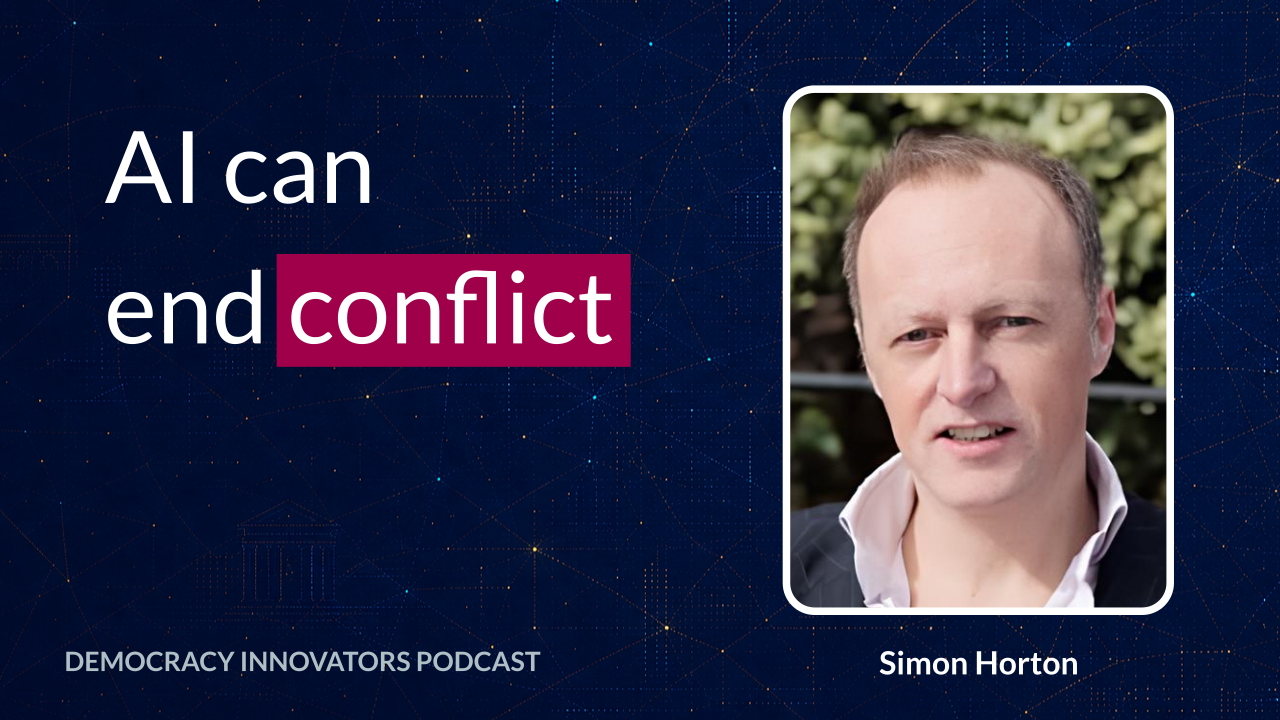
Welcome on another episode of the Democracy Innovators Podcast. My name is Alessandro Oppo and our guest of today is Simon Horton. So thank you Simon for your time.
Simon Horton (00:11)
Thank you. Thank you for having me here.
Alessandro Oppo (00:13)
And I know that you are working on negotiation. And if you'd like to share something about your background and the things you have worked on.
Simon Horton (00:27)
Yeah,
yeah, sure. So, well, my background, before teaching negotiation, I've been teaching negotiation for 20 years, but before that I worked in IT.
in finance, I used to design derivatives trading systems and I was good at it but hated every moment of it. And I had a lot of mental health crises when I was doing this work and a girlfriend, before she left me, before she slammed the door, she turned around and pointed at me and said, you need to sort your head out. And she told me to do some NLP, neuro-linguistic programming, which is kind of psychology.
applied psychology and so I thought maybe she's right and so I did give it a go and it did work it did sort my head out and I described myself as pre NLP unhappy post NLP happy and I enjoyed it so much that I wanted to do more of it and I wanted to teach it but the problem was
the world doesn't buy it so much, it does buy its applications. the most obvious commercial context, commercial application of psychology, I felt was negotiation. Because when you're negotiating, you're negotiating with other people, you need to understand their decision-making process, this kind of stuff, you need to know how they think. And...
So basically, 20 years ago, somebody asked me if I could run a negotiations course and I said, yes, I can. And I did it very much from a psychology perspective, but then I just built on it and built on it and built on it. And yeah, I've been running it for 20 years now, work with all kinds of organizations, people like Goldman Sachs, the British Army, the Qatar Investment Authority. I've worked in over 25 countries.
I'm a visiting lecturer at Imperial College here in London and I've written a number of books on the topic. So that's basically what I do and how I got here.
Alessandro Oppo (02:46)
And if we talk about negotiation, how can we define it? What is to negotiate something?
Simon Horton (02:57)
So negotiation, guess, is when two people, two or more people have desired outcomes in mind.
but there might be differences in those outcomes and maybe even conflicting outcomes that my outcome is the opposite of yours and yours is the opposite of mine or whatever. So we then engage in a process, a conversation, a dialogue by which we can really try and...
Well, if we do it properly, we try and really understand the reasons behind the outcomes, to understand the constraints on each side. And then we can, if we do it properly, we can come to a solution that genuinely meets your outcome and meets my outcome. Unfortunately, negotiation is a field where there is a...
common sense view where the majority have an agreed perspective on negotiation and that perspective is wrong unfortunately that most people view negotiation as the arm wrestle I'm stronger than you know I'm stronger than you kind of thing and so and they lie and they hold information back and do all kinds of tricks to get a good outcome and unfortunately this isn't a good
approach and the best negotiators realize this, the best negotiators view negotiation as a collaborative problem-solving process where the problem to be solved is you've got an outcome you want to achieve, I've got an outcome I want to achieve, you've got real constraints, real limitations, I've got my constraints and limitations
but you've got your resources you can bring to the table, I've got my resources, right, let's put all of that on the table and then work together to solve that equation so that you get your outcome and I get my outcome given the constraints. the best negotiators view it that way and that's a much more effective way, even for selfish reasons. Even if you are the most evil, selfish psychopath in the world and I'm sure you're
you're not Alessandro. But even if you were to be, your best approach is to take this collaborative problem-solving approach. You'll get better outcomes.
Alessandro Oppo (05:38)
And do they exist a different kind of negotiation? I mean in relation to the to the issue like if there are more people I wonder if they can be classified this kind of so I want an outcome you would like another outcome and
I wonder when it goes well, the negotiation, and when it goes bad, and if there are some elements characteristic of this going well or going bad.
Simon Horton (06:16)
So yeah, well, many, many characteristics. So it's when people, so we can broadly say people fit into two types of people. The competitive negotiators, aggressive negotiators, and collaborative negotiators. And the competitive negotiators,
Basically, that's not a good approach, again, even for their own perspective, because if they are too competitive, well, the other person will be competitive back. And so now all of the energy is spent against each other. Rather than collaborative, all of the energy is spent solving the problem and creating value. Now, you might think, yeah, but what if I'm the strongest? Then I don't care about the other person.
Well, even then, what you find is that maybe you've got all of the power now, but the other person will find a way of evening things up. So even if you do have all of the power now, the other person can make things worse for you in different ways. So I'll give you an example of that.
I don't know, you're Italian, I don't know whether you had this issue in Italy, but in Britain, 10 years ago, we had a big scandal, and it was called the horse meat scandal, because the supermarkets, and in Britain there are four or five big supermarkets that control all of the high street food shopping. And so all of the food suppliers wanted to sell through the supermarkets, and the supermarket said, yeah, you can sell through.
but only if you give us a really really good deal and they would squeeze the suppliers and squeeze them more because they could.
And what happened was the suppliers said, yeah, yeah, yeah, we'll sign, we'll sign, we don't mind. But then instead of putting beef in the burger, they put horse meat in the burger because it was the only way they could make it profitable for themselves. And so that then became known and it became a scandal. It was terrible for the supermarkets. It was terrible for the suppliers. So basically, if you are, if you do have the power,
the competitive win-lose approach always becomes lose-lose. Now, another area where it can go wrong is taking the collaborative type of negotiator.
And there are many people who are nice people and who want to be collaborative, but they don't know how to do it beyond the simplest of situations. So let's say you run a team in an organization, in a business, and you need more budget for a new project, and you say to the finance director, hey finance director, can we have more budget? And the finance director says no. Well firstly, if they say yes, great.
But if they say no, what do do? And most people don't know what to do next. They just say, please, go on. No, no, really need the money. And the finance director will say, well no, we really don't have the money. the...
the negotiators don't know what to do to go beyond that. Whereas there are methods. So for example, the workshops I run, we teach structured approaches for reaching win-win outcomes, even in the toughest of situations. And so another issue where... Another...
You know, I'm saying there are competitive negotiators and there are collaborative negotiators.
And some of the collaborative negotiators that I teach, they say, yeah, Simon, great, but this doesn't work with the people who I'm negotiating with because they are competitive. So in those situations, what the collaborative negotiator has to do, it's kind of an education process of showing the competitive negotiator, the aggressive negotiator, that they will be better off if they collaborate and there's ways you
can do that, ways you can make the other person more collaborative basically.
Alessandro Oppo (11:04)
And I was wondering for all the situation when I mean because sometimes It could be that we express some concept in different ways. I don't know The word capitalism can mean something for me something a little bit different for you for someone else depending on the background and so when
I don't know, it happened that there could be a conflict between two countries and I mean both of them maybe they want peace. mean in the newspaper they write this. So the goal is the same but then probably they want different things.
Simon Horton (11:35)
Yep.
Yeah. Yeah.
Yeah.
Yeah, absolutely. And so one of the core factors for a successful negotiation is you saying you want peace.
for me to then understand, well, what do you mean by that? And why do you want that? And to not just take the request at the surface level, but to understand the reasons behind that and...
if we can identify the reasons behind that, it's often easier to solve those than it is to solve the immediate problem kind of thing. there's a good example, you're talking about peace, so there's a good example that illustrates that and that was...
in the 1970s in between Israel and Egypt and they had been at war for 40 years or more and there was a flare up there with the Yom Kippur war and what happened was that Egypt invaded Israel during their during the Jewish holiday Yom Kippur and it took Israel by surprise and then Israel responded and there was backwards and forwards between the two army and then it
came to a stalemate. And the two sides tried to negotiate a ceasefire line in the Sinai, which is where the fighting was taking place, that the two armies could withdraw to in the ceasefire.
and they couldn't come up with a solution, no matter how, and they spent years trying to find a line in the sand which the armies could withdraw to, and they couldn't. But then in 1978, in Camp David, they asked a different question, and the question they asked was not...
Where in the sand do you want to draw the line? But what is this about for you? In other words, why? What's important to you here? What's really important to you? And Egypt said, what's important is sovereignty. The Sinai is our land. We want our land back. It's always been our land. We want our land back. Israel said, well, what's important to us is security. We were invaded. We were taken by surprise. We don't ever want that to happen again.
Hmm. Why didn't you say this? Because we can solve this and the solution was that the Sinai that the Israeli army withdrew back into Israel and So the Sinai went back to Egypt. They got their sovereignty They got their land back but the Egyptian army also agreed it would move back out of the Sinai and back into the Egyptian mainland if you like and
So it fought, the Sinai became a buffer zone between Egypt and Israel, which gave Israel early advanced warnings of any troop movements. Plus America helped build Israel a military airport just inside their border, again giving them early warnings of troop movements. So Egypt got its sovereignty, Israel got its security. And why this is a really nice example is
that for years the classic approach to trying to negotiate had got nowhere. But by changing the approach and asking the question, what is this about for you, not only did it solve that problem, but
Actually what happened is that Egypt and Israel realized they had found a way of working together. And the Egyptian president, President Sadat, gave a landmark speech in the Israeli parliament, the Knesset, and he said, we have found a way of working together. Let's carry on doing this. And they became allies. After decades of being at war, they ended the war and they became allies and have been allies since.
Alessandro Oppo (16:19)
And I was wondering, like if for you, because also now we have conflicts all around the world, I wonder why they don't ask this kind of question to solve the conflicts.
Simon Horton (16:35)
Yes, yes.
So I think there are a number of reasons. One is kind of the personal reasons. well firstly, not everybody knows this approach. You would think in a government there would be enough experts that they would, but for example, Britain...
Alessandro Oppo (16:39)
Yep.
Simon Horton (17:01)
You know, I'm British and recently we had the Brexit, or I say recently, 10 years ago we had the Brexit referendum and then we left the EU. And with those negotiations, the chief negotiator, certainly on the British side, took a very wrong approach to negotiation and you think, this is so disappointing that people in positions of power are letting down their people.
There's also, I think, the personal things. for example, well for example, in Israel at the moment, the Prime Minister there, Benjamin Netanyahu,
there's an element to which he benefits from there being war. Because if the war finishes, he might not, it will be followed by elections in Israel and he probably won't win those and then he's likely to be prosecuted in his country. So he's got personal reasons for not negotiating in good faith. Plus I will say that, you know,
I've never been a prime minister of a country. I can imagine these things are difficult. And there's all kinds of different pressures.
politicians might want one thing, but then the journalists and the media will want other things, and the social media will be pressuring them in other ways. And I can imagine these things are difficult. But what we need is we need this best practice approach to be spread further and for it to become common knowledge, basically.
Alessandro Oppo (19:04)
Yeah, I agree. I was wondering, also, mean, politics in some way is to make sure that everyone reaches their goal. And so I wonder like, if negotiation in politics has some specific characteristic or...
Simon Horton (19:18)
Yes.
So I
think, yeah, think two things I'll probably say. One is ego. And so because the politicians, negotiations in politicians typically have very strong egos and that does not lead to good outcomes.
you want to have ego-free negotiations. typically politicians who conduct political negotiations are typically highly ambitious. It's very much about them and their power rather than what's best for the greater good for the country, for the different communities. The other issue, and this is very big issue, is...
That thing that we were just talking about, that there are many factors and many communities that involved. It's not a simple thing. It's not just me negotiating with my boss about a pay rise, about one simple thing, negotiating with one person about one outcome. They have got so many different interlinked problems to solve.
in affecting so many different people. So for example, I was just talking about Brexit. Well, prior to Brexit, there was a big trade agreement between the EU and Canada. Now, this trade agreement was worth a trillion dollars of trade. So it's a hugely important trade agreement. It affected
half a billion people or more, took 10 years to negotiate and at the end of it they reached a deal and that deal was blocked by Wallonia. Wallonia. Where on earth is Wallonia?
Wallonia, three people live in Wallonia. I'm joking, Wallonia is a part of Belgium, I'm sure you know, it's the French speaking part of Belgium, but as a fraction of the area that it was impacted, it's a tiny fraction, but they said, no, we are not agreeing to this. And so, this is...
kind of shows the complexity of political negotiations. So many different communities, each of whom have got different ideas and different desired outcomes and so many different problems to be solved, all of which are interlinked, that it's a big challenge.
Alessandro Oppo (22:19)
And do you have other examples of good negotiations or like bad negotiations?
Simon Horton (22:29)
Yes, So again staying with the geopolitics, one example that I always think is, you know, gives me hope for the future and
And whenever somebody says to me that their negotiation is impossible, I always think it's not as bad as this one, or as difficult as this one. And that was basically Northern Ireland. So in Northern Ireland...
There was a civil war, again, for many decades. And you had the Catholics on one side, you had the Protestants on the other. And for hundreds of years, they hated each other. And for decades, they were at war in the 70s, the 80s, the 90s, and so on. And by the way, my mum...
was Irish Catholic and my dad was English Protestant. So we fought the Civil War in our dining room kind of thing. nobody, the leaders on each side, on the Irish side was, sorry, on the Catholic side was Gerry Adams and Martin McGuinness and on the Protestant side was the Reverend Ian Paisley and they hated each other.
hated each other. Zero trust. It was so bad that on both sides they bombed their own people so that they could blame the other side for it. It was so bad. So nobody thought that there was going to be a solution. Nobody thought there could be peace. But what happened is that the...
The British government and the Irish government had conversations in secret. And they said, look, we need to resolve this. This is a terrible situation. We need to resolve it. But it's so sensitive. It's so difficult. It's such a difficult problem to solve. We need to agree.
And there is zero trust. Neither side trusts the other side at all. So we need to agree a process and really think hard about the process so that that will be successful so that the two sides don't trust each other, but they can trust the process. And if they can trust the process, they don't need to trust each other. And so...
as a result of those conversations that they had in secret, they decided that the first stage of the process would be to include all parties separately, talking to all of them separately, to agree what that negotiation process would be. And if all of the parties, the Catholics, the Protestants, et cetera,
created the process together, they would trust the process because they created it. and that's what happened. They spent a number of years firstly defining the negotiation process and then...
Once that was agreed, they went through that process and everybody could trust the process and so it reached an agreement. And I'm not saying it's perfect in Northern Ireland now, but it was much better to the extent that the Reverend Paisley became the First Minister of Northern Ireland and Martin McGuinness
the Catholic who hated the in Paisley became his deputy. They shared an office and they became friends. So this was the great success of what happened there.
Alessandro Oppo (26:37)
Before you mentioned also that part of your background was in IT and also you have written a book about how AI can end war. Would you like to tell us something about that?
Simon Horton (26:43)
Yes.
Yes. Yes.
Yeah, so I first got involved in AI in 1989, a long time ago, but in a very, very small way. But then because I worked in the sector, I was interested in it and I followed it.
And it was about the same time as I started up in negotiation, about 20 years. I read a book called The Singularity is Near by Ray Kurzweil. And he is kind of an AI guru. And everything that we are seeing now with AI and ChatGPT and all of that, he predicted that 20 years ago. And he predicted lots of really amazing things. And I read this book and I said, whoa.
This is really interesting. This is super important. Watch this space. So I became kind of obsessed with AI for the last 20 years and my field was negotiation. And I would...
Then, obviously, I would look into what was happening in the world of AI and negotiation. And for a long time, nothing much was happening. And then a little bit was happening, but nothing too impressive. And then a little bit more. And then it was a couple of years ago, two years ago.
that I looked into it and I found some really impressive stuff, really impressive stuff. And I thought, okay, there is a very positive story here to be told in terms of what is happening already in the world of AI and negotiation and what is likely to be happening in the future. And so just to give a few simple examples of...
what changed my mind and what made... So the book is called The End of Conflict and just because I saw them two years ago, there really is. As somebody who teaches negotiation and who teaches conflict resolution, I see a very positive route forward in terms of conflict resolution. So...
The first thing that made me think, there's something positive here, was quite simply ChatGPT. When ChatGPT came out in November 2022, to start off with, it was okay, it was fun, you could play around with it, but it wasn't super useful. But it wasn't long, maybe a year, a year and a half, where you could start to use it for...
serious things and I started to use it for negotiation advice. I would ask it for a question on a negotiation and I noticed that it would give me very good advice based on best practice, based on collaborative negotiation and come up with creative solutions and I started to get quite impressed by its advice and so it made me think, hmm, well that means now everybody
everybody has got access to a good negotiation consultant if you like and who will give them good advice and so and will give them collaborative advice. So now hopefully as people tap into that people will start to negotiate in a more collaborative way because they realize that this is the best approach and then as more and more people do this this will this will
spread. This will spread through how do cultures change? Cultures change one person at a time, one behavior at a time. so collaborative behavior will spread through communities, through the culture and bring about a positive cultural transformation. So that was one thing.
And around at about the same time, I interviewed somebody called Colin Irwin, Professor Colin Irwin, and he had worked in...
in the Northern Ireland peace agreement. And what he did there, basically, he would do kind of opinion polls. He would walk, this was in the 1990s, so he would walk the street, him and his team would walk the streets with a clipboard and a pen, and he would stop people when they were shopping, and he would ask them...
what do you want to see in the peace agreement? And some people would say this and some people would say that and such like. But he would also take down their age, their religion, their gender, these kinds of things. And he would feed all of this information back to the negotiators. And the negotiators would look at it and say, hmm, okay, so the Protestants, they will accept this, but they'd never accept this.
and the Catholics would accept this but they'd never accept this. Okay, we can see where the solution is that both sides would accept and he did this one issue after another and so they were able to come to a solution, an agreement that when they put it to a referendum they knew all people or the majority of people would support it.
So he was involved in Northern Ireland doing that. Now he still does the same thing in different conflict zones around the world, but now he uses AI to support his process. And so he uses a platform called Remesh.
You may know it's a deliberative democracy kind of platform. You can hold conversations between literally thousands of people on very difficult topics and reach nuanced agreements.
So he told me how he was working in Libya. This was 2020 or 2021, can't remember. But basically, the Libyan civil war, it had reached a bit of a ceasefire, a pause. They were trying to make this more permanent and trying to build a government of national unity.
But you can imagine, was pretty, at the end of the Civil War, was pretty chaotic. Nobody thought that it was the end, they just thought it was a pause. Lots of warlords everywhere, all of whom hated each other and wanted revenge. So nobody thought it was a lasting peace, everybody thought it was just a pause. But they tried to form a government of national unity. And...
He conducted a conversation between a thousand people randomly selected from throughout the country, basically asking them what did they want to see in the government of national unity. And he did this in two hours live on national television.
A third of the country watched this. A thousand people were actually involved, but a third of the country watched it. And in two hours, they were able to reach an agreement on what they wanted to see in the constitution for the government of national unity. And they formed a government of national unity and it still exists. Now, again, it's not perfect there. But now, but these days...
in a given month it might be tens of people who die through violence, whereas it used to be tens of thousands. So it was a huge advance, a huge improvement in what it was before, and that was facilitated through AI. And so...
I've just been playing with ChatGPT and seeing the benefit of that and then I hear this story and I go, whoa, this is amazing. And then I start looking deeper and I see things like in the world of law. So AI is being used in the world of law. And another trend in the world of law is...
trying to move from litigation to mediation. Litigation is the fight kind of thing, it's the fight approach, whereas mediation is the collaborative problem-solving approach. And they've been trying to move, certainly in the UK, they've been trying to move in that direction. But it's very slow, basically because the lawyers get paid more for fighting. So...
What's happened is that in law there are software packages, AI-based packages that can now...
mediate much more successfully than ever before and much cheaper. There are software platforms, AI-based platforms, that can predict a judge's decision with something like in some instances 95 %... Actually, that's probably wrong. It's certainly 80 % accuracy and in some instances more accurate than that. So if you can
predict a judge's decision, with that amount of accuracy, you're not going to go to court. Because let's say you think I owe you a million euros, let's say, and you go onto this platform and you put in all of the information and the platform says,
that the judge will probably agree that I owe you not a million, but half a million. And I go onto the same platform and I find out, yeah, the judge will find that I owe you a half a million. Well, we won't go to court because there's no point. We'll just shake hands on half a million. Because if I try and get, if I go to court to say...
well I'll just lose and it will cost me more money. So basically AI is changing the world of law massively so that it will be a solved problem.
it will be universally available and free. The law will be free and universally accessible to everybody. So it's going to be a solved problem. There won't be legal conflicts like this anymore. Now I'm not saying all of this will happen overnight. I'm not saying all of this will happen...
tomorrow but there are already things happening today and tomorrow there will be more and tomorrow the day after tomorrow there will be more still and the AI will get better and better and better and so and there are and there are other contexts like democracy and I'm sure that you know this is something you know a lot about the AI is being used in deliberative democracy to bring about new because democracy is negotiated
It's many, it's not one-to-one, it's many-to-many negotiation. And so there are ways, there are AI platforms that can hold these many-to-many negotiations and facilitate them very effectively.
Alessandro Oppo (39:06)
And I think about this many to many mediation and also what we said before that there could be personal interest in not negotiate. So let's say I'm the president of Italy, you're the president of UK and I don't know.
Simon Horton (39:07)
you
Alessandro Oppo (39:28)
Maybe I have to do things because otherwise journalists, otherwise other politicians, the situation is complex. And so we do not reach an agreement because I'm not interested in to and you also have your constraints. So in relation to these, maybe there could be a sort of many to many mediation between, I don't know, Italian citizens. And so.
Simon Horton (39:34)
Yes.
Yes.
Yeah.
Yeah.
Alessandro Oppo (39:55)
like
because otherwise the leaders sometimes as we said are not interested in negotiating so it would be a mediation between citizens because we want all to live in a a peaceful way yeah
Simon Horton (40:01)
Yeah.
Yes.
Yeah,
exactly.
Many years ago, when was it? think 2010, 2011, I visited Syria and I was sitting and I was in Damascus and it was a beautiful city and I was sitting having a coffee in the morning, sitting outside this cafe watching the world go by and thinking what a beautiful city and what lovely people and I was aware that Baghdad in Iraq was only 200 miles in that direction and I was thinking what terrible things
had happened there and thinking how so easily the same could happen here in Damascus and a year later it happened tragically you know it's terrible it's terrible and and but I was sitting in that cafe thinking these people don't want war these you know the people don't want war the politicians might or the journalists might or the arms manufacturers might and so they might stir the people up to
want war but the people don't want war. So if it's people to people you're going to get better outcomes. As long as it's managed properly because people to people without, they need to be taken through the right process. The quality of the process is important. Like we saw with Northern Ireland, the quality of the process is important.
Alessandro Oppo (41:41)
And regarding to the process, how do you evaluate the quality of it? I mean, I can imagine that it has to be something that is good for both the parts and are there other way of evaluating the process?
Simon Horton (41:55)
Yes.
So, so I...
That's a really interesting question. think it's a really important question. think ultimately, how do we evaluate the process? In a way, the only people who can decide that are the people who have gone through it. So, for example...
There's a famous example, I'm sure you know it, of citizens' assemblies in Ireland in 2016 where they had a citizens' assembly about abortion, should abortion be made legal. And obviously in Ireland it's a very religious country, or certainly earlier generations, my generation and my mum, I've got lots of aunts and uncles, Irish aunts and uncles, then there's no way would they vote for abortion to be legalised. But then generations
younger than me would insist on it being legalised. So it's a very explosive topic.
But they were taken through a process where they had the conversation and it was facilitated well. And in the end, they had a vote and two thirds voted for abortion to be legalized and one third voted, or not even one third voted against it, but I think some people abstained and some people voted against it. But what was really interesting was that even the people who voted against it supported it.
because they said this was a good process. I was heard, my opinions were taken into account, I would have preferred a different outcome, but I recognize I'm a minority and my opinions were heard, so I will support this process. So for me, if even the people who got the wrong outcome support the process, that for me is a good process. Now, what are the factors that make a good
I think that is a really good question and I think what's happening now is in the world of citizens assemblies and deliberative democracy and AI supported deliberative democracy I think there's lots and lots of examples happening around the world in Italy, in Britain, all over the place and they're all doing it slightly differently and I think there's a
a very big natural experiment going on because each...
that each of them are slightly different. And so I think we will be able to step back and look at all of these and start to build a better sense of in this context, you need to do it this way. In another context, you need to do it another way and so on and build a better sense of what is the correct process that we need to be implementing.
Alessandro Oppo (45:10)
Do you think there is something else we should know about negotiation that maybe I haven't asked you the question?
Simon Horton (45:23)
So I think what I would love people to know is that there are best practice approaches.
for solving even that really tough problem. Even that problem where the other person is being evil. Even that person, sorry, even that problem where it's zero sum. Anything I get is at their expense. Anything they get is at my expense. There are best practice solutions for solving even the toughest of problems. And so if people knew that more and then took the time to find out
those best practice things then it would just, the world would become a better place and we wouldn't have wars and we wouldn't have arguments with our neighbors because that behavior would just spread and it would become easier and it would become a positive reinforcing loop through our culture.
Alessandro Oppo (46:26)
Do you have some best practices that can be shared? I think because maybe some of the listeners could be people that are also working on software that can help to negotiate or mediate.
Simon Horton (46:41)
Yeah.
Okay, so let's see what are the... I'll say a few things then. One is, and we talked about this earlier on,
it's about understanding what you might call the need behind the need. So you might be saying I demand a million pounds and maybe I haven't got a million pounds to give you but...
if I start exploring why is it you're demanding a million pounds, what do you need that money for, or why is it so important? And then ask, just find out what's the real nature of the problem. And then similarly on my side, in negotiation terms, they call it the interest, your interest. Not what you're asking for, but what are your interests behind what you're asking for?
similarly
on my side. And that, those bigger, they're your more strategic objectives, if you like. The answer to the question, why, why am I in this negotiation at all? And...
That is going to give you much better solutions. If we go back to the Israel and Egypt thing, at the, we want the line to be here, well, we want the line to be here. They just couldn't solve that. But when it was, well, why do you want the line to be there? Well, for our sovereign, national sovereignty. Why do you want the line to be there? Well, for our security. okay, we can solve that. So that's one thing, work at that higher level, the interests.
Another thing is I say be creative. I think negotiation is a highly creative process. Because if we're talking about problem solving, sometimes these problems are difficult. So you've got to be a creative person to come up with the solution that nobody else had thought of.
Often it's about identifying more than one variable that's negotiated over. So, nine times out of ten, are about one variable and that's money. know, whether it's price or budget or salary or whatever, it's about, all it is is about money. And if the negotiation is just about one thing like that,
you can't get a win-win because if I'm negotiating with you over the price of something, any penny you get is at my expense. Any penny I get is at your expense. So it's impossible to get win-win.
But as soon as we start bringing in more variables, we can now get a win-win across the package of variables. So it's not just price, it's also quantity and quality and payment terms and delivery terms and a million other things that you can bring into it. And the more creative you are about bringing these different things into it, the more likely you can find a solution that genuinely
achieves your goals and genuinely achieves my goals. That's probably what I would say. One other thing, one other thing, as I would also say, just try and step into the shoes of the other person and try and understand where they're coming from. So if I'm negotiating with you about something, if I were to, before the meeting, if I just think, hmmm...
Alessandro Oppo (50:10)
Clear.
Simon Horton (50:35)
I've got a meeting with Alessandro coming up. How does he see this situation? What does he want to achieve from it? And what does he not want to happen? This kind of stuff. If I just take a little bit of time to do that, that is probably gonna give me insight into a solution that you are likely to agree to.
Alessandro Oppo (50:58)
Thank you. the last question is if you have any message for the people that are looking to end conflicts that could be with innovative like with software or could be like in other ways. But yeah, a message to those people.
Simon Horton (51:21)
So my message to those people is firstly, thank you. Thank you so much for the work that you are doing because it's such important work. It's so brave. It's so hard.
My message is also keep going because even if the progress seems slow there is progress We you know the world is much safer than it was a hundred years ago And that was safer than it was five hundred years ago and so on so we are making progress keep going If I would encourage people working in the sector to just see what a I might do for them and
AI is such a powerful tool that it can help in any field and we are seeing.
Every field is, there is somebody bringing AI to that field and making advances and making progress. So, now obviously there are risks and there are dangers with AI and I totally understand that, but there is a very positive side as well if we use it positively. And so I encourage people working in the conflict resolution sector to look into that and see how it might help them in their situations.
Thanks.
Alessandro Oppo (52:52)
Thank you a lot Simon.
Simon Horton (52:54)
My pleasure, my pleasure. It's been very great fun talking to you.
Alessandro Oppo (52:58)
Thank you.

Member discussion: