Automatic transcription, there could be errors.
Alessandro Oppo (00:00)
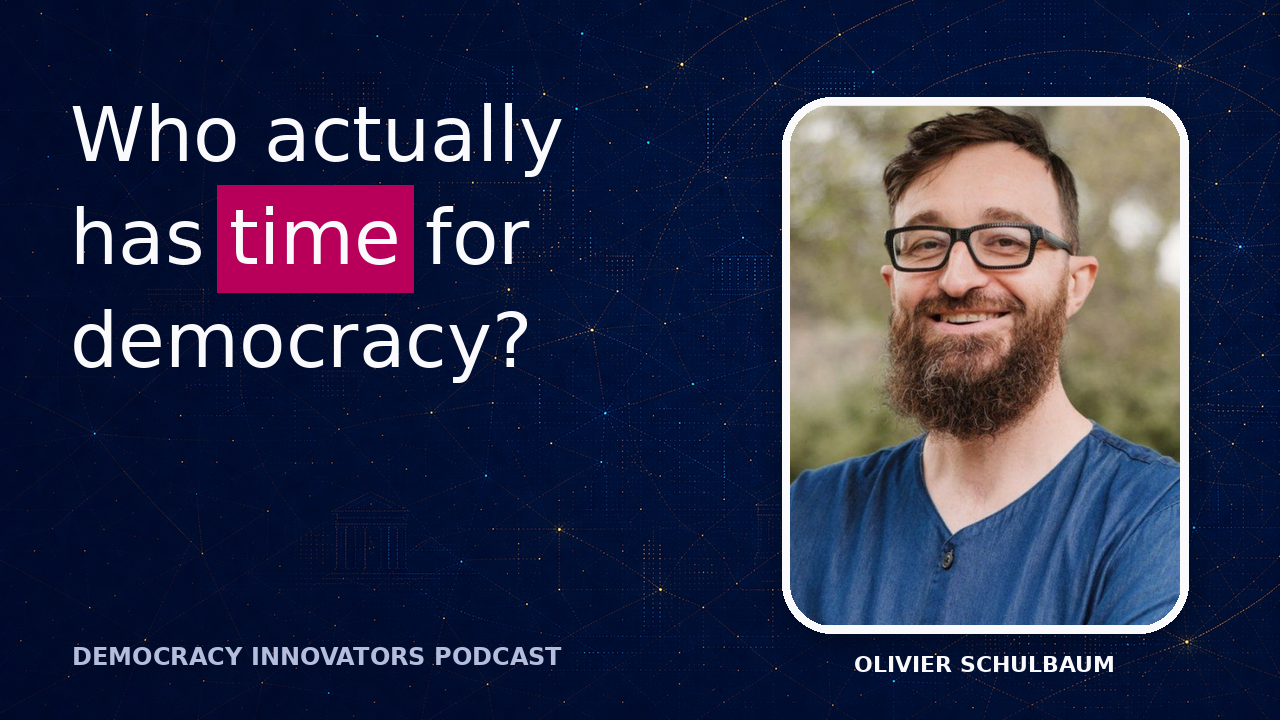
Welcome to another episode of the Democracy Innovators Podcast, and our guest of today is Olivier Schulbaum.
Olivier Schulbaum (00:06)
So Hi there. Hello.
Alessandro Oppo (00:09)
So thank you, Olivier. And if you'd like to share something about you and your path.
Olivier Schulbaum (00:17)
Right, yes, maybe to make it very short, I always thought since I was a child, I would be a poet and apparently it's not quite there yet, but actually, if you want a little secret, I was a young poet champion in France some time ago, but then that drove me to say, well, I need to be an artist if I can be a poet, so then I thought I needed to do study art and then I studied arts at the art school in Dijon and communication and this is how I got into, you know, video editing and then slowly into documentary filmmaking and this is basically where my head started exploded on, you know, the amount of money people who want to provide information to others needs to pay to public archives or to private archives, if you want to talk about anything about something that has been recorded or something historical like you know, civil war, Second World War. You need to pay for any second of these archives you want to have in your documentary and this is where I started thinking, so that's, isn't there a solution to open up more like, you know, think about the commons of knowledge and then this is where I basically learned about, you know, open licensing and then met like crazy guys, the time I was in Berlin, a big, I remember Florian Cramer, he was the first about talking about codes and poetry, so codes as poetry, is basically where I, you know, I derive into code and civic tech, is probably something we'll be talking about, but you know, I'm not a determinist from the start, I'm basically thinking that art based methodology are the best to create dialogue, even like deal with conflicts and create democracy. So this is basically where I come into civic tech, but really my training is humanities or right now that would be something associated with digital humanities and deliberations, something like that. This is my dream was not really true, but, you know, I do I do, you know, political poetry somehow sometimes to express myself, to talk about our work. So for, you know, forgive me if I if I speak in rhymes and all these bullshit, but, you know, let's make it fun.
Alessandro Oppo (02:27)
Yeah. And then, I mean, it could be possible that your career moved to just poetry, maybe?
Olivier Schulbaum (02:34)
Maybe I'll get back to it because tomorrow there's an eclipse and where I'm standing in in the Balearic Island now, this is the best spot to see it. So probably I will be blinded by, you know, the the black lights tomorrow and the eclipse, and I changed, you know, tomorrow maybe we can speak again, and then I'm I'm back to poetry, obscure poetry being the trying to be the Edgar Allan Poe of democracy, I don't think it would work anyway. But anyway, now maybe just to, you know, geographically, I mentioned I was really influenced by the scene in Berlin, but this is basically when I met Susana and we founded Platoniq together and she was into occupation and alternative economies in Barcelona and basically because of love, this is the best excuse in the world to do, to work on democracy. I just moved to Barcelona and it's then, that was the second exploding moment for me because of the light, the quality of light, but also the fact that all our activism was happening on the streets and not in bunkers like in Berlin. So this is basically, you know, Platoniq at the end of the day is a bit of a mix of the two culture of Susanna and me together. And at the beginning, actually, wanted to be an independent label because by the time we were doing internet radio, which is really old already, and then we thought we need an internet label. So we did lots of projects around like using, you know, music or digital labels as a vehicle to talk about how, you know, the effects of patents and copyright on society and on dialogue. So this is basically where all these interests for us on developing technology, which basically was a kind of a, we call this Burn Station. It was basically a sound system that moved in the street with like computers where people could copy music. We had like free licensed music and we had like lots of live acts and then talking about, you know, patents on health, you know, all that kind. So music and art in general is the best, for me, it's the best vehicle to bring, you know, to deal with conflict, to deal with polarized positions and this is how we came into work, working also on free software technology. So we always have been developing our own tech and started from scratch just as a way of learning because Susana is a learner and she's a hacker in her nurse learner. So this this is basically the way we approach technology by creating small open source tech with different communities and see that would work. And at some point we created Goteo, which is an alternative funding platform in Spain and it took it took up. So this is basically where we started designing like next serious, let's say, serious open source technology. And this is basically how we came into into developing technology with with a meaning, let's say.
Alessandro Oppo (05:29)
And the Platoniq Foundation, what is doing?
Olivier Schulbaum (05:33)
That's actually a great question and probably not the best name. We should maybe thought about being Socratic, you know, it would be more, even more fun. But anyway, I can deal with the myth of the cavern, won't talk about that today, but basically Platoniq would, the foundation was at the intersection of, let's say, participation, civic technology, culture, social innovation, and democratic experimentation, I would say. And basically what we try to do is creating more and more communities for citizens to participate while people increasingly think that they have less and less political agencies. So we create an other bridge between institution and grassroots movements. So we build platforms, we love consultations, but we love citizens' assemblies, but we see the limits and the obstacles of them. So we trying to redesign all this from a more, you know, intersectional point of view, but we talk probably about that a little bit more. So yes, we have increasingly sophisticated methodologies and our tools. So yeah, that's the issue. And we are basically a foundation, there's a reason for it because we shall be, we part of the social and solidarity economy, we shall be a cooperative, but in fact, we need it to be a foundation because of that Goteo platform we created, which is basically, it's kind of a, you know, we call it the Trojan Crowdfunding as the Trojan horse of the commons. So we use the standard of crowdfunding just to finance social impact projects and project that we're building or retrieving or protecting an intangible, tangible physical and digital commons. And by the time we were thinking and designing the old statement or mission for it, thought, yeah, well, if now, because I must say it could have happened by the time that the, you know, 2008, we started to design it. And this is basically what, by the time we had like a big crisis of financing social and political projects, also like micro credits at the bank that used to finance social projects were basically completely dry and ending, so we thought we needed tool to be, and this is basically how we started building Goteo, but we thought if, you know, now we basically a 100% dependent on citizens supporting commons projects and the public, you know, the public administration is not part of it, it's not really fair. So we thought, you know, at least whenever someone is financing or helping financing a project, if I take a €100, if I have this economic capacity and supporting the project in Barcelona, Basically we did a little hack, and this is why we are a foundation, you get 80% of the money back from the state, which is basically a little hack, the more you invest, the more you donate in Goteo, the more you get back from the state. And then, you know, if you keep on doing that, I think it's nice little hack. So I think, you know, I should also take care of what I'm saying publicly because, know, it's a very nice hack, but, know, we also on the lots of threats from especially right wings, right wings parties and governments right now and extreme right, just because of the success of the tool, because we have raised almost 25 millions for political projects. Some of them are about, you know, basically, you know, paying for solidarity cases, you know, so some groups have been, as an example, been basically have to pay a lot of money because they were striking, so we just basically repay it and we also sometimes litigate against government for the project, so which is, you know, puts us in the position that we do institutional participation, but sometimes we're also conscious that, you know, there's still some obscurity that needs to be put in the light in the public administration. That's also why I'm an active member of the board of another foundation called Civio, they do civic, let's say journalism and they litigate against governments. So they have a few cases that are really some case studies for, I would say in Europe at least, so they won a case against the government, Spanish government that didn't release the code of BOSCO, which is basically a tool to determine if people on the vulnerable conditions can access a bonus, know, something like a cheaper energy and the code was not released and it's public code, so that's an example of litigation from civil society that creates precedence for others to build that. So I think that's important that money is some of the main obstacle that civil society has to build more, you know, grassroots initiatives or advocacies. This is basically what we call crowdvocacy.
Alessandro Oppo (10:44)
Okay. And I was thinking like during this time, have you seen any changes in, don't know, in the civic tech field or similar and connected fields?
Olivier Schulbaum (10:58)
Yeah. For sure. I I would say Decidim is one of the other example, and actually, it's it's also important to mention both Goteo and Decidim happens in Barcelona, which is a city which has a long tradition of, you know, like free schools, if you took like rationalist school during the second civil war, and that's not something disconnected from the fact that an open source technology for participation such as Goteo or Decidim is built in that environment because the culture is basically also teaching lines of codes for us, know, It's basic, almost like automatic writing, the code should be responsible for, you know, empowerment of society and the people using it. So I think it's pretty interesting. So what I've seen, of course, by the adoption of Decidim by more than 500 instances, governments, cooperatives among the world makes it something to be considered by the commission as the tool to be reused and adapted. So it's also used for all these European cities and assemblies. So I think it's interesting to mention that the civic tech is growing under, you know, progressive governments, but now we are really facing a threat on how this shall evolve. So we, you know, and I think sustainability is an issue here. So if government stops financing a tool like Decidim or public civic tech, we'll have a real issue, right? So will the community be self sustainable? Not quite sure, yes. And then we need to enter in another debate which we will not have today, what is the cost of such a technology? By the time the government is feeding it, you know, you can launch, you know, working with a language that is on the market, very expensive, but it's not a problem if you're a public entity, it could be, but if you're a grassroots community, then that comes an issue. So are we talking about civic tech, open code, but is the code approach or the approach to the code democratic enough? So that would mean now it's much cheaper to develop Goteo because it's mostly PHP and it's much more expensive to develop any, you know, tricks, you know, any new modules on Decidim. So that's basically why we also do lots of very opening projects to be able to provide some innovation and feeding Decidim back, you know, from a more community approach, but through European funding, because it's not easy to, you know, that's something to consider. So for me, the debate is about like being open is not maybe the first thing we'd have to define, but it's like being democratic and then the we look at the open technology that is the most democratic to do that.
Alessandro Oppo (13:51)
And and other projects that you are working on right now or ideas that you would like to develop and maybe you don't have the time. So both
Olivier Schulbaum (14:04)
Yeah. Basically, what I'm really interested in these days, we have we run this project called School for Community in Democracy, which is about training the youth facilitators of, you know, citizen assemblies or grassroots assemblies in the future. It's based on art based methodology, as I was mentioning in the beginning, like sociodrama, legislative theater, something interesting that could interest you and we need some support for this. We basically, we call it dramatization as democratic inquiry. So we were using a lot of legislative theater and social drama, more than engagement techniques that are analogical, you know, there are methods of inquiry. And what we're trying to do is how would the digitalization of these methods would look like, which is really that physical space based and interaction. So how can we make this, you know, the scene in the theatre or in socio drama, the stage is something really important. So how can the civic tech platform can be a stage? So we're working on on adaptation of Decidim. Eventually we'll be releasing a distribution of legislative theater. So we like clean Decidim that is cleaned up and adapted to legislative theater and participatory policy making in general. So basically my obsession is this is going from what we call like affect to digital participation, I would say. So this basically where we we at. And if you look at civic tech precisely, I'm more now researching and designing what we call political user experience. So, you know, that's so PUX, and this is basically something we've been reading reports on it, and it's basically about imagining platforms like almost like a city, like you would navigate a city or you yeah. Like, citizen would basically meet up in a school or meet up wherever in a in a factory by the time of the Second Republic, you know, or all that idea that the platform should allow people to navigate a space they feel comfortable with, safe, but also like feel like, you know, this is exactly the architecture I'm living in. So it's not a flat interface with lots of, you know, box to fill with text because basically this is what policy making is, you know, providing text to be technified by policy makers to adopt them, and this is basically something we're trying to push back or avoid. So what about like non discursive participation? What about, you know, audio participation? What about, you know, that this is a lot of, whole that's universe to, from art-based methodology to bring onto platform like Decidim. So we wrote about it, so I'm happy to share with whoever listened to this podcast, the more and more and more detailed definition of what, you know, political user experience shall be.
Alessandro Oppo (17:00)
Sure. Then, if you have any link, we can put them in the description. And I was thinking, do you think that is important that, let's say, participation also maybe is not directly connected to institution or association? I'm thinking about specifically about citizen assembly that most of the times they are, let's say, they are organized by an association or a foundation. But I'm thinking also also about, I don't know, providing, I don't know, a tool where, I don't know, a person can just organize a citizen assembly inside their community, inside their neighborhood.
Olivier Schulbaum (17:41)
Yes. Yeah. Actually, I was basically mentioning affect, you know. So what is the emotional connection of people or citizens to democracy? Is there any? So it's basically how can we recreate affect with democracy? And then with you talking about citizen assemblies, and I'm a big defender sometimes in a, you know, in the facilitation world is not very welcome. I'm a big defender of enclave deliberation. So basically starting with the most affected by the topic of an assembly. And of course, this will bring you to identifying which communities are already active dealing with certain topic. Like, this typical topic that are sensible and a politician would not take as a starter for citizen assemblies, like racism, gender violence, or even like the management of trash in a city. It's not, it's almost non institutional citizen assemblies that deal with it. Nevertheless, I think the agenda should be defined by the most affected. So my question is how do we make people, let's say, feel that democracy has something to do with them again, but not with them individually, with them individually and collectively. So what has democracy done actually to deserve people's trust? That's the good question, not much. Not only their trust, their attention and their emotional investment, you know, because you have seen lots of cities and assemblies happening, lots of recommendation being voted, prioritized, but not adopted or implemented yet. So, you know, that's a big bottleneck there. So democratic participation can not only produce rational legitimacy, I would say, it also needs to reconstruct what we might call like affective legitimacy. So the question is like, if I had a claim, if I start with the most affected, always, depending on the topic, even climate change, look at who needs really climate refugees in a city like Barcelona, start creating a mandate for an assembly where you have the rest of the population coming in. But I think it's very important that, you know, avoiding that experts formulate the question. They should only help people affected formulate the questions a little bit better or less activist at home, let's say. So, but we ask, what is clear, the person who asked, what if the people most affected entered before the question or the mandate has been decided? This is basically what I see, and here you don't need much technology, I haven't talked about technology. I think that's, I think the idea of migrant community discussing borders and the right to the city, people experiencing housing insecurity, discussing housing policy. This should happen first and then create the mandate for a more representative citizen assembly to happen. This is something we're trying to provide. So of course, probably decidim could be a tool for community to self organize and claim for such an incidence, but this is also where we need to help and make sure that, you know, institutions are aware that there's this red zone of topics that they will never treat and they shall, otherwise there will not be no legitimation or affective reconnection with democracy, I would say. So really I believe in enclave deliberation to agendas and agenda setting and co designing the mandate. So this is basically what I think the mostly the bottleneck of citizen assemblies are. And you talked also about self organization of citizens. I think that's a loss of a big opportunity in citizen service. So there has been many in citizen assemblies, if in general 100 citizens are selected, we might have a huge amount of citizens that already have felt, lived, understood what an assembly is and could create, and actually there's we're supporting also a federation of some of the citizen assembly members associations that the one in France, in there's one in Austria, there's one in Spain from the climate assemblies, they come together and I think, you know, and basically reclaim the role in expanding what happens in the cities and assemblies, and going to school to explain what climate change might be, and what, you know, participatory policy making shall be. But in the world of professionals like the one I'm part of, they would be considered a new lobby so you can throw these ex members of citizen assemblies away. It's a bit exaggerated in what I'm saying, but I had these conversations with with professionals of my sector, which I entered in shock, because I think digital citizen unions of ex members of citizen assemblies is the best to contaminate the rest of population, because at the end of the day, will be only 100 citizens elected, what about the rest? So there's some kind of an omission, and then we can maybe have beyond technology and the technology we use, which are the physical space that are used in these citizens only, you know? Usually institution, the European Commission that I see in Catalonia, I see in, you know, in the French assemblies, you know, it's always about bringing the citizens to the parliament. Fuck that. Citizens should choose their own space. You talk about climate change, go to the forest. You know, so I believe this is also a bottleneck of citizen assemblies, the way we imagining that citizens should play the role of politicians for a certain amount of time and disappear, you know? So we should avoid that, think. They should contaminate all that, especially the youth in schools. So what about like, you know, if you have had lots of national assemblies in France about climate change and in Spain, what about going in a in a in a Catalan school and redimension the policy recommendation to, you know, the word that kids know? So what about how this recommendation, which is on the national level affects my river, the river that goes through the school or the trash, the management of trash in my city? So there's lots of opportunity to bring, you know, that culture to, you know, scaling deep as people like ScaleDem would say. It's about scaling deep more than scaling abroad or resale or like laterally, you know.
Alessandro Oppo (24:09)
Yeah. And indeed there was scaling. I I think it's a very important concept because otherwise, as you said, if you organize a citizen assembly of 100 people and then those people are not able to organize other participatory process because they could. And and then the other issue, I think, is commitment because maybe an institution and I can also understand that could be a little bit scared about signing that they will do what the citizens will say.
Olivier Schulbaum (24:48)
Yeah, but once they're prioritized and adopted, you know, they should the mandate should be automatic, but that's the stage that usually, I think for the French convention on climate, we have lots of colleagues that have wrote it, written about it, it's quite documented, but it's not the case of all citizen assemblies in Europe. I think basically there's something that is not clear to most of the society is that these recommendations are technified after the assembly. That means to be to be, you know, to land on the whoever administration technician in charge of developing it, they will ask for, you know, the technified version of it. And in technification, again, there's a loss of the original meaning by the citizens. And it's not very well documented, so we should also take care that, you know, maybe AI is a nice way of saying, you know, if you have access to this technification moment and how the proposals have been reformulated, then it's much more evident that you lose a lot of meaning and power in technifications.
Alessandro Oppo (25:55)
Maybe we need the sort of social political hack regarding
Olivier Schulbaum (26:00)
A lot of them.
Alessandro Oppo (26:02)
Regarding these problems. Yeah. Because I I see, like, this problem about commitment many times came out during the interviews, and I think it's a sort of unsolved problem. And, yeah, I wanted to ask you if you think there are if there are some, let's say, open problems, are there some open problems in the in this space, in this field?
Olivier Schulbaum (26:34)
Yeah, I think the other mass obsession of basically neutralizing conflict and find consensus. So there's lots of literature about how we can avoid that, you know, from Chantal Mouffe, for example, it's difficult also to bring that, but I think conflict is basically an activator of our credibility as citizens. That basically allows us to go beyond the expert knowledge that was presented to us as citizens. You know, so I think finding the polarized views is something that should also be sometime discussed. And I saw these these these ideas of how can we rebalance the algorithm of sortition depending on discussion, universities and SMEs. So and there's not many cases about that, about documented about that, but, know, you would imagine that at some point, of having, if we're talking about vulnerable communities that are present around the room, in a room, right off the bat, instead of having one of these community members in each of the table, take one table exclusively with these people together, to live it an enclave deliberation in the middle of a a of a sortition process, deliberation kind of assembly, and I think that would also rebalance power and interest. So I think that from there, probably there would be more polarized views that if you consider art based methodology like the theater would be easy to create empathy from the people who are on both sides. So, and probably technology can also help you doing this, that would not necessarily be a participatory methodology, but more a digital display where, or like a room. So this we project using the Decidim Barcelona data, you know, on climate discussions in various processes where we see, identify polarized issues, and then try to get them back in what we call an augmented deliberation space, where you basically talk to the most polarized views or representants of these views, and they work together on seeing a series of materials from the other point of view, and come to work again physically, and then again from this process where we use non discursive approach, people drawing together, people doing sociodrama to understand the position of the most affected, And then back, we take back this discussion onto the digital platform, and we're working on something like that. So extracting polarization from data, it physical and see how much data visualization or experimental data visualization or non discursive methodology can help us building like, you know, more understanding, but not basically neutralize conflict by consensus. So it's something we that should be worked out. So yeah. Yeah. This thing is super interesting to me,
Alessandro Oppo (29:33)
like, because I thought about it many times. As you say, like, if you put a member of a minority, let's say, in different tables or just in one table, you obtain a different result. And, also, I mean, sometimes it is clear if someone is part of a minority, but the other time I was thinking like, let's say there is a process where, I don't know, 100 people participate in a citizen assembly sort of. And then after some time, you put together the people that think the same or think in a different way, or maybe you have different steps, different rounds.
Olivier Schulbaum (30:15)
Because at the end, you obtain different results, like in one way one way But there's there's only few few experiments that have been and sometimes even with smaller groups, so not even a hundred, more on on mini publics. And and I don't have the the research in front of me, but, know, you it's pretty surprising that sometimes, you know, these echo chambers, if they're physical, they're really different, if they make them physical in an assembly than online. You know, people looking at emotionally at at people's eyes, you know, it's all different conditions that civic tech would never bring. So I believe that hybridity is the best way to work that out. So it's not like I, you know, representativity should be coming back regularly, but we should move around these these more like and if you want to talk about affect, you need to realize what you how what you're discussing is affecting people who are, you know, directly involved. So probably, maybe sometimes I'm not in the room, but, you know, a good sortition algorithm would guarantee that probably there's a, you know, percentage that is reserved to, you know, the most affected in the assembly. That that would be enough to start with.
Alessandro Oppo (31:34)
The I was thinking, are you thinking about any tool? Because now there is AI, so it's possible to create new tools. Coding is cheaper, very, very cheap now. And so I was thinking, yeah, if you are satisfied with the actual tools, or do you think that a new tool should be created?
Olivier Schulbaum (31:58)
And Yeah. That's, yeah, that's a good question actually. But so that's a nice example. So you've seen the Habermas Machine. Again, I'm talking about probably partially a failed experiment just because of consensus and we're trying to reproduce institutional deliberation. So now we're building a small experiment called GRID and it's basically we're trying to create an AI agent with different personalities, so a bit schizophrenic, and one of them is the joker who's a facilitator from legislative theatre, who was a kind of provocative agent that would also stop you to use him as an agent and saying, you need to reflect on that, stopping the flow of, you know, you're the perfect companion for the deliberation, that would be the Habermas Machine, we don't want that. And then we have introduced a philosopher and he's an agent we're feeding with scanned books from a collection of a colleague of mine who's a philosopher from forty years of collection. And this is basically how we feeding this AI engine. And of course, we have the deliberator, which looks a little bit more like the Habermas Machine, so we're introducing the Habermas Machine to see how it evolves in front of a legislative joker. But the idea of using this AI is to use it in physical space by the time we have people deliberating together. So it's a collective use of it, it's not an individual one. And it's basically helps you also to design, you know, mandates that have all these intersectional elements in consideration and all, you know, elements that we have been introducing like design justice. So, and then all these literature about the bottlenecks of AI that is also feeding the agent to be self conscious about these limitations. And then we, as a way of experimenting as part of INSPIRE project, so we have the radically independent agent, which is on my, one of our developer TV sets, so it's not even a computer, the AI agents runs on a very small memory, and then we have the one that is more connected with the beast, like OpenAI and see the different results. You know, it's very difficult so to close your knowledge, the knowledge, your knowledge base from OpenAI, you never know if it's completely independent. But it's interesting. So each time we do, we have collective prompts running, we also have systematically an analysis that gets to us to see how much percentage of the, let's say, the corpus we fed the AI agent with was used for the response and how much it had to identify what is type of knowledge that was missing from our own corpus. And sometimes we allow then the agent to go to OpenAI and see this, some responses there. So we have the two experiments running at the same time, the one that is basically part of the beast and the one that is completely radically independent, that is probably not sustainable, because it takes more of time. So if you ask like, what is democracy? Then, you know, the TV set agent will last, you know, will take more time, but it would be a 100% independent from any previous, you know, biases that shall have been introduced by someone else. So this is how we we approach the AI deliberation. It should be a collective use, not something that is used only to digest results. I I don't think that I mean, it's probably not the most exciting use you can do. It's just facilitating, you know, institutional work, but it's, you know, if yeah. I I would rather probably use AI to basically activate people's creativity during a citizen assembly. That could be something. That's the also the idea of our of our GRID agent. Yeah. Yeah.
Alessandro Oppo (35:51)
No. I had a question like from a practical point of view, because you were saying like people in real life in some ways supported by the AI agents. So I can imagine like with a phone microphone and the so it's a sort of like a participant or
Olivier Schulbaum (36:11)
Exactly. It's just one more participant. Yeah. And sometimes we bring him onto, you know, as a more facilitated group and people are also using it collectively to organize, to design and mandate. So, you know, it's something we're still discussing and with our INSPIRE project colleagues, but shall be presented into the web when we're happy with the results, but it may be only, you know, an an internal so we haven't released the agent yet because it wouldn't make sense if we're not happy with the result. It's more of an experiment of learning how these AI agents work, so what is the best way of learning is creating your own, which is basically a very simple hacker principle that should be always applied. So this is basically what we do. So it's about also like what's the opportunity for technological sovereignty in AI work, not easy to answer. And then how much of, you know, of data would we need or how much? So right now we're quite happy with a smaller amount of data and then we have prepared like sets of data that are only activated depending on the topic of where we use it. So if it's about like, you know, frontiers migration or if it's about trash management, we have presets. So we avoiding working with too many data because that would then be something, an agent that would look like I know everything, you know, so we're reducing sometimes the the power and the role of the of the AI, but those are the participants decide on how to, you know, expand the use of it. So I guess by by October, we we will be releasing some articles papers and deep dives about the experiment, and then we'll decide if if it's worth releasing it or not. It will be open source, of course. But now it's so connected with corpus that, you know, it's it's really a crucial element.
Alessandro Oppo (38:10)
I really like this kind of experiment because I think they are really connected with scaling because sometimes I mean, in this way, you could provide, let's say, I don't know, a tool for citizen assembly with moderation and facilitation inside the tool. And then because you were mentioning you what is democracy? I want to ask you, what is democracy?
Olivier Schulbaum (38:36)
How about this? No. This is this not a question you want to be asked. Now for me, democracy has to has lot to do with affect. So probably democracy is about solidarity in a way. So, from a privileged position such as ours, it's basically about like reversing it, flipping it and saying, who's affected by whatever topic or ideas or decision that needs to be made. So it's really a simple exercise, who should be in the room first, who should we listen to first. So I don't think democracy can be described as a tool in itself, but I think it would basically imagine that we would forbid any institution to do any discursive production around democracy and only art based art based expressions. Oh, that could be a good experience in one year. So the policymakers would be freaking out and I guess citizens less. So you could do that in schools, for example, as a small entrepreneur can build their own democracy without the use of any discourse or even you could also say pre established knowledge, that could be something interesting. Designing a corpus of what we need to design a democratic process is something kids at school should be able to design themselves. It's more of the new library for me, you know, where we basically, when we were young and we were going like, you know, illustrations as important of the text, you can be driven by a poem, which is a political poem more than any political discourse or an essay. So, you know, we should offer the opportunity of people to relate or create, you know, positive affection with democracy, choosing a language they feel more comfortable. And maybe if the AI can translate this for everybody, so, you know, all these different human agents at the end of the day that have different ways of expression, different work, you know, I'm talking a lot about sociodrama and legislative theatre, but there's lots of people that wouldn't be comfortable in using their body to express themselves. We understand that too. It's not that creating more justice doesn't really need to avoid creating more all this affection by a certain series of people or also unsafe space, because when you talk about oppressions, sometimes you have the oppressor in the room. So if you apply legislative theater in Citizen Assemblies, for example, that would be a deed. So how can we create also like enclaved legislative theater with people that feel comfortable with, and then back to eventually, you know, the rest of the groups? Because if you, we do lots of experiments as part of the School of Creativity and Democracy in Schools, and we talk about gender violence, we know that it's not, it's a sensible theme. So you basically want to have maybe one to one dialogues, bring, individual have inquiry and then build some, you know, mandate or questioning that you can be different people from the classroom together. So if you talk about trash management, you don't need that. But if you talk about sensible issues that you're maybe other person in the room, that's it, it's a real issue. So, yeah. So I don't know how you have been coming to that point talking about simple idea of what democracy is, but, you know, I've been explaining, so not easy.
Alessandro Oppo (42:10)
And if we think about the future, what democracy could look like, I mean, if there is also in relation to participation, civic tech, I don't know if you can if you think that maybe a more direct democracy, different kind of relationship with institutions, more horizontal.
Olivier Schulbaum (42:33)
Yeah. Well, since we're both part of the civic tech movement, the one simple question is what does the civic tech movement really need? Right? So civic tech, I think doesn't need more apps. Right? We already have an enormous graveyard. Most of with beautiful design, civic tech tools, most of them financed by commission through Horizon Projects and they have no community associate to that. So it's kind of a cemetery. So we shall need to avoid that. So we have been, I think I would say maintenance is a political work and it needs community. So maintenance is never a question for, of techies, maintenance is a question of people who are really in need of certain tech, I would say. And then, you know, talking about AI, one of the question we have to ask is who govern civic tech, right? Versus GAFAMs, but really who governs civic techs and who funds civic tech? The founders, the developers, the institutions or the communities using it? So I think developing new governance model shall be something we shall start with. And I think, you know, there's a few example that already happened, but I would say civic nets would need to recover something that the word tech sometimes make us forget, so people, relationships, conflict in a good sense of it, care, bodies, time, which is a crucial element, and imagination. So let's say, you know, what I'm saying, how can we build non discursive deliberation? How can we build non discursive code? So code that somehow is community sensible. So that's a real issue, that's something we should thought about. But and then as to open up on what we obsessed with in the future with my colleague, Sonia Bussu from INSPIRE project, we're working on the conception of intersectional time. So who has time for democracy, right? So who has actually time to participate? So, because, you know, we know the time is not distributed equally, a student, single parent, someone working two jobs or three jobs, a person with disability, so they're not entering a deliberative process with the same temporal resources, right? So, and you know, I think that that's something we should also consider. So what if one of the most powerful forms of democratic exclusion is simply the control of time? So I think, and that's something we would definitely think about that time in democracy is not a natural resource. So it's basically, you know, and also looking at citizens democratic times, especially when we talk about youth participation, you know, their notion of time is really different, but if you talk also about certain communities, the use of time and the perception of time is also something really different, the effect of your participation on time is sometimes perceived differently. So I think that's a crucial element, which we haven't take enough care of when building technology or building or designing deliberation, really.
Alessandro Oppo (46:01)
When you were mentioning theater, I was thinking also about Sonia Bussu.
Olivier Schulbaum (46:07)
Of course. Yes. Because no. A that's a few that's a few projects or pilots that have been developed, especially youth led. So there's this one called You're Fried about employment of the youth, but also the mindset revolution project, which turned out to a more international project called the mental health, Youth Mental Health Beyond Borders, where we have collaborated and so that's also a small piece of documentary that I can share with you also about it. And I think that these are crucial elements on defining, and especially when I see Mindset Revolution participants that have grown from participants to legislative theater or digital deliberation designers, when at the start they were basically participants in a in a process around youth mental health, and I'm seeing that they are, you know, professional facilitators that have grown up through this participation process. It also makes me think that, you know, people who have the opportunity to participate in any of these projects should be cared of, should be, you know, should deep dive with them on their capacities. We should check with them what their democratic and dialogic capacities they have acquired and design from their insights or inquiries, design, you know, a better approach on democratic capabilities, which is also something that our colleague Lucy Parry, Oliver Escobar from INSPIRE are working on. So this democratic capabilities framework, how is this connected, you know, to the power that participants acquire that I would say, which are the capabilities that institution can learn from working with the most affected also. I think that has to be seen on both sides.
Alessandro Oppo (47:59)
So there has to be a sort of feedback loop with citizens that are involved.
Olivier Schulbaum (48:05)
Yeah. And if citizens are conscious about like establishing their own path on which are the capabilities as part of this process that I want to acquire, so do I want to raise a political voice that can be a capacity, or do I want to raise more capacities on my solidarity capabilities with others? You know, you should be able to decide from the start, this is the path, so I'd like to grow, you know, from this perspective. So that would also determine the type of role you can have beyond being a participant in the process. So quickly come to participating, but sometimes that can also help, you know, maybe prioritizing as part of a group, negotiating conflict when it appears in the citizen assembly, you know, but by the way, you can choose the path on which are the democratic capabilities you want to acquire as participants. If it's stated in a very simple terms, not technical terms, I think that's very useful to make people understand that we learn through the process and we will take, you know, we will take in consideration the capacities to be active, you know, in in the parallel process. I think that's that's about like democratic and and legacy in fact. It's really something we trying to integrate as part of our School for Creativity and Democracy, having members or cohorts of participants teaching their peers in the next experiment.
Alessandro Oppo (49:29)
And we are near the end, I wanted to ask you if we miss something or otherwise I will ask you the last question. If you think that you want to add something that we didn't touch.
Olivier Schulbaum (49:41)
Maybe taking it back to when we talked about AI and deliberation, I think what we are living now is AI and the acceleration of deliberation. So this, everybody's convinced that, wow, AI is great to digest, but I think the digestion is something that needs a specific time and non text digestion. So I think we should also take care of that. This is just something like, you know, what if acceleration itself becomes a democratic bias? So how can we slow down AI in deliberation? And that's partly what we tried to do with GRID, especially with our joker agent, who's constantly about like provocating that, you know, rediscussing the prompt as it is, you know, to avoid sycophancy and all these elements. So I just forgot about that.
Alessandro Oppo (50:28)
And so the last question will be, if you have a final message, I mean, for all the people that are working on civic tech or participation or similar field?
Olivier Schulbaum (50:42)
No. I'd I'd love to invite people to read our journal. We have some a journal called Wilder Journal. No. Don't be afraid. It's not an academic journal. It's got every, you know, I think this is something we I'd like to recommend and also we'd love to see contributions. And of course, will share with you all the, for the civic tech people or the, you know, Goteo repository on GitHub and all our modules for Decidim, there's lots of them that go behind this, you know, text into box kind of navigation.
Alessandro Oppo (51:17)
And I actually have another last question. Okay. The last last. Because now you were mentioning the Decidim modules. And before you were also saying that there are a lot of civic tech applications, so a sort of cemetery. And so I was thinking if there is someone that has an idea about a civic tech app at the same time to not replicate this to not create another that the civic tech app that goes directly in the cemetery, What could be an approach so that we do not always recreate, but in some way we connect the dots of what is already existing?
Olivier Schulbaum (52:01)
Probably recycling, you know, so this cemetery is worth visiting sometimes. Maybe not for the tech in itself, but because it's partly funded by European projects, most of it have lots of reports and, you know, requirements, documents. So probably even more interesting than the code that can be, you know, grow old. But anyway, you, you know, Goteo is starting in 02/2011 and we just, we did the code from scratch last year. So there's, you know, if you design well, you know, no importance that if the code is still something sexy, it's is something stable. I think that that should be something also to consider. And again, back to, you know, the silly question, why are we using a certain language and other, you know, reflection on what is the language you will be using and what's the price of it in the market to avoid the fact that you will have to pay a developer 10 times what something, someone in your team that has basically studied humanities paid, I think it's very unfair. So we should avoid that on civic tech. So watch out the socioeconomic condition of the code itself and the dependency we require by this, you know, from a choice or another. Yeah. That that that's that's that's something that should be considered.
Alessandro Oppo (53:27)
Thank you a lot, Olivier.
Olivier Schulbaum (53:29)
You're welcome, Alessandro.
Alessandro Oppo (53:31)
It was a pleasure.
Olivier Schulbaum (53:33)
Cheers. Bye.

Member discussion: