
Automatic transcription, there could be errors.
Political debate and Quaker roots
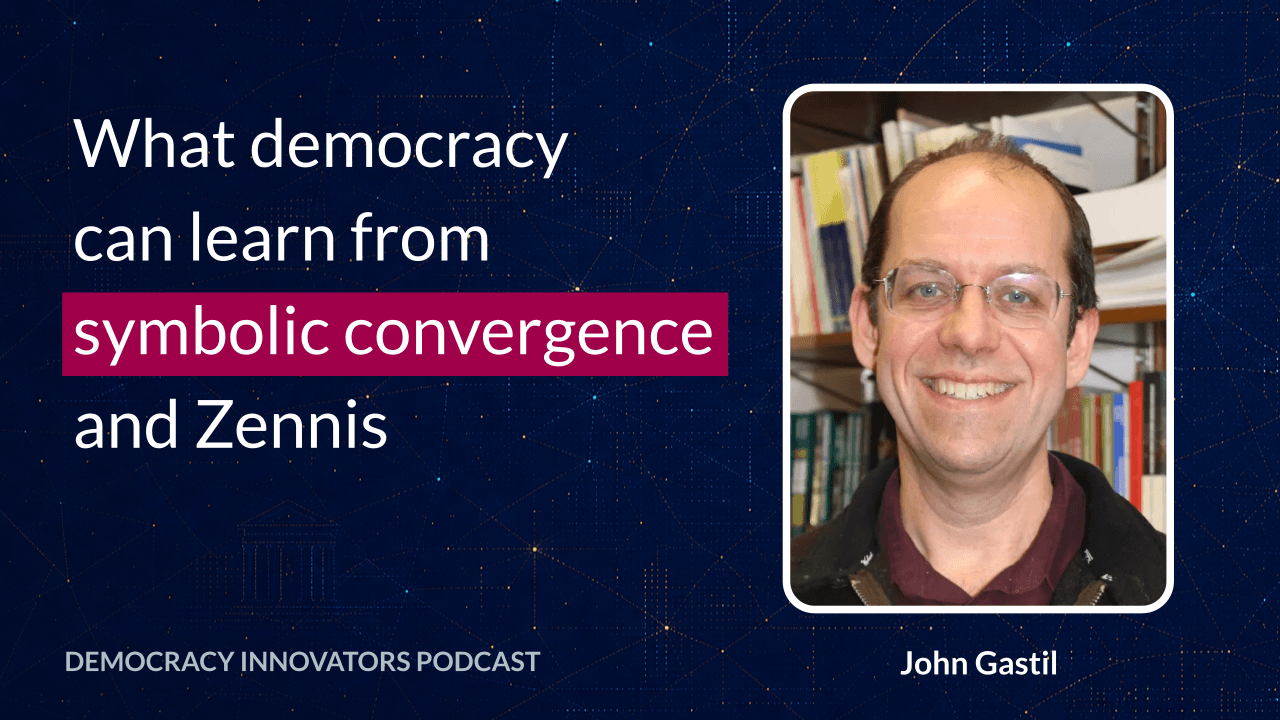
Alessandro Oppo00:00Welcome to another episode of the Democracy Innovators Podcast, and our guest of today is John Gastil. So thank you, John, for your time and for being here.
John Gastil00:09Oh, you're welcome. It's a pleasure to be here.
Alessandro Oppo00:12And the first question is if you'd like to tell us something about you, your research. I know that you have worked on many things and also you have written many different books, but they're all related to a topic like.
John Gastil00:33Yeah, one way to understand my research is just to understand two things about how I grew up. So often the things we study are a reflection of what interests us or what scares us, and in my case, it's a little of both. I grew up in a very political family. Both of my parents ran for US Congress unsuccessfully, and we were constantly arguing about politics, and sometimes the arguments would get heated. The funny thing is we mostly agreed, but any small difference was worth a big argument. On the other hand, and I should add that then I did debate in high school and college, competitive debate. I really enjoyed it, had great success, and thought, This is something I'm really good at, arguing. On the other hand, I was raised in the tradition of Quakers, which is a relatively obscure Christian religion. It's not particularly theological. There's a tremendous emphasis on sitting in silence, being inspired to speak. There's no hierarchy. Decisions within Quaker meetings are made essentially by consensus, and famously in The United States, the Quakers were the first religious organization to formally oppose slavery, which is much more remarkable when you think about the fact that literally every single Quaker had to agree, Every single one. Any one person could block a single Quaker meeting on that issue. So here I have this consensus tradition that is so well developed historically, almost spiritually, right, that I find very attractive and interesting. I love the idea of facilitating and building consensus and listening, and on the other hand, this very aggressive political debate tradition, and in my research, you really see me working with both. On the one hand, my first book, Democracy in Small Groups, is about how groups can be democratic together. What does it mean to really be democratic at a very small scale? And then on the other hand, you might know that I actually ran political campaigns, like the purpose is to defeat someone, to beat them, and so reconciling those really is deliberative democracy, so whether I'm studying a jury system, is trying to use careful deliberation mixed with an adversarial process, studying elections where I want people to think through the issues, but there will be winners and losers, or mini publics, and so on. All of that research that I do in one way or another is about how to live together with other people in a way that brings out the best in us, makes the best decisions, and really tries to help us resolve or at least address the biggest problems we face together. It's not easy. Democracy is tough, but I think it gives me an advantage to have these very conflicting early experiences and impulses in my work.
Democracy in small groups and movements
Alessandro Oppo03:46And how does it work, like, for a small group that is trying to be, let's say, democratic? How do...
John Gastil03:53Yeah. I I mean, there's no one answer, and part of the point of democracy in small groups is that there really are variations on democracy that work well at a small scale, so on the one hand, there's nothing wrong with being majoritarian, right, and it's okay to have a majority vote on some things, but on other issues, particularly issues that are foundational to the identity of the group, you probably need to move closer towards consensus. So why does the jury use unanimity? Well, it doesn't always. If it's, you know, someone's charged with murder, absolutely, has to be unanimous. In fact, a Supreme Court ruling recently clarified that in a couple states that tried to deviate from that a bit, no, it has to be absolutely unanimous, but as you go down to lower stakes, let's say your car ran into my car, you know, maybe we don't require unanimity. On civil cases, where it's not, you know, a question of whether you're going to jail, but a question of often how much money someone has to pay someone, then typically it is like a two thirds majority or something, but I even left a little room for random selection for the decision itself, So imagine you're in a group of friends and you're trying to decide what movie to watch tonight, you know, if you're torn between two movies, you might do a majority vote, but then, you know, there's winners and losers and who cares? You're just gonna watch a movie, so why not flip a coin, right? And it turns out that random selection is used sometimes by even democratic groups because if you think about it, it's a perfectly fair process, it's just a different way of resolving, so there's lots of variations along those lines and I think that's a valuable lesson when you get up to a larger scale, you start to recognize, well, there's still variations within democracy, like voting systems and so on. Some maybe work better than others, but there's definitely more than one way to be a good democracy.
Alessandro Oppo05:57And I was thinking before when you were saying that you were always discussing with your family about politics, and most of the times you were agreeing, But then like small differences could, you know, you could argue for maybe for hours. And I was thinking how often like the small differences inside a movement then are very, very like important. I mean, people fight a lot, and probably they maybe see like more as a enemy, the one that is like very similar to them, but with small differences instead of the other one that has a very different ideology.
John Gastil06:42Well, before we began this call, you'll recall you and I, we were talking a little bit about where we've traveled, and we've both been to Mexico. Well, Leon Trotsky went to Mexico and was assassinated there by fellow communists because he didn't have the right version of their ideology, and you're absolutely right. I mean, these differences within a movement that shares broad goals can be so toxic that they wind up becoming personal differences, differences in personality and style, and sometimes that covers up real substantive debates that need to happen. The challenge, I think, often in a movement is how do we maintain our solidarity and our shared focus while still having really good internal deliberation, and in fact, again, a colleague of mine in Italy, Andrea Felicetti, a part of his research is on social movements and deliberation, and looking at what is the potential for a movement to either foster sort of a national deliberation while still having movement aims, right, where there's an outcome we want, but we can still promote deliberation, but crucially, how do we maintain a deliberative culture within our movement? It's not always easy, but if you are a democratic social movement, this has to be part of your identity. Your internal democratic process has to be authentic and really deliberative and robust, or it's too easy to fall into the kinds of hierarchies and personality fights that can destroy a movement or corrupt it.
Mini publics and democratic trust
Alessandro Oppo08:25Yeah. That happens a lot of times. They can Yeah. And it was very interesting what you said about the Quaker community, like... And I was thinking how does it work like the governance inside the... Because you mentioned consensus, that is a very interesting things. And yeah, if there are other things that could be interesting to know.
John Gastil08:55At like a national level you're saying, or just any large scale?
Alessandro Oppo09:00Yeah. At... I will say what is the kind of organization in relation to, let's say, governance that is used? I mean, I can imagine some assembly with consensus, but then how Sure, does
John Gastil09:15so let's think broadly about the concept of a mini public for a second. So a mini public, broadly speaking, is a random sample of some political unit, like a nation or a state or a city, that's brought together either online or in person to discuss usually an issue or maybe a set of issues and do something about them. Usually, it's make a recommendation. Sometimes it's more than that. Some mini publics actually analyze an issue and then provide information to voters who are gonna vote on that issue. Some mini publics get to place a question on the ballot for voters to vote up or down, or they hand that issue to the legislature, which then hopefully follows through on a promise to then put it on the ballot. They do various things, right, from recommendations to providing information and so on. These mini publics are sometimes confused with the entire project of deliberative democracy. All they really are is one institutional innovation that very effectively illustrates the need for a deliberative moment within an adversarial process. What I mean by that is the mini publics tend to be highly deliberative. Really, if you design it well, it's hard to find a good case where it totally failed to deliberate. Usually when the deliberation becomes messy and problematic, usually you gave it too many things to do in a short period of time, or you didn't give it the information resources it needed or so on, but well designed mini publics work great as deliberative bodies. The question is, do they have any relevance beyond themselves, and if they're well integrated into like an election, for instance, yeah, they're absolutely consequential. In Ireland, they liberalized abortion laws because a mini public deliberated on a difficult issue in a Catholic country and came up with a proposal that was broadly acceptable to the public, and they ratified it through a vote. In Oregon or in Geneva, they used the Citizens Initiative review process to analyze an issue on the ballot and help voters like you and me read that statement and say, oh, I understand. Okay, I understand what I'm voting on now. I now want to vote yes or I want to vote no. The point is we're now more confident, we're well informed, so the deliberation is improving the election and getting you a better outcome. That doesn't make society deliberative, it doesn't mean we reach consensus, but it does mean there's more deliberation infused into our politics, and I think in the long run, one of the things that we'll do is build up the legitimacy of democracy itself and the deliberative processes in democracy. Just one more example, as you know, I studied the jury process for many years. One of the things that serving on a jury does is it makes you more confident in the legal process. Not always, but in general it does because people tend to have a positive experience. That building up of confidence in an institution can help that institution work well. You don't want it to be unwarranted trust, right? You don't want to trust in an institution that is terrible, but when you serve as a jury, you see it unmediated. Those are your eyes looking at the judge, looking at the process, and in a way, a mini public helps do that for politics to some degree. It's not the same, but it can help people feel like, okay, our politics is not just misinformation, personality, deception. It does also include these moments of deliberation, so I think if if well designed and integrated into your political system, those deliberative moments, I think, can have powerful lessons for all of us in how we think about ourselves and our role in democracy.
Quaker process and shared belonging
Alessandro Oppo13:33And now, yeah, I wanted to ask you like the... Because before you said like in the Quaker community, in the consensus is used and not majority. So I wonder, like, which other kind of mechanism they used or they are using now.
John Gastil13:56So I... It... It's it's worth noting. I I was raised Quaker, I became officially a Quaker sometime when I was in college, it's a whole story there, and now I'm no longer officially Quaker. I'm culturally Quaker. On my first date with my partner, I realized after the fact I must have mentioned Quakerism like eight times. I felt like an idiot. We're still together, so I guess no harm done, but it's weird how it becomes a part of you even if you're no longer part of the religion, and Quakers are formally called the Religious Society of Friends, with a capital F, and it is a religious society, so there have actually been books written about Quaker process, and usually they're very careful to say this, Quakers are sometimes offended when you tell them that they run by consensus because they think they make all their decisions through a religious process, not through what you and I would recognize as good facilitation, effective listening, bargaining, no. Everyone is supposed to be inspired by the Holy Spirit, some supernatural force that inspires you to speak and to listen, and we're finding the truth. The truth was already there. We're all just sort of finding it, and no one has more authority over anyone else. It's very Habermasian in the sense that everyone's validity claims can be challenged, everyone is supposed to be equal, but their answer to that question is that it's a spiritual practice, but one of the best books written on Quaker process has a quote from a Quaker, which is, How do you reach consensus on an issue or unanimity or whatever when someone disagrees and they're adamant about their disagreement? The example was gay marriage. Most Quaker meetings are happy to welcome in gay and lesbian couples to become married. That was true even before it became the law in The United States, but there were exceptions. There are meetings that did not support that, and the answer was we will reach consensus once we have a few good Quaker funerals, meaning a few people need to die. Now, not that we're gonna kill them, it is a non violent religion, they don't even go to war under any circumstance, but they can certainly wait someone out and then vote again after they have passed from natural causes. So that is a recognition of the reality of vote counting, they're not saying well the Holy Spirit is not reaching these members well, no, they're saying they just need to go. So, know, it's funny, but I think there is something to that and when you watch a mini public, it's obviously gonna be secular. Well, not obviously, but genuinely, in the humanist tradition. There is not usually a moment of prayer in a mini public because it's a diverse group and there's no, and yet, if you watch closely, you will see that there are elements of it that are not about rational argument. They're about sharing identity, having meals together, having a sense of common purpose, inside jokes develop, things that we all laugh at that no one would understand. There's a technical term in small group research called symbolic convergence, which means that you know we all exist in these complex symbol systems, right? You have your favorite movie and when you're with friends who've seen that movie, you can make a reference to it and they all laugh. I was playing video games last night with an old friend from high school and he made a movie reference and I laughed but then I said, I'm not sure I'm laughing at the right movie and he said, were you thinking of this movie? And I said, no and he said, oh you need to go watch this Smokey and the Bandit again, some movie from the 1970s with Burt Reynolds. So we laughed and had a good time because of the complexity of our symbol systems, and we're trying to merge them all the time. Well, these mini publics do the same thing, right? They have ways of making people feel like they belong and there's something special, and sometimes they'll even talk as though something magical is happening, right? Something almost supernatural. I can't believe that I could sit down with 200 people from across my country and we could have this experience, right? In Australia, I'm remembering they had a parliament with 150 people randomly selected except that they included, I think, five Aboriginal Australians who were quasi random, but they just wanted to make sure they represented people with a very distinct historical and cultural experience, and at one of the plenary sessions, one of them spoke about feeling Australian, like that national identity, and that may not sound magical to you, but everybody started crying. I'm almost crying telling you about it. I had the privilege of being there studying it, and there's something else going on there, right? It's not that I say, well, I look forward to challenging your validity claims later. No, I'm excited to be sharing a space with someone who is part of my national history, who I'm otherwise never gonna meet, unconnected with, yet today you feel like a friend, like a neighbor, and so there is a kind of magic in deliberation that the Quakers understand they've made it into a whole religious brand, but very few of us will ever experience that, but if we're randomly selected, we might get a taste of it in one of these deliberative processes.
Can consensus work at scale?
Alessandro Oppo19:44This is very interesting. And I was thinking when you were... When you say symbolic convergence at nations, at also religions that, I mean, being part of a country, feeling, I don't know, Italian, Canadian, or whatever, is like a convergence. But then what happened like in comparison to like, let's say, a mini public is that when we are too many, it's very hard to organize and the governance things is very hard. And usually we have hierarchies. But then that has a lot of pros, we can say, because then make the organization easier, but also a lot of cons. And, yeah, what are your thoughts about this?
John Gastil20:41Let me make sure I understand the question. What I'm hearing you say is a lot of governments don't want that kind of deliberation, and they're kind of structurally built to maintain hierarchy. Is that where you're going, or is there something more you're you're asking specifically?
Alessandro Oppo21:00No. I was thinking also about these things that I've read in a book that was from Yuval Noah Harari, it's something that I always have in my mind that he was saying that most of animals after they are more than 150 members, usually they split, while other as humans, were able to create things that do not really exist, let's say in the real world, but they are in our mind. So like Yeah. I mean, Italy or another country is not really written on the earth, but it's something that we agree that this is Italy, and that is France, I don't know, or that we are all Christian or Muslims, and so this keep us, let's say united, but then if we are a lot of people, then it's hard, let's say to keep, let's say to use consensus. And so we find different ways of governance.
John Gastil22:09A book I wrote called The Group in Society is it's partly meant as a kind of a textbook for teaching a course on small groups, but it was also an attempt to write a theoretical book about how groups function, and one of the questions that comes up always with small group research is what is a small group, How big can a small group become? There's a confusing correct answer, which is it's not obvious what the upper limit is. Three is the minimum. If you have two people, you have a dyad, you have two people, majority rule is the same as unanimity, right? It's either two to nothing or one to one, right? Three people, you start to have a coalition and so and you know, people talk about the number 12 or the number 24. It's not surprising that juries, you know, the maximum size for a typical jury is 12. A classroom is still considered small when there's only 22, 24 people, right? You start to get into a large classroom when you're over 30 people and so on, but not to overuse the example of Quakers, but when they gather for say a regional meeting, there could be hundreds of people, and they'll still run by consensus. Now, why can they do that? Because of how much they have in common, right? Not just that they have a common background and belong to the same religious group, but they have a shared understanding of procedure, a complex and delicate procedure. For instance, with Quakers, you can object to a decision but choose to stand aside, meaning essentially it's like if you all say that one sports team is gonna win, I can say, you know what, go ahead and place that bet, but I'm gonna stand aside so that when that team loses, I will say, I told you so. I will tell, I told you you were wrong, I let you do the foolish thing, but I'm on the record saying you're idiots, but I can block it, I can absolutely block it and say, No, we're not gonna do this. So that delicate balance is one of the things they manage, but there are also cooperatives. You've surely heard of Burning Man in the desert. There are things that are less expensive like the rainbow gathering and these other sort of hippie groups that can get together and run by consensus with again hundreds of people because of shared norms, understandings, and procedures. I was part of a protest movement in Wisconsin during one of the many U. S. Wars, this was back in the 90s, and we reached consensus on how to protest, and it was a we talked before about how you know how small disagreements can become explosive within a social movement, but we had very different tactical strategies, some of which involved civil disobedience, and we wound up reaching a consensus through a very aggressively facilitated process, constantly moving into small discussions and coming back together, so it can be done at larger and larger scales. That said, even for small groups, I encourage not relying on consensus or unanimity because really, I think you want the spirit of consensus, but you need to have voting procedures that don't require it. Even at the small group level, my very first book was studying a small grocery co op, they were a grocery store that ran through a democratic process, all their staff, well they basically needed to fire someone. Guess what, she blocked consensus every time, she didn't want to be fired, and they really didn't have a solution to that problem, So, you know, it's funny, but it's also kind of obvious that you need something that lets you, at some point, take a vote, and you'll see this in mini-publics sometimes in reverse, where in British Columbia, they had a large gathering of people deciding on a voting procedure, they had a clever step where they took an informal vote. It was clear what the preferred procedure was. It was something called single transferable vote, and they were going to recommend a version of that for British Columbia Canada. After the informal vote, they said, now let's take the final official vote which goes into the record and wouldn't you know it, the majority got even larger, right? Because what people were saying was, well, I really preferred proportional representation or something else, but I want to show the public that we came together on a proposal and so, you know, there's these clever things you can do in design that make sure everyone's voice gets heard and they have a place for their dissent, but you still have a strong majority, so it is partly a question of design, but also a question of symbolic significance. Just the last point on this is we haven't yet talked about the EU. The EU is funding deliberative processes all the time, and the EU is very much in the business of symbolic convergence. They want EU members to feel like they belong to something called the EU and when they hold a deliberation that involves the EU, obviously they have to have so many languages, but they have to find a way for people to feel like they were part of one thing while still retaining their identity and that's a delicate balance, but it can be done and I think we've seen some positive efforts, some good examples of deliberation in the EU, so I think this can be achieved, you can bring large groups together, but it takes a lot of work and a lot of practice.
The Democracy Machine and local participation
Alessandro Oppo27:47And I was thinking, we can say that maybe like could be consensus, could be a minority, it depends on the group and what they are trying to achieve. So I wonder like what could be like the design of something that works, let's say better than the actual system that we have now, the different form of representative democracy basically.
John Gastil28:16Sure, sure. So I'll give a more specific answer, I'm speaking in general, almost sociological terms I suppose, but I'll give a more specific answer. So the last several years, I've been focusing more of my energy on something I call the democracy machine project, and the phrase democracy machine really honestly started as a joke at a talk I gave in Silicon Valley, someone, a friend of mine was supposed to give a talk for a democracy foundation, and she really didn't want to, so she asked if I would do it, and so I said, sure, and I wrote up some slides and I've been playing a lot of online games and mobile app games just to try to get my head back in that space because I think there is something interesting about gaming and deliberation, and so I gave this talk and I talked about this idea of a democracy machine, which caught on, and some people hate that term, some people loved it, and I thought, well, people are reacting to it, so my book coming out next year is going to be Democracy Machine is in the title, and you can find the project online, but the point is that one of the things we can very much improve is giving people like yourself and me and anyone else who has any interest in local affairs more of a role and a voice in local decision making. Why do I focus on local, like the town, the city, maybe the county? It's really much easier to have voice at the local level. The stakes aren't as high. It's hard to solve climate change in, you know, a single town, but you can do things in that town. You can meet the mayor, you can see the hole in the street that needs to be repaired, and know, interact with the city and do something about it. You can clean up a park where kids could play, You can do meaningful things that change your daily life. Now, I think digital technology has a powerful role to play in that. The internet right now is sometimes thought of as kind of the enemy of democracy because so many bad things happen online, right? This is why we can't have nice things on the internet. You've probably heard the term from Cory Doctorow, Enshittification, that everything becomes, excuse me, shitty over time when it's owned by a corporation, it starts out as fun, and pretty soon it just becomes maximized for profit, and we hate it. That's a very unfortunate but common pattern. Well, the digital technology that we have that connects everyday citizens with their local governments is very poor. Some cities have made a real effort to have some interactive websites, but there's nothing really sustained and deliberative going on, and that's a total shame. I think there's a real opportunity there. Now, where digital games come in is I am not afraid of the word gamification. I like how many syllables it has. That's fun. You know, it's not gonna help you with Wordle where you only get a few letters, but gamification means take something and improve it by using lessons from game design. It doesn't mean make everything into a game, but what do games teach us? Well, one of the things they teach us is it's great if you know the objective, and it's great if those objectives kind of come and go, that is there's something that needs to be done this month, this week, let's get it done and then now there's something new we need to do. When you're playing a game, it's very confusing if someone has explained the game to you and you're still not sure what you're supposed to do or if there's only one objective and as far as you can tell, it's seven hours away and you thought you were gonna play a board game for thirty minutes. That kind of thing is very discouraging, it's the reason why some people never play board games again, but when I get recruited into an online opportunity to interact with my city government, I would like that. I would like to know what is the thing we're doing. What is our objective? What are we trying to do? And then when we reach the deadline, we make a decision. I get to see a consequence, and now there's something else we might turn our attention to. It's just one small example, but there's so many ways in which we actually, to quote Josh Lerner, one of my colleagues, we can make democracy fun, we really can. That doesn't mean that the issues are trivial or silly, it just means that we really could enjoy the process of working together, deliberating, it doesn't all have to be pain and power struggles, so that's one example of where I think we can maybe start to change, in this case, some of the digital structures we live in to change the way we do democracy.
Zennis: Turning competition into cooperation
Alessandro Oppo33:19Yeah. I I was thinking about the relationship of, yeah, deliberation and and gaming. And, I mean, nowadays, I'm not playing anymore, but in the past, I played a little bit. Yeah. I know.
John Gastil33:33Yeah. Have to study. Get to ask I get to ask a question. Board games, video games, or or more sports? What what was your preferred gaming?
Alessandro Oppo33:43Now I would say probably more sports because I see that if I have to sit down a lot of time because I have to study or to do other things, then I prefer like to not sit down.
John Gastil33:56Oh, I just I just lost your audio suddenly. Oh, no. Okay. There you go. There you go. Yeah. So you're playing... Is that football or or
Alessandro Oppo34:07Football. I was really into table tennis.
John Gastil34:10Oh, fantastic. That's great. Yeah, no, it's great. It's physical, but notice something about one of the things I like about table tennis, and tennis in general, is that you decide how many games to play. It's not just one three hour game, right? Oh my god, no, you play to eleven or 21 or whatever, and then you can decide to play a new It understands that there's a nice rhythm, and just like in tennis, a game is over pretty quickly, oh my gosh, the set's gonna take a while, the match could take forever, so you get to choose how to set the rules, and let me give you just one more example, we actually, a dear friend of mine named Mark Forehand, yes, we would play tennis together and Forehand obviously is something you have in tennis, but that's his real name, he and I would play tennis together, but he was very competitive and he recognized it could become a problem, and so instead of playing tennis, we invented a game we called Zen Buddhism, and in Zenith, you rally, but you're trying to hit a winner, and you collectively get a point if someone hits a winner, a point that a great shot the other person couldn't get back, impossible. You both lose a point if anything else happens, and your score at the end is how many errors it took to reach 10 winners. So like a score of 20, not bad. A score of 10 is incredible, and then we transferred that to table tennis, and mostly what we played is Zenith at the table tennis, but look at what that does to the game. It takes a competitive game and it makes it into a cooperative activity, but it's complex because the cooperative activity requires competition because otherwise you never get a winner, So, my point is just, so let's take that, you know, the one game you chose, I have no prior knowledge, I promise, dear listener, and it's so easy to restructure it and make it different, and have different social outcomes. Mark and I love playing together. If we competed, maybe not. Maybe we wouldn't still be friends to this day.
Alessandro Oppo36:30Yeah. This is very true because I also felt the same, like with table tennis, sometimes I don't like to play a match, but just to, let's say, to train, because I feel like that, or someone ruined my day, or I will ruin the day off of someone else. Yes. Yes. Yeah.
John Gastil36:52And also look at, we can move on to something else, but I do think these examples can be really powerful illustrations. So, in tennis, you have to call whether the ball is in or out, and arguments can happen and so on. You would think in table tennis, you always know whether the ball hit the table or not because there's no... It's either there's a table or nothing, right? In tennis, the ball just hit outside the... But you and I both know, Oh, no. There is that situation where the ball may have hit, barely hit the edge of the table, its movement barely moved, and the other person may say it was out, and you get upset because you're sure it hit the table. Well, in Zenith, that's not really a problem. You're making a collective judgment. You both want to get it right. Maybe you're biased in favor of yourselves together or maybe you're very tough on yourselves, you know, it doesn't really matter, the point is you have a shared goal so you make judgment differently and there shouldn't really be any reason to quarrel. So again, change the rules slightly and we just see very different social dynamics and different moods afterwards, you know. I will tell you Mark and I played this for years together when we were both in Seattle, I mean for a dozen years, I think once or possibly twice we had a perfect score, that is we made 10 winners with no errors, but I guarantee you maybe 15, 20, 30 times we had eight winners and no errors and then somebody screwed up, but I don't remember who screwed up, all I remember is we were so close to a perfect 10 winners with no errors, but the you know, the failure was shared and we would laugh about it instead of being frustrated.
Competition, cooperation, and common problems
Alessandro Oppo38:43I was thinking that as an exercise is like super cool. Also sometimes with chess, I try to, let's say, to change the rules to see if we were able to play a different game. Because also I thought that most of the games in society, usually they're competitive, and I still don't have a clear idea about if that competitiveness... Yeah. I don't know. Is it like a sort of things that we have and it's good to, let's say, use in a game? So not in, let's say, in the real world, I mean, also game is in the real world, or if to compete in a game also train us to also compete outside of the game. Wonder about So the educational
John Gastil39:42a couple things. One is you and I grew up in a world that believed that evolutionary biology was the story of competition, survival of the fittest, right? But in our lifetimes, evolutionary research has come to suggest it's much more complex than that, particularly with humans, that we appear to have selected for cooperation and community. Absolutely, early pre history humans absolutely would fight each other, kill each other, but you were never gonna survive if you didn't build a community. You had to build some kind of band that's bigger than your biological immediate family to thrive, and so we selected for people who can get along, and so we have these conflicting impulses, that competitive and that cooperative kind of impulse is in our DNA, if you will, and when it comes to modern society, I still think partly because of capitalism, there's a very strong ethos of competition as being natural and appropriate. There's a book that's now quite old, but it was a wonderful summary of the research and an argument called No Contest by Alfie Kohn, and it's kind of a popular social science book, but it really lays out the argument really well for how damaging competition can be, and I think Norway is the country that has been one of the most successful Olympic countries per capita in history, and I'm pretty sure you don't play competitive sports until after the age of 14. You're supposed to just play everything, just have fun, and it's organized kind of, but in The United States, I mean, we're putting you on specialized teams that travel the country at like the age of 10, and very often, you know, kids totally lose interest in sports. They they become anxious, bitter, they fight with their parents who are enforcing, you know, it's crazy, and so we really do need to think about that balance, but I do see a bit of a culture shift, and now this is very nerdy, but when it comes to board gaming, when I was a kid, we really didn't have very good cooperative games. There weren't many, even on the playground there weren't really many. Now it's a whole industry, right? Really good cooperative games like Pandemic is a famous one, which came out before COVID. I think it was more popular before COVID, but so many other games. There's a great Lord of the Rings game, right? Can you get to Mount Doom at time? And you know, what those cooperative games tend to have in common is some common enemy, some public problem. One, there's a really good firefighting game where you're all working together to try to put out a fire at a building or a house, and you each have different skills and abilities and equipment. The common enemy is fire, right? Lord of the Rings, obviously, it's the Dark Lord Sauron, and in a pandemic, obviously, is a pandemic, but when we do deliberation, again, back to the symbolic convergence, what is the work we're doing together? Usually there is some kind of common enemy we're trying to vanquish, and it's to some extent, I mean, sounds weird, but we're trying to overcome kind of ignorance and our own foolishness, that is, unfortunately, humans often make decisions with terrible unintended consequences, and we're trying to avoid that. We're also usually trying to tackle a problem that is really tough. It's poverty, it's climate change, it's bad health outcomes, right? What can we do together to help tackle this problem and overcome our own weaknesses, our own biases, our own ignorance and that is where people kind of band together. Now, don't think we do a great job of managing that kind of symbolic aspect, but I think that's one of the things we can play with in digital technology and we can start to reinforce your identity. So for example, you might get a badge that says, one of the things you're really good at is bringing up contrary points of view, not to disrupt the discussion, but to enrich it, and you now start to feel proud about that like, hey, this is this is one of my special roles. This is what I do. Someone else is famous for finding factual information that maybe was missing when we started the deliberation. They're the nerdiest nerd in our group and we love them for it, right? Sometimes they bring up information that doesn't seem genuinely relevant, but we don't want to discourage them because we, you know, you get the point, and that we start to now, if you've ever played Dungeons and Dragons or any of the other fine role playing games, aren't official D and D, you'll recognize that, oh, this is the cleric, the thief, the, you know, swords person, you know, the monk, and so on. Sorry for the wizards and magic users. I didn't mean to forget you. That, you know, and then what do they all have? They have a story, right? And so, you know, that idea of complementary skills banding together, it's an old story, and we love that story, but it's funny how often we forget that some of the best stories in human history are groups and communities banding together as opposed to great individuals that did great and often terrible things.
Political division by design
Alessandro Oppo45:31Yeah, I was thinking about these things about collaborating and compete. Because also as you said, let's say that we are working, we see the symbolic convergence of let's say making better democracy in the future. And so at the same time, it's like competing with other kind of, I don't know, political system, possible political systems. So there is always this sort of conflict. And I was thinking that is also very related to, let's say, I don't know, a movement that could identify, you know, like internal enemy or external enemy that makes the group more united.
John Gastil46:20Yeah, the tricky part is when that enemy becomes the other half of my society, and that's where everything breaks down, and that's what we have right now in The US and so many other countries. We unfortunately have chosen an electoral system that kind of makes it rational to have only two major parties. It's very hard otherwise. And that just encourages this exact division where my side good, your side bad, and that's not to say that the two sides are equal or share equal blame for our problems in our country, I don't believe that at all, but we have built our political system for division. That is its design, and I think that's a mistake. Now, some of my colleagues in The US will say, Well, I'm jealous of these countries that are proportional representation and have multipart. Well, Italy and Israel can tell you something about, you know, that doesn't always work, right? You can sometimes have trouble finding a government, right? Forming a majority. Israel is about to experience that yet again, right? So, you know, there are all sorts of ways of thinking about this. I do want to plug two very different books here. One is a classic. So I was a graduate student from 1989 to 1994, and that was just a few years after Beyond Adversary Democracy by Jane Mansbridge, and she basically makes points that you're hearing in all of my talk about unitary democracy and adversarial democracy, and it's that same kind of experience I had as a child, right? How much do we find how to reach consensus? How much do we disagree? And you need both. The core point of that book is you need both and if your system skews too far to one side or the other, you either become too adversarial or too monocultural, right? You know, one party rule isn't ever working well in democracy. Now, the very different book I'll recommend is more self serving. I did write a couple novels that both came out in 2020 and one is called Dungeon Party and it's fiction, it's about gaming, and it's about a group that participates in a game like Dungeons and Dragons. The point is that, yeah, it's a book about games and gaming and so on, but anyone who, like this conversation, you'll hear it in there, and it's not a fantasy book per se. It really is about people playing a game and the characters that they play in that game, and it's about how they deal with conflict, how they overcome adversity, how they potentially do or don't build a shared symbolic universe, and anyone who's been to a gaming convention, especially a smaller one, they will recognize that people are passionate about their games, they'll argue about the rules and so on, but they're also generally the sweetest people you'll ever meet. They're so kind, they're welcoming, they want you to come play the games, and they're incredibly inclusive for the most part. They've had their problems with gender and race and so on, but especially in the modern age, it's really remarkable, and so there's a group that shares a passion, they've learned how to work together, they have rules, they have organization, they don't think of themselves as a movement, but secretly they do, and I think we could learn something from how they deal with conflict and how they really master symbolic convergence in a way that sometimes we're so secular and so political that we kind of forget about the kind of the magic of forming community together, which really sets the stage for good deliberation.
Connecting games to real decisions
Alessandro Oppo50:06I was thinking about how, because I think one of the main problem that is quite recurrent is that democracy is not fun for most of the people. I mean, democracy, I mean, then it's not even true because, I mean, people argue maybe with their family, with their brother, with their friends, maybe they argue a lot all the night long, but then that is not, let's say, recorded in the... And so I was thinking because on one side, we could make like, I don't know, taking decisions and talking about issues, more fun. And on the other side also going where there are activities that are already fun for people. So it could be, I don't know, they play World of Warcraft online, and I don't know the... How do you call that? NPC, like the... Right. The... How it's it's called? Like, the artificial, like there is not behind a person. I'm just telling for people that are Artificial intelligence or like a chatbot or? No, like the non, how do you... Because usually, like, a person move their character, like the, I don't know, the human inside the game, but then there are some that that are played by the game itself. Oh, non player characters? NPC? Exactly. Exactly the NPC. Yep. Maybe they could just, I don't know, because right now they are functional, what they suggest. I don't know, they ask you to take a decision, maybe there is a story. But I was thinking maybe they could be connected to real things. I don't know, let's say in Absolutely. There is a case in The US, and then people all around the world on World Warcraft, they click yes, I agree, disagree for this reason.
John Gastil52:08Well, consider this for example. So, betting markets, prediction markets, Kalshi and so on, are incredibly popular, and there's, you know, a lot of people who love betting on sports, now they're betting on politics. Some of it is very problematic. There's also a successful micro lending culture, right, where very small loans in developing countries might let someone start an auto repair business. Maybe they only need the equivalent of like a thousand US dollars, right? But when we think of investment, we tend to think of investing in companies that are worth billions of dollars. Well, imagine if we could take the passion of the betting community, and you could essentially bet on by investing in small entrepreneurs and so on, and you could develop a reputation for having a very keen eye for what's a shrewd investment, and you could get all this status for it, but you're really building community. Now, it's not a big step to go from a successful small business like someone who's gonna sew clothes or repair machines to communities and community building, so now I want to reduce the rate of malaria in a community and I think I know the best investment to help do that. I think these medicines and these medical practices, partnering Western doctors with traditional healers, know, that's where I think the smart money is, that's where I'm placing my bets and I'm putting real money into that, meanwhile you disagree and you think this, you know, and there could be this sort of competitive fun in trying to optimize real social outcomes. The only key that all these things have in common is a measurable outcome, and sometimes I think we lack a little creativity about that. You don't want it to just rely on what some grad student rated that case as successful. No, you want some objective indicator like the infection rate or the poverty rate and so on. So I think we can get creative. In the Democracy Machine book, I'm trying to suggest how these sort of creative impulses can mix into real institutional design, but I don't pretend to have the solutions. I think that's the right approach, but every year, we're getting more and more creative with some of the things we can do digitally, and as problematic as AI is, I think AI is also, when well used, is going to be incredibly powerful to help us do some of these things. It's just a question of who controls it and how its benefits are distributed, but I don't think sending it away is gonna be the solution.
Alessandro Oppo55:01No, absolutely. And also, let's say, very excited about how we can use AI for politics, and also worried about the concentration of power relation to AI. And I wanted to ask you, let's say we are, let's say, very creative and there's very, let's say, I don't know, positive, how it could look like the democracy of the future, let's say in ten or twenty years. Yeah. If everything goes well, no third world war, no no another pandemic, no Yeah. Natural disaster, and so on. Yeah.
John Gastil55:40You know, I... It is so hard to forecast. My favorite sports team is the Detroit Lions American football team and if you ask me to forecast them this year, it will be of course they're gonna win the Super Bowl. If you asked me last year, I would give you the same answer. Every single year you will get that answer because I'm confident and irrational. Hey, they might. They have a good team, but if you ask me about politics, I'm reluctant to predict an outcome. I'm more interested in laying out the range of possible outcomes because we're making a choice together. You know, people who can forecast confidently are mostly wrong and unaccountable, right? We only remember the person who got it right, and so the thing I would stress is what you know living in Italy and I know living in The US, which is there are nightmare scenarios ahead of us where power gets even more concentrated. If you think we have inequality now, just you wait. It can get so much worse, but there really are other possibilities. We get excited when we see a student movement transform a government overnight, the public broadcaster apologizes for having lied for several years. These are exciting events happening right near Italy. I wish they were nearer to us. In our case, we see Canada suddenly rising in international leadership and saying, you know what, it's time to move on. There's a different vision for the world and it's one of collaboration and oh my god, it's inspiring. Well, you know, our system inspired that response in an unfortunate way, so there really are positive possibilities. Transformative and I know too many cynics who say, well, we're doomed, we're doomed, and you know, our last chance was last year or five years ago or ten years ago or World War II or whatever, you know, they always make up some theory that explains why the outcome is inevitable and it's bad. Well, they're just wrong. Know, there's always hope. There's always the potential for transformation. If anything, sometimes the rate of change has accelerated, and so I think just the internet is the last example I'll give you and I want to say before we go, just how much I've enjoyed this conversation, I love how spontaneous these things are and we wind up talking about table tennis, you never know, but just take the internet. A colleague of mine at Stanford always says, the internet is younger than you think, right? We haven't really made decisions about how it works, about how to structure it. Facebook, Google, Apple, these things didn't exist like five seconds ago, and we've never really sat down as a country, as a world and said, what do we want? We've just sort of let the market go and let the capital concentrate, and now the EU in particular is starting to push back more. That may happen in my country as well, but it's not just about pushing back, I think it's about affirmatively making decisions. What do we want? How do we want to live together, and what can we do to make that better? So, I think we have a lot of good choices ahead of us. I just hope we make them.
Alessandro Oppo59:09Yeah, hopefully, yes. But I don't know, looking at history, sometimes I'm like, I don't know. Like, sometimes sometimes human don't really take good decisions, but
John Gastil59:24Well, ask me how I feel next Wednesday after our elections. I'll tell you this, my Brazilian colleagues are feeling a lot more optimistic about the future than they were two weeks ago, so you know, I mean, you've heard the phrase elections have consequences, I mean, does matter and the choices we make are absolutely consequential, so, you know, every local election, every regional election, certainly every national election, every EU election, they all matter, the stakes are real, what we have to hope is that we're organizing political movements that give us good choices on every ballot. We never want to just choose between two choices that are unexciting and uninspiring, so that's part of the work of democracy is really organizing people who are passionate about deliberation, about progress, and getting the message out effectively and really encouraging people to make positive choices for our future.
Alessandro Oppo01:00:27Yeah, and also sometimes I think that maybe also the things about parties, maybe we could go over that, but I don't know. Maybe in the future.
John Gastil01:00:41Maybe our next hour. Yes.
Final message: trust and viable reforms
Alessandro Oppo01:00:45Can I? Last question and then Sure. Okay. I mean, it's one question and a half, actually. Like, if you have any open question regarding, like, politics, democracy, like something that you're thinking a lot and recently. And also, if you have a final message for all the people that are working on democratic innovation, political things.
John Gastil01:01:16Sure. So I think one of the one of the most fun research questions, and we haven't made a lot of progress on this, but I've seen a couple studies, under what circumstances can you increase people's confidence in democracy and in the democratic process even when they lose? So some of these questions, some of these issues really do come down to a majority vote. I think the most exciting processes are those where even when you're on the losing side, you feel good, you feel good about it, you feel like that was a fair process. I've facilitated processes before where my preferred choice got destroyed, I still felt good. How can that experience happen not just for a professional facilitator whose job is neutrality, but for a participant and then the even harder one is for someone who was not in a deliberative process but was observing it or a party to it, so if we have a mini public, can the people in that country feel good about that process even if it results in an outcome that they wouldn't have preferred? That's fascinating to me and democracy really needs that. It doesn't mean that you changed your mind, means that you didn't change your mind about the best outcome, but you liked the process and you respected it. It's sort of like at the end of a sporting match, I love seeing this, American football is brutal, it's a brutal sport, why I like it is complicated, I'm sure it has something to do with my inner rebellion against Quakerism or something, but I love at the end of the game when the players are hugging each other, exchanging jerseys just like in, you know, football elsewhere, and just in general, you know, supporting each other, and during the game when that happens, I love it even more, but it's more rare, so I think that's a fun research puzzle. What I said just a moment ago is kind of my general takeaway for people at large, but for people who study democratic innovation, the one small note I would offer, I think, is one of the lessons of British Columbia's Citizens Assembly, which is democratic innovations, I think our impulse is to create a process that chooses the optimal solution, that is, given all the information, all the mathematics, all the modeling, this is the choice that is the most rational given the distribution of public values and so on, that isn't necessarily a politically viable solution. What British Columbia chose was single transferable vote, a system that almost no one there had ever heard of before the deliberation and certainly people who learned about that recommendation had to try to figure out what it meant. Many people still weren't sure what it meant, some voted for it, but there was a nearby choice, which would have been almost as optimal, but make a lot more sense to people, right? You don't have to explain it with a five minute cartoon. And so I think sometimes we have to think about deliberation as fusing sort of decision optimization with kind of political viability and, you know, kind of the sense making that people do when they're making choices, and be comfortable with an innovation that helps us make good choices that people will broadly accept as opposed to recommending perfect choices that nobody understands. Thank you a lot, John, really. Oh, thank you so much, and thank you anyone who took I'm the time to sorry you didn't have better choices in your life that you found yourself here today, but hopefully we gave you a good time.
Alessandro Oppo01:05:02I'm sure. I hope.
John Gastil01:05:06Well, they made it
Discussion
Continue the conversation
Loading comments…