
[YouTube embed placeholder]
Automatic transcription, there could be errors.
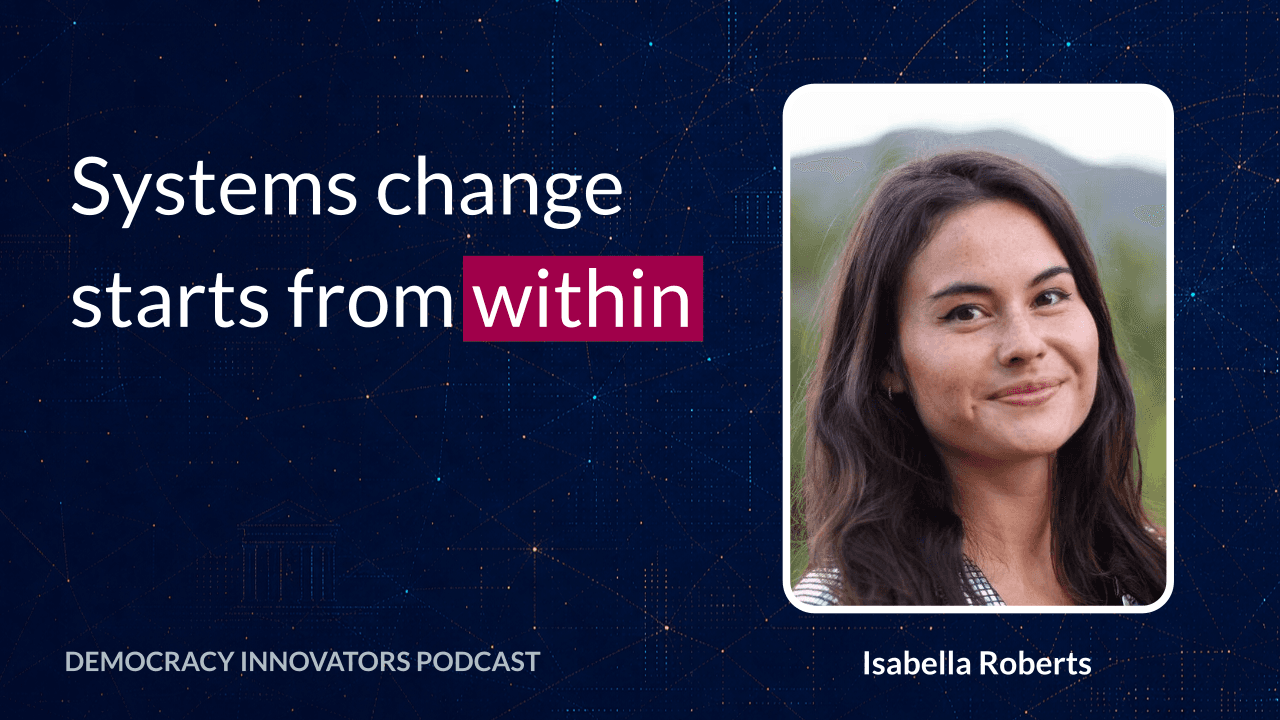
Alessandro Oppo00:00Welcome to another episode of the Democracy Innovators Podcast, and our guest of today is Isabella Roberts. So thank you, Isabella, for joining us.
Isabella Roberts00:10Thanks, Alessandro.
Alessandro Oppo00:13And, I mean, the first question is if you can tell us something about you and so personal background or also academic.
Isabella Roberts00:23Yeah. Sure. I'll try and keep it brief. Otherwise, we could be here forever. I think what's relevant for this conversation is, yeah, I came from a different background actually. I came into the democracy space with sort of full steam ahead, I would say, because I actually switched from a professional career in finance, investments, auditing, fundraising straight into a election campaign in 2021. So I left I left the sort of banking and finance industry and at the time of COVID and Boris Johnson because I was just so fed up with what the prime minister at the time was doing to our country, our democracy, and I decided to take a stand, and that was that looked like running for the London Assembly elections in May 2021. Then And after that experience, decided to retrain, reeducate myself and just, yeah, embark on this journey of inquiry as to like, you know, what does democracy actually mean? Separating democracy from politics, Even though I got involved in this election campaign that's very political about parties and people trying to win over each other, win votes, through my masters in digital politics and sustainable development, I actually focused my thesis on how can collective intelligence enhance democracy. So yeah, looking at actually other forms of democracy that's more deliberative, more collective, more direct, and that's led me to where I am now. So I've just started a PhD at Southampton University this year and focusing on exactly like deliberative democracy, but also how AI and immersive tech can enhance that, and also replicate the feelings of engaging with deliberative democracy between in person and online virtual formats. So yeah, that's that's where I've come from, so not fully academic background, but I find myself pretty much in the academic world right now. I've also worked on a couple of deliberative processes with the Birmingham Museums Trust and the National Gallery in The UK, so it just happens to be arts and culture sector, but I think it's important to note as well that even though I'm in the academic space, I have actually physically been in the room of these Citizens Assembly, Citizens Juries, so I actually do know what it feels like. So when I'm writing about and researching about it, like, I actually have this firsthand experience as well.
Alessandro Oppo02:42Wonderful. And you also... You just... Yeah. I mean, I know that you're working on a project, let's call the BoomTown Festival project. And if you'd like to tell us something about it, I know that it's still ongoing, the research. So.
Isabella Roberts03:03Yeah. Yeah. So I'm really excited to share this with you hot off the press. But, yeah, this summer I went to BoomTown Festival, which is this huge music immersive festival in The UK. It's almost like The UK version of Tomorrowland, I would say. Maybe it's the second largest festival after Glastonbury, but it's interesting because I personally have had my own journey with BoomTown. It's my fifth year going this year, but then it just so happened that the first year that BoomTown Festival is hosting this academic research tent called the Observatory, so it's a specific venue within the festival that is focused on a range of, yeah, academics doing different focusing on different research projects from, you know, like movement is medicine, the brain signals when someone's doing yoga or meditation, and then to mine, my workshop was called Dancing Our Way into a New Democracy. I ran two sessions on the Thursday and the Saturday and basically set up a mini citizens' assembly format, one hour each, each of those days, replicated the exact same design, and wanted to measure through people's feedback in surveys, but also measure through directly and objectively through these biosensory equipment that look like mood rings that you have on your finger, that can also sense the physiological physiological responses of participants, meaning you know their heart rate, heart rate variability, galvanic skin responses, temperature, all these things that our body is actually signaling or telling us about how we're feeling in that moment. So then I've also got this data that tracks in real time, like how the body is responding to that mini citizens assembly event. So yeah, really, really interesting, and it's just really cool that, you know, Boomtown Festival has its own reputation. I don't if any listeners here will be familiar with it, But yeah, it is maybe known as this. Yeah, big drum and bass, like lots of it's its own world, you know, every year of the festival, there's a storyline that progresses. And it's just so crazy that this year, it was the first year that they do an academic research tent, which is also the same year that I'm doing my PhD. And also the storyline of BoomTown this year had a little mini citizens assembly and they called it the network assembly. So there's immersive actors and performers in the festival that actually like all jump up almost like a flash dance and had this, like, sort of mini assembly on the weekend too. So it's just really, yeah, one of those synchronous moments when all these themes kind of come together at the same time from different areas or angles. And, yeah, it's great to be working on it this year. So, yeah, glad to share with you how how that workshop went. And, I can also speak to some of the findings or results if you'd like to hear that high level now.
Alessandro Oppo05:54Yeah. It's super interesting because I'm thinking that citizen assembly often they are done in, let's say, more institutional places or maybe inside the academy. And I can imagine that the festival there are, let's say, other vibes. So maybe more like good vibes. And so, I will be interested in knowing more about your findings.
Isabella Roberts06:17Yeah. Good. Yeah. Very good point. Very good point. And also, I guess that is essentially like very much a limitation that I'll write into the report findings as well, because exactly as you say, there is already good vibes in the room. So, you know, if I come up with these results saying, okay, yeah, everyone had a great time, felt really energized, buoyant, smiling, well actually if they're already in this festival environment that you know is generally positive, you know, to what extent was the deliberative event contributing to that? And at the end of the day, vibes is also, you know, short for vibration, so and actually from an academic perspective, there's this concept called resonance by Hartmut Rosa. Resonance is essentially describing this kind of vibration or this resonant feeling that you can have between participants when you sort of react and respond to each other, so that is one of these concepts that I'm really like bringing forward and looking to empirically test now. But yeah, in terms of headline findings, I think one of key results that's come out so far that's emerging from the survey data, and overall I've got about 75 participants and about 35 all the way through to a month post the festival, so I also sent a survey round to everyone one month after the festival to see any lasting impacts, but in terms of the 75 people that got involved with the actual session over both days, one of the key findings was that they have a significant increase in shared identity. So yes, sure, there was lots of sensations of like feeling refreshed, buoyant, happy, smiling, which links to this concept called kama muta and sort of intensity of bodily sensations, they also had to answer this question about shared identity by taking one diagram out of these options of like two circles progressively overlapping, so the first option, there's like sort of two circles quite far apart, and then the last option of like, you know, just complete merging of identity of oneself with the rest of the group is a sense of belonging essentially is one circle within a bigger circle. And yeah, majority of participants had a significant increase from start of the session to the end of the session. So within one hour of and it was also technically a bit less than an hour because the hour included filling out these surveys pre and post and consent forms, etc. Etc. Being in that room, deliberating, there was also some movement exercises. This group of essentially strangers, a handful did come with friends, but essentially strangers had a real significant increase in a shared identity with other participants within less than an hour. That is really important in terms of, yeah, bridging divides and trying to bring people together in a polarized society.
Alessandro Oppo09:10Yeah. I I was wondering, like, this kind of experiment is, I would say, it's a sort of... I I think I haven't read about similar experiments. So I was wondering if, you know, if there are, let's say, other experiments, maybe in places, I don't know, let's say institutional places or academic places where they do citizen assembly measuring biosensory data. It would be interesting to know, like, a sort of comparison between what happened when there are a certain kind of vibes. So we said that the vibes changes a lot in comparison to the places. So I was wondering if you are aware of other similar experiments, let's say.
Isabella Roberts10:04Yeah. No. Good question. There are some experiments in a festival setting that just looks at sort of shared identity and collective participation in a festival setting, but then separate to deliberative democracy. In terms of the deliberative events that, you know, I've been a part of and the other reports from other citizens assemblies in sort of UK and Europe, yeah, definitely not hooking up to any biosensory equipment, so they're not tracking bodily responses at all, but they do do participant surveys for sure, mostly asking questions about, yeah, enjoyment of the process, and that's usually quite high. So I think we already know that people enjoy the process, but the more sort of specific questions around, yeah, like belonging, shared identity, lasting impact, so actually they ask at the end of the process, but not many of the organizations will follow-up one month later to ask like, how are you still feeling? It's kind of like, you know, job done, write up the report, now let's bring the outputs and recommendations to the next level, and don't really tend to follow-up with participants a month or some time later to ask how they feel, and I think that's important especially for, you know, the ripple effects if we want this deliberative movement to sort of grow and spread. And then in terms of the biosensory data in general, there was actually one recent study that looked at the physiological sensations and viewing artwork actually. So similar equipment has been used to sense like, okay, how do people feel when they're like viewing original pieces of artwork versus copies, and then that has impacts on, yeah, like the nervous system and sense of calm, relaxation, etc. So yeah, I'm really drawing from various fields and studies and applications to bring this project together, and I do think it's yes, it's definitely something new in the deliberative space. I think the next phase though, when I want to look at comparing these sensations to deliberating in a VR or online environment, there has been a couple of studies of deliberative democracy or deliberations in VR. But again, not really looking at how people feel about it. They've just run some deliberations in VR, but not necessarily focusing on the participants feelings and sensations about the actual participation itself.
Alessandro Oppo12:27And I was thinking also about the difficult in analyzing the results because sometimes maybe you can produce a report, let's say, five minutes after the citizen assembly, you know, with AI and these kind of things. But then to really look at the outcomes, because as an example, it could be that some people become friends and after five years, maybe they organize as a political movement, but all of this is out of the view of the researcher. And so I was wondering what could be the next steps of... Yeah. In how to find the... How all the process worked and how yeah, because you mentioned that these are some preliminary findings. So if you have in mind how to continue the research.
Isabella Roberts13:23Yeah, no, that's a really good point. So, I mean, in my project or in my study so far, it has already shown that the feelings in the body are and the intensity of the bodily sensations is more of a greater indicator and tied to the lasting impact that the process had on people. Yeah, based on the questions they asked, the results, and who responded a month later, and how they responded, and you know that really just speaks to that saying. Think it was Brené Brown who said, you know, people always forget what you say, but they'll never forget how you made them feel. So that just shows that actually you might not remember exactly like facts, figures and names, but you just remember a feeling that you had when you were in that room or when you were talking with someone, right? The feeling or the vibes that someone gave you. So that's really what my research is really trying to like measure and make real empirically and yeah, something that we like to call, like, something called that the magic in the room of deliberative processes and making that corporeal. I think it's a really weird word I've just learned recently, making something that's pretty abstract and intangible into something like real and measurable essentially. But in terms of, you know, you touched on something there around, you know, lasting relationships and friendships of participants and like kind of tracking that, you know, post the event, and I think that is actually something really, really valuable and actually less. Yeah, less done in this space. And it but it's so valuable because exactly it's memorable. It's also it's all around storytelling. And I think as humans, we remember and pass on knowledge and memory and inspiration through stories, right? Like intergenerational, we've been doing that for generations. So and that's why the most famous one of the most famous stories of deliberative assemblies comes from that Irish assembly in the case of, is it Chris and Finbarr, when it was a, you know, deeply homophobic man, actually changed his view and his mind and opened his mind up to actually agreeing with and accepting same sex marriage when he heard the story of a gay man in that assembly directly face to face, know, heard of you know his struggles throughout life and that face to face empathy and storytelling yeah, made made him change his mind about some really deeply held views, and they did become friends. But that story came out in a sort of journalistic article in some, you know, maybe some more local newspaper. That's not necessarily something that's captured usually in the official or formal, like, Citizens Assembly reports. And I believe it really should. And actually, yeah, like, you know, during each of these events and even in the pre design and preparations, we should we should be really ready to capture these stories because this is what people remember and people can share to again spread the message of citizens assemblies and why they're such a good thing and why they're one of the key instruments and models for bringing disparate groups of people together and yet again bridging divide in society. And I think one key reason why it hasn't happened so far, to be honest, on a practical level, is it's pretty much to do with budget, you know, like delivery organizations are commissioned to deliver this event, write a report at the end of it. And so if we pre design in the budget and include in the budget at the beginning, okay, like that we want to have this follow-up post comms sort of community building and sharing of the message of what came out of the Citizens Assembly, that would make us much better prepared and make sure that we don't just let the event and all the amazing things and transformations that happened in it to just fizzle out. Yeah. I also really like citizen assembly as a as a tool because
Alessandro Oppo17:15compared to the different civic tech tools, I mean, every tool and every practice has, let's say, its own reason to exist. But I really appreciate when people can talk to each other, let's say, in real life. And then technology, it's a sort of assistant and not really the entity we have to deal with. And I I was wondering, like, because of your experiment with citizen assemblies, if you... I don't know. On one side, if you have any criticism about how the... I don't know if you think that maybe something different should be done as an example. I don't know. Running citizen assembly in places with good vibes. So it could be like a park instead of, I don't know, a room inside the municipality office or something else, like if you have any thoughts about this.
Isabella Roberts18:16Yeah. Love that. And I'm sorry if if there's any change of location and sound in the background because I'm just getting bitten to death by my husky puppy and hoping he doesn't continue. But that's a really good that's a really good point, really good idea. And actually, where physically hosting something like a citizens' assembly in a park or a festival is okay, is less practical in person. That is something I would love to recreate in the VR phase of the next part of my study. And yeah, anyone watching on the video can see my husky pup bear make a little cameo. So I yeah, I think I think the environment and the space, as you say, as you already intuitively picked up on, is super important for the sort of, yeah, this magic in the room, the gelling and the connection and just those feel good vibes of like the participants actually coming together. You know, I've definitely been in some rooms or venues or forums where, you know, it's maybe it's quite clinical, it's quite grey, it's not it's the opposite of warm, you know, and also the acoustics really matter, like people struggling to hear what speakers are saying in the back of the room, things are echoing, and all these things to do with physical space. Again, yeah, that is definitely criticism that I don't think that is really prepared or designed much for in advance. But I think also again on a practical level, because until you have the 50 participants in the room, how can you like test for that? You know, unless you get, you know, 50 staff members to just fill out the room and be like, can you hear that in the back? So I think there's a lot of stuff that is unfortunately just by the way things go has to be left for that moment in time. So yeah, there's a lot of things to do with the physical space that I would improve with the citizens' assembly process to just basically make the experience better from an embodied perspective. But otherwise, there's there's a few more just more general criticisms of citizens assembly model that I could say as well. If at the end of the day, we want them to come up with, you know, good decisions and better decisions. And that's one of the main criticisms from the outside. You know, how can you trust ordinary people to make decisions on your behalf? Obviously my argument or rebuttal there would just be like, well, do you think these politicians are any much more knowledgeable? It's all about lived experience. It's all about being able to listen and listen to each other and yeah, come together for this collective decision making. But there is something around knowledge management of the process. So like all the, all the inputs that come from the participants, everything that comes from the experts, there's something around the actual, like maybe the note taking and the transference of what participants are saying and contributing to this discussion and what actually comes out at the other end. That funnel of knowledge management, I think needs closer and needs a closer look at. And that's from my experience of doing a couple of independent evaluations now, you know, because especially if there's no digital tools actually being used to record people's voices, and you've just got these like small tables and a facilitator like furiously scribbling down loads of notes, there's a lot that gets leaked, right, From what have been said around the table and what's actually ended up on those scribbled notes. And then those notes are then consolidated by hand or by the facilitators in person to come to the final summarized sort of report or output there. And again, there's all these tools now, even if it's a simple mp3 transcription tool, there are a suite of DeliberTech tools that you know you're aware of working with for the SAFE DeliberTech project, for example. So yeah, these tools exist. They don't cost much because you know they have their heart in the right place as well and even in their startups they're much more willing to be applied for free or near cost basis. It's just about, yeah, these facilitators or delivery organizations to open up to these tools and kind of, yeah, not so swallow their pride, but just be open to adopt this new technology and not be too scared or anxious about it because we need to, yeah, evolve or die, basically. And I think that would really help with the knowledge management of these processes.
Alessandro Oppo22:45Yeah. I I think we should not be scared about experimenting in the... In this field because many times I I ask myself why people participate or they or why people do not participate in their political social life. And, yeah, I think we should find, like, the best way so that people feel engaged and also they feel like they're doing something that they like. So I don't know, meeting new people, talking to people. And and, yeah, before you mentioned also the SAFE project and because I know that you also work on other projects. So if you'd like to to tell us something.
Isabella Roberts23:29Yeah. Sure. So SAFE, it's got two a's. It's an acronym. So s double a f e. That stands for space for silent contemplation and reflection, active listening and feeling heard, ability to change one's mind, feeling connected as part of a whole, and then E is epistemic growth, epistemic humility, and these are the safe principles that I've been working on and actually co developing with a handful of DeliberTech developers, so the founders of these DeliberTech tools such as Deliberate, Dembrane, the Stanford deliberation platform, and also another one called PSI, PSI. We've got a handful of them together alongside about five democratic practitioners or facilitators also from across UK, Europe, US, to get involved in a series of workshops last year, through each of those SAFE principles in turn, and just really going into detail in ninety minute workshops, as well with post surveys, etc, as to, okay, you know, why exactly is space for silence, contemplation, reflection, important in deliberation? How do each of these tools currently allow for that? And I think that first principle is quite difficult already to even think unless you'd use like a pause button or because especially in a world where, yeah, all these digital innovations or civic tech is all about speeding up processes, making them more efficient, you know, Technology is essentially making everything fast forward, right? So this first principle of like silence, contemplation, reflection, pause, taking breaks, space for silence is actually kind of reversing that trend. And that's why these are also called human centered principles because, yeah, I believe that actually doing things slowly, slowing down, pausing, reflecting and meditating is a very conscious thing that like only humans can do and not AI. So that's why these safe principles are super important when we're adopting more of these AI powered DeliberTech tools, especially when they're being adopted to scale and speed up processes. We want to make sure that, okay, if we scale and speed up these processes, how can we retain the humanness, all that stuff that we've just been talking about, about the human interaction, human connection, how can we still retain that even though we're using these tools online or in hybrid processes? And to be honest that's why, so I did that last year. It also came from my Masters for Digital Politics Masters, as I mentioned, that was I guess a couple years prior, so it has been this kind of progression, you know, of my personal journey as well as how the world's been moving and changing. And I would say that the PhD project I'm focusing on now with like embodiment, magic in a room, this Boomtown festival study is probably really drawing or lifting specifically the F of SAFE, so like feeling connected as part of the whole, like that's maybe like the main principle that I'm now taking forward into this next phase of my work and study. But yeah, SAFE DeliberTech is still is still out there. It's still there. It's still alive. You know, it's open to be refined the more it gets applied and the feedback that we get. So the website is there, like the diliptech. com, and essentially, yeah, any of these deliberative processes that wanna use any of these DeliberTech tools, just get in touch, and then we can help at the design phase of, like, how to ensure that when we're using these tools in these processes, like, to use them in a safe way.
Alessandro Oppo26:56I I think you touched an important point that it is, let's say, collaboration in the civic tech field or political tech field. And... Because there is a lot of collaboration at the... But at the same time, maybe we could also collaborate even more. So what are your thoughts and experience in relation to this?
Isabella Roberts27:22Yeah. No. That's... Yeah. Thanks for picking up on that, Alessandro, because for sure, like, in the tech space, usually, it's very competitive. Right? It's very, like, cutthroat, dog eat dog kind of world out there. But, yeah, from the start, you know, the DelibTech tools that I convened for this SAAFE DelibTech project, super collaborative, super cooperative, very open and transparent, you know, they're each giving demonstrations of features and maybe upcoming features, beta features that they know that's still in the works and sharing that with other tools that, you know, essentially or ultimately are somewhat in competition with them. But actually, it's about leaning into each other's strengths, giving feedback that helps the wider cause. And actually, there's nothing to say, and this also came up during workshops, that there's nothing to say that a single process can use more than one of these tools at the same time for different phases that suit it best. So, you know, for example, deliberAIde could be the sort of background backend operational, just dashboard that helps to like store most of the files and the notes, and it's basically used mostly by the facilitators of the process. And then Dembrane is the one that's more front end on the table, listening to participants and feeding in all the inputs and contributions of participants into that backend dashboard that deliberAIde is operating. So, no, it was really it was very, very conducive and positive in that sense, you know, but then I guess as the years have gone on, I mean, it's probably like a year and a bit now since those workshops and since we've been we used to catch up monthly again, that's kind of fizzled off now as we've all moved on to different things. And we've still got a group chat there, you know, but when there was like some seldom funding grants, I think maybe earlier this year, you know, we just share these opportunities with each other and kind of catch up as well. Like, oh, how did everyone do? Did anyone get it? You know, so it's still very the attitude is still very collaborative, but maybe it's just fizzled out at the moment in time because, know, at the end of the day, you need someone like aka me or someone else to keep that group together and keep that glue together. But unless you have a active community manager in that sense, people just end up going off and doing their own things. But it was a really, yeah, really inspiring sort of effort from all of them I would say, and hopefully, I don't know if there's any other initiatives similar, but I hope that that kind of, yeah, approach continues with the other with the other tools.
Alessandro Oppo29:55Yeah. And I remember also the ANTIPARTY project that is Oh, yeah. Yeah. If you'd like to tell us something because... Yeah, I mean, I could say something, but it's better if you say something by yourself.
Isabella Roberts30:15Oh, yeah. Oh, no. Yeah. I mean, if you... Yeah. If you wanna... What you... I know you have thoughts about political parties and everything. So if you wanna start with your angle and I'll see how ANTIPARTY can fit into it maybe. Yeah.
Alessandro Oppo30:27I mean... Yeah. Because I mean, now technology is being used by, I mean, most of the people. And we can see society, institutions, politics that in both in an informal way. So people just... I don't know, politician use WhatsApp or another tool to communicate. And also from, let's say, formal point of view, we see digitalization happening all around society, digital transformation. And, I mean, technology now could allow a lot of people to discuss, decide. And so it is possible now to do what it was not possible to do, let's say ten years ago or twenty years ago. And so I was... Yeah. Many times I thought about how political parties could evolve or maybe we don't need political parties. You can just have citizens that communicate with institutions. Yeah. But all of this is... All of those are, let's say, open questions, and they don't have clear thoughts about it. I mean, I have some thoughts. Mhmm. But, yeah, I was curious about yours one.
Isabella Roberts31:51Yeah. And I'm just trying to find the stat now because you picked up on it. So I think it's... Yeah. So a survey of over 1, 000, 000 people showed that only 1. 9% of these one over 1, 000, 000 people, only 1. 9% chose policies that fit within a single political party. So that's in The UK. I know you're based in Italy, so it's a bit different, but yeah, within The UK, you know, party membership is down, people's policy preferences don't even fit into a single party, we have a voting system that spits out this, you know, two party result each time, it's a pendulum swinging each election essentially. It's totally, yeah, it's totally defunct, and so that's why I created this movement called ANTIPARTY, which ruffled a few feathers even in the beginning. I think people were just so even at just anything that's like anti or whatever, like can also create quite strong reactions interestingly enough, but then even people who or groups that say that they're apolitical or nonpartisan, and I would have thought that anti party is within the same category, but apparently not. Still, we were still kind of sidelined from those groups. But it's yeah, what you just said as well about if citizens can make all our decisions directly through all these platforms that's available now, all these digital tools that's available, convening and collectively deciding with models such as citizens' assemblies. It's very, very possible, and I totally believe in that vision and that's the decisive system change I'm working towards. Think I one of the key hurdles, though, is really just raising awareness of what else is possible, you know, and again in The UK, there was that recent poll that was it was since been kind of picked apart, but the headline at the time before it was picked apart was that majority of Gen Z preferred dictatorship to a democracy. And that's because in that survey, the alternative to what they defined as democracy, which is simply the voting for the next politician model, of course, they're going to pick a dictatorship because they're like, they're so fed up with the current system, the current way things are, that they think the only other alternative is a is a benevolent dictator. And it's like, well, actually, there's a few other things in between that, aka deliberative democracy, the citizens' assembly model. But if people don't know that, they're not going to know to pick it. And then the survey, which is also very prescriptive in the options it gives you, right? That's why things like voting, referendum, I think are very blunt tools, because they only give you set prescribed options, whereas in a citizen's assembly, it's open, it's generative, anything can emerge in that space, and it's a much more safe and controlled space in terms of the information and the environment that you're deliberating and deciding within. Apart from, again, which is different to the Wild West that we're currently in normally day to day with social media, fake news, algorithms, and that's the current Wild West information environment that we're currently doing making decisions on referendum and voting. So people need to be aware that these alternative models exist in the first instance. So yeah, think it's down to the whole space really to just spread that to spread that awareness. And I think, know, for me, like a key key indicator of success of, like, all the work and research that I'm doing is that just if the average person off the street, taxi driver, someone I meet if in the smoking area of a bar or whatever knows what a citizen assembly is and they are really keen to take part in one sometime. To me that would be that would mean, okay, great. We're finally living in a world where this alternative and I think better system is is really becoming a reality.
Alessandro Oppo35:38Yeah. And before when your dog wanted to say something, I can suppose I can imagine that he wanted to participate in the conversation. It made me think about an interview I made to Alice Casiraghi, that is a professor in Milano. And I don't remember exactly, but I remember she was saying something about maybe we should also include animals in the conversation about what they want. Mhmm. Like in the... And of course, we cannot ask them to participate in a citizen assembly, but maybe there are ways to, let's say, involve them in the political life because it happened many times that in history that we do not include a group of people in the decisions. So it could be people with a different color of the skin, could be different religious group, or it could be... It happened the same with women. And so maybe in the future, we will include those animals and we will ask their Yeah. Sort of feedback from from them.
Isabella Roberts36:53Yeah. That yeah, that would be really cute. I mean, there's a there is a conversation about sort of non human, including the non human into, yeah, deliberative democracy or in the in the new democracy, and that includes, you know, things like rivers and natural phenomena as well, so like whether it's like rivers and trees and things. I mean, yeah, and like you say, even within humans, there's been groups that's been excluded, there's languages that are also potentially excluded, so there is a lot of criteria to even communicate smoothly amongst smoothly and fully and accessibly and fully, right, between the same species of us humans. So I mean, yeah, I mean, I smile and obviously I'm an animal lover and I do also love nature. So on a theoretical level, like absolutely would love to do that. But do I trust humans to translate these non human sort of messages or needs, you know, in an unbiased way without their own agenda of whoever's doing the translating into the assembly or into the conversation? I don't know. I'm not sure if I trust humans to do that, to be honest. So unless we get a new technology or something, or I can experience firsthand myself some sort of like, you know, psycho transmission through some sort of transcendental meditation of like, yeah, what, what these non human entities want. Yeah, I'm not sure I would, I would be so trusting of humans to do that.
Alessandro Oppo38:29No, of course, because then it will be also representative democracy in a way. So where a human is representing a lot of dogs. Okay. I wonder, like, if we ask their dog, would you prefer, like, at the supermarket there or a public park? Then maybe we can imagine, like, the reply. And yeah, but of course also this is an open question about if and how to include the non humans, but I think it will be interesting.
Isabella Roberts39:07Yeah. Maybe you can speak with someone from that space in your next... Yeah. That'd be great.
Alessandro Oppo39:12Absolutely. And at the beginning, were talking about when you did your research, when you, let's say, also changed your, let's say, your career because you said that you started working on democracy later on. And and you said something about what democracy actual means, and so I was wondering what is for you democracy?
Isabella Roberts39:43Yeah, thanks. It's a yeah, it's a really good question. I think everyone should be asked that question as well at the beginning, especially because we can all start talking about something usually, but in our heads be interpreting a very different thing. So to me, is about everyone having a say, everyone having a voice, and being able to contribute to decision making, and also that opportunity to contribute being fair and equal amongst everyone, so just everyone. At least everyone that's able to vote, so obviously there's age limits there. And essentially, and I know that there's this whole thing about having to having the ability to make decisions on issues that affect them, but obviously in the representative model and also with the citizen's assembly model, people might get called to a citizen's assembly on an issue, maybe it's same sex marriage, that doesn't directly affect them, but you are still making these decisions or contributing to the decision on behalf of what you think is best for the rest of society, the rest of humanity. So yeah, it's being able to just essentially have a say and be able to contribute to that, and also trusting that other people like you will have you in mind when they go and do that on your behalf. And that's why I do my I believe that the direct deliberative model where people are randomly selected and they they step up with their own lived experiences and their own, you know, their own stories, own ups and downs in their own life, and everyone's lived through a myriad of things, when that's why they I think have a much more richer experience to contribute to these decisions as opposed to career politicians who, for example, the standard, you know, went through school, went to uni, started working in parliament, you know, got, you know, got elected, become the Conservative politician, and it's all about they focus so much of their time and energy on gaining and retaining power. So the moment we remove that, the moment we remove this sort of like hunger for power and for keeping hold of power, and you just strip it back down to just like the everyday normal human and individual, I think the decisions are going to be much more rich, much more empathetic and compassionate. And also, again, you strip away the party whip, so these politicians have in The UK anyway, part of the system, or we have this whip system where these politicians are essentially being whipped into saying top down what, yeah, what they should, what they should say, what they should vote. So they're not even actually voting with their own, you know, conscience. They are simply following what the party line tells them to do. So if you just strip all of that away, then, you know, we're going to have much better decisions on behalf of the rest of society.
Alessandro Oppo42:42And how do you imagine like society, I know it's hard to reply, but it's like, I don't know, in five years, ten years, twenty years, Are you, let's say, optimistic, pessimistic? Is there something you would like to see? I mean, I can imagine that you would like to see more, I don't know, citizen assembly or, like, people talking to each other. But yeah, if you have a sort of image of how society could be or should be.
Isabella Roberts43:18Mhmm. Yeah. I mean, so I mean, maybe just bringing it right back round to, you know, festivals. Right? I mean, I did this BoomTown Festival experiment study, but I also go to other kinds of festivals. So there's sort of these more, yeah, musical, but more spiritual and like non alcoholic. They call them like, you know, kind of higher consciousness wellness festivals in The UK. Medicine festival is a big one. Soul Revolution is a really promising one. I went to the first time this year as well. You know, then so with Soul Revolution Festival, for example, next year, their theme is The Rising. And there's a real opportunity, I think, when people go to these sort of spaces where they're, yeah, again, there's good vibes. People are working on themselves with each other in a safe, natural environment, you know, yes, literally surrounded by nature, grass beneath your feet. So it's a very embodied experience, but it's also facilitated and safe and spiritual. It doesn't have to be religious, but it's spiritual. We all have a soul and a spirit. I believe we all have a conscience and we all have a consciousness, but not everyone has the opportunity to get in touch with that. And so these spaces are great opportunities for individuals, for every single person to get in touch with that in their own way, whether it's breath work, sound healing, a dance movement workshop, all sorts, and some of them, yes, they draw from indigenous wisdoms, etc, and they have people coming from all over the country to bring their cultural spirituality practices as well. So you'd really just go, you get to go and get drawn and pulled towards whichever feels right for you. And we all come from different backgrounds as well. So what appeals more to you might not appeal to me. For example, there was a fire walking exercise, you know, at one of the festivals or like a hapé thing. So, yeah, it's it's a really, really enriching experience that I think, you know, to day in our lives of like work, study, you know, just this like constant churn of survival and, you know, potential routine, you know, everyone's day to day lives. It's an amazing intervention to go to these kind of like festivals or even retreats, you know, any time of the year, there's retreats that you can go on for like a few days or a week again with all their varying styles. And so I would really invite, yeah, everyone to enter these spaces or take the time and space for themselves to really get in tune with that inner world, to then be able to enter the outside world and contribute to the wider systems change from a place of more groundedness, more self awareness, and hopefully a more empathetic and compassionate place. And I think that also brings in this phrase that I came up with with the anti party launch party a few years ago at the same time as the last general election in The UK. But the phrases like systems change starts from within. So you know, before we enter these phases, whether it's a citizens' assembly or whether it's even like, you know, a protest march or just any sort of democratic engagement, you would hope that we as participants, as citizens are, you know, already self aware and sure of ourselves. We know where we're coming from, and therefore we're also able to hold space, be kind and compassionate to other people as well. Because I think at the end of the day, a lot of the issues that come up in society that's about, you know, othering, hatred of other groups, blame, fear, excuse me, that all comes from some sort of disturbance and something's triggering you from the inside, you know? So the sooner that we identify and deal with that, then the sooner our outside world will respond to that in a more positive way.
Alessandro Oppo47:17Mhmm. And I have still a couple of question, and I was thinking both for the field of politics and both, and also the field of technology, there are more males than female. And and also at the intersection of technology and politics is maybe even more in equal. So I was wondering, like, what is your experience about it?
Isabella Roberts47:54Yeah. I mean, I came from a already male dominated environment with finance. Right? So it wasn't really a big surprise to me. And also when I ran for the London Assembly, I was the only and youngest female... Youngest person. I'm the only female in that whole party, and there was an independent party at the time. So, yeah, you know, did I feel like I could really connect with my other teammates, especially when at the time, the Sarah Everard case here in London of this girl being kidnapped and killed by a serving police officer that was erupting at the same time as the election campaign. So as a solo female living in London at the time, you know, I'm reading and hearing about this. She was missing for ages and news was being coming out as the days goes on about, okay, now she's found who did it. Oh my God, looks like a police officer did it. It's a very scary time. Meanwhile, I'm exposing myself out there on this campaign trail saying, you know, vote for me and I'm opening myself up to all sorts of criticism and stuff at the time as you do, as any people running for, you know, election does. Did I feel like safe and supported by the rest of my team members? No. Would it have helped if there were other women or females in the team, in the party? Yeah, for sure, because then they would understand where I'm coming from and they'll understand the woman's experience. I have noticed that it is a shame because, and you know, I don't want to stereotype, and actually from my BoomTown study, the findings so far, there's no distinction between male and female. I actually did push back a bit with my supervisors in the beginning about collecting gender data in the beginning, because I'm just looking at the human experience, the embodied experience, you know, against AI. And so for me, it's human versus AI. It's not about genders between each other in the in between humans. So but in the end, I was like, okay, whatever, I'll just put it on there. Obviously there's lots of different genders and options available now, but essentially high level though, we had a very mixed we had out of the 75 participants overall, very mixed group in terms of gender, but so far like no split in the findings of the physiological sensations and the impact on people between genders. So that has no impact. But in terms of like, you know, why there might be less women. Well, maybe I can't really speak to why there's not as much women in this space, but I can speak to why it would be good to have more women in this space. And just as a very high level example, I was going through a UK Select Committee minutes document just the other night, and there's three people from the democracy space reporting on that, two guys and one lady. And the two guys, their sort of, you know, contributions and statements were very much, you know, why something would be better, how to do it better in a very practical sense and, you know, positives and minuses, that kind of very, yeah, very logically setting out the preferred route. But then it was actually the lady that brought up things about like education and awareness. And it was actually her that brought up these very like much more subtle between the lines. And I guess again something to do with actually taking into account like humans sort of lives and experience and feelings and experience of what's being proposed or what's happening into account, you know, and so again, I don't want to stereotype and say that, oh, you know, men don't take into account emotions and feelings and women do more. But if we do need to include, we need to include more women anyway. We need to include more more consideration of these factors, especially if we're talking about like the digital democracy space and everything is becoming more mechanic, you know, autonomous, etcetera, etcetera. And yes, at the end of the day, I am a female, I'm a woman, and is it any surprise that my research is all about, yeah, like feelings and experience and embodiment, because that's a big gap that I spotted in the literature so far and in the research so far, and that's what I'm trying to reverse or refocus to balance everything out. Know, everything's about balance. That's why we have men and women and the yin and yang and all these things. So yeah, we definitely need to bring to bring back balance. And it's also no surprise that when I am doing my readings, a lot of the key literature that I am drawing from, you know, there's like Donna Haraway, like cyborg feminism, Amanda Machin, like bodies and politics. And there's one other lady, I'm going to remember her later, but like, you know, the key readings on sort of like embodiment, feelings, yeah, empathy. There's like Lala Muradova here at Southampton University. It's it's all women contributing this stuff, you know. So, yeah, hoping to just add to that to essentially just make sure that everything is as balanced as possible.
Alessandro Oppo52:54Yeah. Thank you. Also, because I think it's important because if it happens that, I mean, if with technology and new practises, we can create a sort of, I don't know, new political system, social system, then it will be nice to hear every voice. I mean, not just inside the citizen assembly, but also people that organize and also different contribution and different attention to what people say. So I think it's very important this... And if you have a
Isabella Roberts53:32And isn't the first computer programmer like that Ada Lovelace? Like wasn't she like the first, right? And she obviously, she was a lady and she came from a very different background of sort of humanities, she was the daughter of that famous poet. Right? So I think also even within history, there's a lot of examples where women have contributed a lot to the development and design and the leaps that this technology has had to get here. But then it's just a shame that now, yeah, most of the digital democracy or, you know, civic tech space tends to be being run by by men. So, yeah, let's see if we can shift that.
Alessandro Oppo54:17Yeah. I I've read recently Zeros and Ones from Sadie Plant, and she was also telling about Ada Lovelace history. And also it was interesting that she was comparing like the, let's say, art of... Is it weaving? Like, when you produce fabric, is it like... Weave. It is basically an weaving. Yeah. That is very similar because at the end, there's a sort of network of different threads. And so she was comparing it to, let's say, to the Internet and and there were different parallels to technology. It was quite interesting. And I have the last question that is about if you have a message for all the people that are working in the field or in different parts of the field.
Isabella Roberts55:22Yeah, I think, you know, in line with the themes that we've touched upon in this conversation. Yeah, my like, you know, kind of key message or invite to others in the field, anyone listening, is to have a think about what sort of embodiment practices have you done recently or can you do to basically get in touch with your physical experience of your body in this space? And just remember that we are embodied beings and we have more than five senses. Right? It's not just everything that's going on in our mind, and just really, yeah, bring yourself out of your mind, back into your body, into your heart space, into your breath, into your lungs. I'm gonna stop there before I do my whole like Breathe with Bella meditation spiel, but yeah, even if that's a five, ten minute meditation first thing in the morning, going to an ecstatic dance event, there's loads around London, I'm sure wherever you are in The UK, you can find something that find a sound healing event, and I would just really invite you to try out one of these potentially crazy woo woo experience workshops and just see see how you feel and just be really really aware of how you feel and how it's shifted anything inside you.
Alessandro Oppo56:40Thank you a lot, Bella. Really?
Isabella Roberts56:44Yeah. Thanks, Alessandro. Thanks for your questions. We've gone through so many deep things.
Alessandro Oppo56:50And if you want to add anything else, otherwise, I close the
Isabella Roberts56:54Oh, pressure's on now. I would just say, well, maybe even just after listening to this, let's just say, after listening to this, just just take one minute in complete silence, focusing on your breath and just see what emerges and just be really, really present in the moment. Enjoy. Thank you. Thank you.
Discussion
Continue the conversation
Loading comments…