Automatic transcription, it could contain errors.
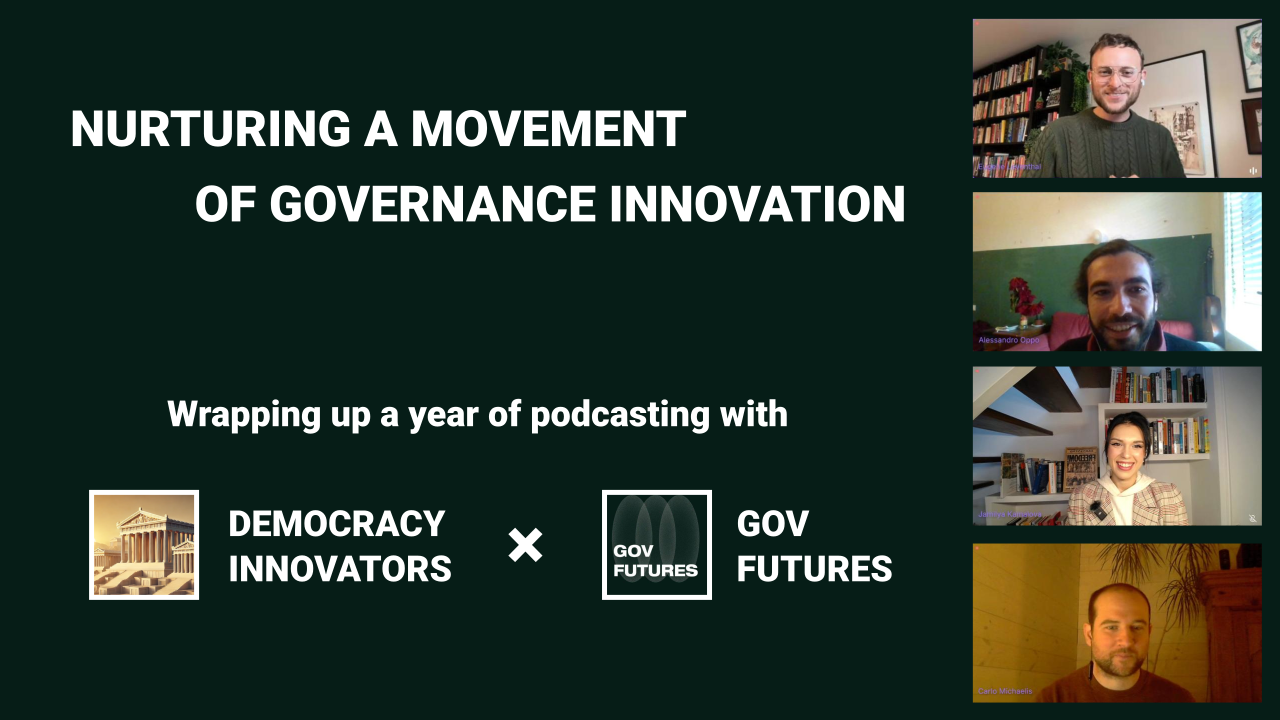
[0:01] Eugene: today is december 11 and i'm very excited for the conversation we are having today it's a little podcast crossover livestream action we got going on where we have alessandra and carlo from the democracy innovators podcast and jamila and myself from the governance futures podcast we realized earlier in the year that we were both in same kind of meta dove and governance related circles and yeah i know when alessandro when you reached out and i checked out your podcast i got super excited i'm like oh my gosh these are very much some of the conversations i hope we were having and yeah it just seemed like a no brainer for us to at least be friendly and i'm glad that you know it's gotten to this point so yeah really excited to get to kind of present both of our podcasts and what we're working on what we're all about and then just have kind of a discussion reflecting on this year why we started what how what we feel we accomplished or where we got to this year and kinda look forward to what are the kind of conversations and dialogues we hope to be part of and to seed or nurture next year and then we'll show off a little tool because we also think conversation is great and we love hanging out with with other governors such as ourselves but at the same time we also feel like you know there needs to be some kind of action and tangible steps to do so this is just a small attempt at doing that but yeah i think we can just go ahead and and get right into it and yeah alessandro if you don't mind kicking us off with kind of a brief you know introduction how do you present yourself and what you work on and you know feel free to take a minute or two and even just get right into like what was your journey getting to where you are as well so yeah alessandro please
[1:48] Alessandro: thank you eugene for your kind introduction yeah my name is alessandro from italy and with carlo i'm doing the democracy hosting the democracy innovators podcast that is a podcast that started more or less one year ago and my background is actually in history and computer science so i thought that in some way was fitting for this podcast and i'm very interested by the intersection of course of technology and politics and yeah i was thinking also recently why and when we started the podcast like because me and carlo we met we actually never met in person but we met because i saw his advocacy project and then we got in touch and we we had many calls discussing about what could we could do together and and then yeah we started the podcast and yeah i don't know carlo if you want to say something also
[3:01] Carlo: yeah i can i can add in here so first i'm i'm also like really excited to have this collaboration because it feels like we're coming here together and with a kind of same or very very similar journey and and goals this is really cool to have this together and like my like i'm originally actually from germany but i'm living in sweden for i think four years now already and my background is a little bit diverse actually in a in a sense so i studied psychology but i also studied physics i studied statistics and i did my phd in computation neuroscience and then somehow switched to collective intelligence research in a way this is mainly caused by i i felt like all my life through all my life that's like making democracy more efficient is a very important topic which became just much more important and at some point i decided to kind of switch and focus more on this which was actually also like fueled kind of by the fact that we had a project and some idea running already for a longer time that i'm now focusing on and yeah as alessandro said like we're we we met at some point as as alessandro said he he contacted me and then i think for like nine months or so we were just in lose contact meeting from time to time i think it was like to say it actually in kind of alessandro alessandro's words we were i think at the the at the same place at the same time with a very similar in a similar status of our path in a way both kind of starting looking like what what direction can we move on and yeah after some time we identified that this podcast thing would be a cool combination while it's a little bit different like in your case eugene and and you know it's it's like for us more like alessandro is doing the interviews i'm doing all the background work like i'm doing the thumbnails contacting the guests making sure that they're happy with the titles and thumbnails and stuff like this and and also i'm i'm also listening to all the episodes doing the chapters descriptions linkedin posts and stuff like this so i'm a little like we have a little bit shared tasks in a way but this works quite well so so far we're very happy with this yeah i think that's for now from my side
[5:14] Eugene: yeah thank you so much and i will just quickly comment as you know as fellow podcasters so many folks don't realize all the invisible work around it and granted it's gotten easier year by year especially with a lot of the new tooling but if you haven't tried it yeah feel free to and you'll be so pleasantly or not so pleasantly surprised by all that additional labor around it as well so yeah yeah very much makes sense to have the kind of split that y'all were mentioning but to kinda keep the intros going jamila do you mind hopping in and yeah telling what you're up to and kinda how you got to where you're at
[5:52] Jamilya: too sure thank you so much so i don't know i was thinking recently it's actually next year is gonna be ten years since i'm in crypto i feel like i'm an absolute dinosaur and it just feels surreal i don't know if it's a good or bad thing that i've actually never worked outside of crypto i don't know i mean i did have a bit more corporate experience but again i was i started as a lawyer and i was consulting on crypto projects so then i tried myself in research and i'm still doing my phd i worked for some time as governance facilitator and now i'm in the more project management side of things at sky and yeah it's it's it's crazy it's interesting it's chaotic i wouldn't trade it for anything i still have troubles explaining to my parents and my relatives what i do but most of the time it's so exciting and i feel like yeah i just found so many like minded people and friends and one unique feature about our field i guess is that you know i just get to meet my friends all around the world throughout years in different locations but just the ability to exchange ideas to kind of feel like oh my god actually i'm not a weird one there's so many other weird nerds that are also sharing some of my ideas or sometimes challenging them which is also exciting and personally yeah i just have a lot of things to thank like crypto community and just so many learnings that i've taken throughout those years but yeah ten years it's it's actually quite crazy i've seen some drama in many dao spaces especially but if anything it only reinstated my desire to continue growing and working in the space hopefully contributing to something good i love seeing people coordinate like human coordination and just like solidarity and you know coming together for some shared purpose to you know to do something great together is is just so inspiring and it could be as small as just you know some i don't know some very local grassroots initiative to something like bigger and ambitious but just seeing people coordinate work together regardless of their backgrounds regardless of where they come from is just so inspiring to me so yeah it's messy out here but i love it i wouldn't trade it for anything so yeah what about you eugene how how did you how did you yeah manage to stay in this place for so long i also know that it's definitely not not i don't know how long have you been in this space but same in my institution for yeah
[8:30] Eugene: yeah ten ish years yeah i think i at some point i looked it up and it was an intern at a previous employer when i was still in the corporate world i was like hey have you read about this bitcoin thing like i think this you'll find this interesting and yeah it still took me a few months to actually get there but it was yeah roughly end of 2015 when that initial putting it on my radar happened one quick logistical thing before i keep answering the question if you are hanging out with us on and watching on youtube live i am keeping an eye on the chat on youtube so if you do have questions things you want us to ask each other you wanna directly ask all of us or one of us please feel free to do so in the youtube comments or tweet at us and yeah we will do it on the youtube comments that'll be easier to manage i can only look at so many things at the same time but yeah so to answer the question so yeah i mean it took me a while somewhere in like the six seven years into my experience out of undergrad to realize that governance was the thing that i got really excited about and i started kinda realizing that as i started learning about the dao in 2016 and around the same time i i don't know how many folks remember but there was also just questions of and regulatory changes in the states on the ability to do equity crowdfunding and things like that so it was just a time when kind of communal interaction was happening in a different way and so i was able to coordinate around things like venture capital or you know communal decision making in some kind of financial linked way that was novel and so you know i i started working on a project called edudao which i know there's an edudao out there now and apologies for confusion but new spaces same names but our version of edudao was really trying to work on you know how can we create a dao crowdfunding platform specifically supporting schools and nonprofits where the governance of what is allowed on the platform and not is managed within the neighborhoods because i was working in the corporate world i was on the board of a few nonprofits around new york city and it was just very common that you know like the board of a group that is just meant to you know support a local community in the bronx or deep in queens or deep in brooklyn that actually most of their board members are like corporate fancy people from manhattan who have no personal association with the with that neighborhood who might not actually understand the direct needs and so like this question of how do you give certain power to the people who should who have the most context and that looking into that design space really got me more excited about it i decided to go back to grad school after that do some public policy learning to kinda round out my own knowledge and then since kinda covid times or what was it 2021 i made the full time jump into web three so yeah to your point jamila depending on how one looks at it i know i i frequently criticize a a lot of folks who have only had web three jobs and i tell them you know what would be great having a job outside of web three where you actually deal with humans who don't just have crazy web three expectations but i mean the the essence of what really got me excited to like do governance in web three has really been rooted around being this test bed for democratic innovation and this idea that you know you may have whatever feelings you have about like most of crypto and the fact that we're doing like finance things on new infrastructure and yada yada right there's the separate camp of like cypherpunk ideals there's obviously a lot of other groups and actually through medigob we've had this like a political party mapping of ethereum in a couple years ago so you could i'll try to find that and link to that but yeah it's it still does present this opportunity on the governance side where we can kind of hopefully speed run experimentation to see how we could do better at coordinating and coordination is just like one of the fundamental elements of us as a species because what for me differentiates humans from a lot of other animals is our ability to coordinate and right like opposable thumbs and language and all those things are like very useful tools to like amplify that coordination but it's really the coordination that just seems at least from my perspective like so essentially human and with the way tech has been changing especially in recent decades like look at all the case studies in social media and how that's gone in different capacities that kinda worries me so it feels like experimenting more on the governance side can be this counterweight to what we're seeing as like broad centralization of authority and power in a lot of different contexts and i hope that you know my dream of doing all the various things i'm doing is that you know this is a drop in the bucket of creating that counterweight of like truly empowering communities to have their desires their demands reflected in the actual power structures that we find ourselves in and you know in crypto you could totally criticize us of like we're just doing that for fake internet money treasuries and sure that's a valid criticism but nonetheless given it's this weird test bed right there's also technically less risk to society at large if we fail which is much more comfortable than like if we mess up a presidential election that's kind of a big deal right like that we we should be aware of the consequences and actually last night i saw a tweet from andy hall where he talked about how prediction markets might influence presidential elections and like actually wrote it out as if it's mark cuban versus jd vance in the twenty twenty eight america election and like they're super close and he he wrote out this thought experiment around it but it it just talks to me about this the other side of tech and like what are the dangers of what is getting built and how it can be misused which to me starts wanting to ask the next question of you know what have been some of both either the exciting takeaways from the conversations that y'all have had alessandro and carlo you know what are the questions that either or findings that get you most motivated most hopeful most you know positively looking towards the future or what are the things that you know came up this year that you're like oh i have no clue how we're gonna solve that or that really scares me or you know what have been some of these these takeaways from the year
[15:01] Alessandro: if i can i have one that is in some way connected also to the question from alexis sotto digital that his question is or her question is compared to when you enter the crypto ecosystem are we closer to or further further from the principles that triggered it and because you know i i did my bachelor thesis in history about blockchain and the title was blockchain decentralization of money the power and the state and recently i had the pleasure to interview bruce schneier i sorry for the pronunciation and he said something like every every platform software okay but that it it is using blockchain can be way better without blockchains and so i was like because in some way i believe that it can lead to some decentralization of power and and so i i'm very confused by this because you know we have an expert that is saying something and i he's probably right you know he's the expert and at the same time there are could be me could be you could be other people that believe that blockchain technology can lead to some decentralization of power so it was like a moment of like where i am what i'm doing and and then i thought maybe we are just looking at the same thing from different point of views so maybe just this like that we it's something common like something that we know that there is the there's a separation of knowledge between people that study like very technical things people that are interested maybe by politics and other things and maybe this is the key maybe we are just as i say looking at the same object from different perspective but i don't know what do you think about it
[17:10] Jamilya: oh it's very interesting because like i joined web three and crypto because at that time as a law student graduate i was disappointed with the political system and just the legal system and of my home country and i wanted to you know find refuge or find like minded people who share same ideas that well maybe coordination can take a different shape or form or maybe we actually don't need intermediaries or like centralised power to tell us how to coordinate how to organize and etcetera and i feel like perhaps that's like i think we can talk for a very long time like also following up on alex's question but it's it's always i feel like it's just human nature technology pops up and i see very often conversations about oh well now is gonna solve everything and maybe it's just our human nature that we project certain things or we very often seek for very easy solutions or answers and it's normal though that some things sometimes being overhyped or just you know overstated and i remember back in 02/1617 every single company wanted to put their production on blockchain or whatever to the point when i i was interning as a as a law graduate i was like but why do you need blockchain though like what what what is it but like why you don't need it and then i think after that initial spike of huge interest which i think something that is going around ai now it naturally just kind of like corrected itself and now we do see blockchain being used for so many amazing things that would not be able would not have been possible without it but it's correction and it's normal do i get sometimes upset this sometimes like i i have a very low outlook yes it happens i think sometimes like we try and fail we see certain experiments fail and we i think it's normal as humans to be like oh my god well it's not gonna work is it but i feel like it's very important to also not just focus on negative examples it's like to zoom out you know elinor ostrom would refer to this phenomena is that people just you know we single out these negative examples because they just have you know maybe bigger impact we're watching news and everything that we see is just something negative happening we rarely see actually something positive being you know air and now i think it's more more important than ever to focus on positive just usage of blockchain or decentralized coordination or like governance within web3 and i think eugene will maybe touch upon you know this kind of statement that governance of web three is dead or is it to me it's not and i think that is is we evolve we continue we experiment we fail we try again as long as we try again i think we have a lot of hope and that goes for decentralized coordination that goes for you know alternative forms of self organization for daos for governance in general for me so yeah sorry i hope it wasn't too long but carlo i'm also curious to hear your perspective based on your season whether you know yeah you have any points of reflection
[20:37] Carlo: yeah yeah thanks so i i can i can really agree to to what you've said like with this hype thing i have the same thing like as as you mentioned also with ai right now i mean in the podcast there are a lot of people like talking about tools or perspectives on on ai like in in a huge spectrum you know from from like we should use it as an like supporting assistant up to it should take over democracy and all the decision making and there's certainly this feeling of hype of of the hype of this and i i think there is like it's it's you know we we can go with it and we can observe what people develop and do and there's certainly a lot of value also created in this but i think a lot of things will also not sustain and it's certainly not like the solution for everything actually i think that so from my perspective to be honest like when blockchain and especially ethereum started i became very interested in blockchain because i i also like felt like this is this is a new approach for yeah coordinating humans actually and and in general i like everything that is decentralized but i was actually a little bit frustrated to be honest in this phase of you know icos and defi and all this stuff is actually to to a certain part still ongoing and and it's kind of it it was it was not serving that vision in a way but i think i think below this threshold or below this hype thing that is or financial thing that is still ongoing there's i feel a new wave coming up and for me it starts to become more and more interesting this is also why my current research project is now in web three governance and and i would i would like to go more into this because i feel like in the shadow of the ai hype hype maybe blockchain has a new chance to to develop some cool new things but otherwise i think one of the most important learnings from the podcast is that there are really the people who are able to to think fully beyond hypes like like there were this robert bjornsson for example from iceland or geert lovik i think he's from netherlands you know they they are like in this civic tech field even before it was called civic tech like twenty thirty years ago they start like when the internet came up they started to think about can we do governance democratic decision making and so on online and i i i think i think it's very interesting to hear also to these voices because they are like a little bit more immune to these hype cycles and focus more on the long term long term direction of everything and this is this is actually kind of a learning to see that you know there is this long term perspective and it heals and helps to come over this very hypey thing in a way and maybe maybe one more thing to add is like like you know when when you observe the ai like how ai has developed over the years actually like when ttpt came up it was for me it was like the end of the hype in a way you know it was the convergence point of several i don't know tens of years i mean i mean i mean the the perceptual model which is still the basic element kind of of deep neural networks was developed in the nineteen fifties and from then on people developed like more and more algorithms computation came up and it was more powerful and more powerful and deep deep neural networks came up and so on and so on and for me like jgpt is kind of the end of this ai cycle in a way and now we ops we we kind of experiment the effect on society of ai but from a technological perspective for me it's actually the end and this is also quite exciting of course but but but i for me this is also kind of an important kind of perspective i got from the podcast in a way yeah yeah maybe eugene you have
[24:16] Eugene: and quickly does one cycle ending inherently imply another cycle beginning or or do or do you see a bigger end with that the way you're framing that chat gpt is kind of the end of the cycle
[24:27] Carlo: no no no of course there's a new cycle beginning i i i think so but i think it will take longer than many people like communicators right now so i i think in the in this current hype people tend to like communicate that there is a lot of things coming up in the next one two three years but i i feel like when you listen more closely to the experts in a way you know to those implementing the networks they are more saying like yeah they are they will certainly become there's there's more to come but it will take more time and there is a lot more we have to understand and especially like from my background of like coming from theoretical computational neuroscience you know all these ai systems today they are like highly inspired of course of how the brain works but only inspired like they are very very far away from how the brain actually works and there are a lot of things that we really need to understand first also in in way of how the brain works before we can do the new iteration at least that that that is what i think i mean it might be that you know tomorrow something is released and and then okay then i'm surprised and i was wrong that's fine but but i think the most probable way is that it will take some time until this like the new big thing is coming in the way yeah
[25:40] Eugene: for sure i guess in that sense and also to come back to alex's question on the the principles i mean one one thing aside from the principles it feels like from that hype mentality you know we're a couple of years from mainstream adoption has been like the mantra since 2015 '16 in different ways and sure we can see a lot more evidence of it with stable coin adoption or banks getting involved or yada yada but at the same time when you take that lens of how old or new of a technology is this and what could or should we realistically be expecting given its relative novelty and even though the bitcoin white paper was what 2008 right digital money or different versions of that were already being experimented with for two plus decades and like the history of distributed computing and and decentralized computing and everything and anyway so to to directly answer alex the the question about the principles i think that's a really hard question to answer honestly in the sense that i think it is very easy to put on rose colored glasses looking back and say that ethereum exists because cypherpunk stuff or the trustless jump to show you the results of a different one so that you could see what happens when people actually fill it out and why this can be useful for folks so i'm not gonna go into like the full unpacking of agora though their team is amazing and this is agora citizen agoracitizen.app there's also a governance tool agora for governance infrastructure in web three different tools so we're specifically talking about the citizen app here but you can have a summary where you can effectively you know get this broad overview but you could get this kinda common ground or divisive views right so what did the people who respond most agree with or disagree with and then you can actually i'm sorry my zooming is being weird but you could click in and see of the total participants how many agreed how many disagreed how many were unsure so just to give you a sense of like what these color mean blue means who agreed the middle is unsure the the darker gray this yellowy orangey color is disagree and this lighter gray is people who did not answer that possibly because they did not see it right if not all the seed statements are there right away so where this has felt very useful to me is if you're like hey i know if i just ask in a survey form or just ask people point blank do you agree with a or b it's like a low fidelity question right like they you you have to like really talk to them and get information out of them so where i find this useful is once you have a bunch of opinions so like the way i use this in a strategy exercise i did one on ones with everyone involved i got their initial set of opinions and then to put them in conversation and each other i created about 50 seed statements had all of them fill it out and then we had a discussion about it right and the feedback i got was like oh well i had a vague sense of what everyone around me thought but i didn't actually know i thought this was a full agreement from everyone i didn't know there were some dissenters or i had no clue that it's only one dissenter or actually you know like the community is almost split on it so that's where i think this kind of tool can really be powerful and i wanted to showcase it especially for the web three crowd because that tool is a fork of polis pol.is which is an amazing tool and i feel like the og in that direction and what they forked it for is that you could actually link it to z k based identity solutions so that you can have privacy preserving verifiability of that real people are the ones filling this information out right because us doing this kind of sentiment gathering on the internet about a thing that we're just you know wanna get a vibe on is one thing if you're using this in a political process with your citizens right you probably wanna make sure there aren't a ton of nation state bots influencing that kind of discussion so yeah coming back to the like what are we excited for in in next year i wanna get people experimenting with more tools and understanding where they work and where they don't work and how we can best support each other in that kind of learning so if that kind of stuff is of interest to you please do reach out please fill out this serve this agora conversation i'm gonna fill it out too and i i know all the four of us will so i think it's going to be exciting just to see like what's the vibe right and this isn't the only way to use the tool so if folks find and i would love to hear kinda as we start wrapping up you know like where do you like where do you hope or do you wanna do say given we're we're technically have a minute left in the scheduled time but to to kinda wrap like where do you hope people will experiment with tools if you could get communities to run any kind of experiment what would be one that you would wanna see next year and maybe we could end on that i don't know who who wants to take that up before i popcorn it to someone
[30:51] Jamilya: i just wanted to add to polis i mean i have to say agora is a better ux than polis no shade we love polis but i also wanted to add for people who are unfamiliar it's not just like a tool on the website for just nerds to play around well it is but it also was used for example by taiwan and back if if i remember correctly 2014 2015 and around 200,000 people took part in that so it's not just you know it it can actually be used to to to engage community and even larger groups so for me the tools that i want see experimentation i don't know there are many amazing tools many most of them are ai driven i will add a controversial opinion i actually want communities to experiment with like you know in person meet ups or just creating together by you know sharing a meal together or going to a hike together or doing something that is born out of human face to face connection and collaboration so sorry that wasn't very much in line with technological tools but i just wanted to leave it out there what do you guys think alessandro
[32:14] Alessandro: yeah i i was thinking that maybe both tools are needed like because i'm also very excited by the tools like polly's or like similar tools where you're yeah i mean they're awesome and but i also think that in person evans could be like the way because in some way we are maybe using technology too much and i realized that it's it's crazy that i'm saying this because maybe it's just me i'm using technology too much but yeah i and and i'm also moving like towards some software that i'm prototyping that are maybe similar like to citizen assemblies so where people like see each other in face and they talk and this is in some way related to what i was thinking about like people that dance and participate because i totally agree about the just a small percentage of people that agree and are coordinate coordinated between each other then they can change the world in some way and but yeah people like are discussing about politics every day it happens to me with my friends i see other people that are like discussing about capitalism socialism and the future the past and so on and what if we are able like to in some way extract that richness of and so this is yeah what i see when you jamila you you were saying about in person events so i don't know it's it's a mix between in person and in person assisted but are we live no yes okay
[34:00] Jamilya: yeah so we have to wrap though unfortunately carlo what is what is your opinion do you have any tools in mind that you wanna see more experimentation with going forward
[34:11] Carlo: i i i keep it short so so for me also the conversational part is is is the important one for me it's also okay like if tools provide like video calls and whatever but like the the core deliberative conversational part debating with each other is really like what i would see more kind of beyond ai and beyond just voting in a way like the tool i'm working with like the advocacy protocol there i'm i'm implementing also kind of a tool for it where i'm testing the web three governance thing with is also more on the side of conversations instead of like just voting and ai and i would like to see more in this direction and also try out more in this direction to be honest
[34:54] Jamilya: thank you so much eugene over to you to wrap our live
[35:00] Eugene: yeah no this has been wonderful i know i super enjoyed the conversation i hope the folks tuning in enjoyed as well so i just wanna take a moment to thank alessandro carlo and jamila for joining us for this this is super fun hopefully more to come from many different directions going into next year both in terms of conversation and experimentation so yeah if anything we said was exciting to you please make sure to follow our podcast to hear more about our conversations and also to reach out to us yeah we're again we're very happy to work with others and kind of put our money where our time is being spent and not just building tools or processes or researching them but actually building that muscle and building that culture and practice around it too so yeah thank you again to everyone and super excited to to have more in the future have a good rest of the day yolanda
[35:51] Jamilya: it's it's like an ongoing craftsmanship with the way i see governance but this is why it's so exciting because if it was so easy probably we'd we wouldn't have had so many conversations so many experts so many it's like building democracy is it easy no the idea is pretty easy but go ahead try to make it work it it it like we're still centuries later trying to make it work and some countries maybe are more successful than others but we have so many examples of you know just absolutely falling on the basic assumptions of democracy that someone would think that we should have figured out in twenty first century and alessandra i'm i'm just curious what your takes on you know maybe just the conversation you had with your guests because you know for example holcomb schwerin told us that you always should find this kind of resilience and strength within yourself to fight whatever that might be oppression censorship pessimists do you have any mix or maybe some of the inspirational perhaps insights based on your conversations with guests actually
[37:01] Alessandro: i have some thoughts because all of you said the interesting things one it is that many times we look for the immediate change but we forget that historical process take a lot of time we're used now to with technology every two months there is a new version of chargebee whatever but then we are always the same and we take a lot of time to to change and so like we had the industrial revolution but then it took like a a lot of time to really spread around europe and then another thing is the is related to what i was saying before about like blockchains seeing blockchain from different point of views and so i was wondering and this is a thought i also had for other things but like if we shouldn't like maybe change the name because now we are like saying blockchain and for someone it means like decentralization of power in using technology and for other people it means something else because if you look at the the blockchain term and for you it represent i don't know a technology that use proof of work and so proof of work it means that if you have a a lot of computational power then it's not really decentralized because it's decentralized at physical level but not at a logical level then blockchain is not useful for to decentralized power and so i thought about add some thoughts about it and i don't have an answer and related to your ans as to your question jamila there is this question that i was asking to a lot of guests and i think maybe carlo is i mean why people do not participate this was the question because yeah i i think it's very important like to take care of the place where we live in could be like the city the neighborhood could be also whatsapp group and yeah people do not participate and then i thought i i also we had some guests that they were saying like maybe it was yeah by the way he was saying maybe asking this question could be a little bit paternalistic in some way because people are living their lives and maybe political life is not part of what they do and and so now i'm wondering how to bring like let's say participation in the things they are doing there was like the last interviews that we recorded and so it's not published yet from someone low yeah by the way we were saying that politics is unsexy while music it is sexy and and so i mean people are not participating in politics but maybe they are participating with music and so i wonder like how can we is it possible to bring like politics into music so i don't know people dance at the same time they decide something they participate so i don't know actually why people do not participate
[40:50] Carlo: maybe maybe i can can add a small like controversial point here because i i actually believe like that there is it's not necessary that two like like that everyone is participating in a way or that huge amounts of people that participate like there's this one interview i think it's two three episodes ago with tiago paixoto and he like he was like like saying clearly that all this like political tooling and and algorithms and stuff like this is all kind of i mean it's it's a little bit i'm i'm i'm over pronouncing this a little bit but it's a it's kind of useless if it's not backed by a social movement that is kind of fighting for the results that are coming out or for the changes that are needed and there is actually research like there's this from political theory there's this 4% rule i don't know if you're familiar with this like that in in history there's always like 44% of of a society necessary to kind of organize for or against something to make change happen and i i think i think this is kind for me this is kind of you know which is the threshold which which is required actually to to bring 4% of people of a of a society behind one goal and then there's change that can happen i mean this this itself is already hard you know 4% of of a whole society that is kind of engaging for the same thing and aligned with the same idea is already a very very hard thing but it's much less hard than having 100 bring behind the same goal because most people they are not willing to participate but i think the good thing is they are also okay with like whatever is coming out and if they are not okay they still have the opportunity to participate yeah so so actually actually to be honest like maybe maybe putting this in and also framing it into this direction like like the interview with tiago was also quite interesting from this perspective and like you know understanding it from this side
[42:45] Jamilya: eugene do you have i feel like we spend so much time talking about like this participation in crypto space as well how do you incentivize people participating but just being mindful of time i know that we have something prepared would you would you share what are your also main takes and something that maybe you would hope to see going forward in your work or maybe in the next seasons of our podcast what is something that maybe was like eye opening if there was anything
[43:14] Eugene: yeah i mean and and hearing what the three of you were saying right now made me think of a few points which both relate to kinda takeaways from the pot and just generally but a one element of it is relating to the culture is like governance as a skill and not just a process and thing we partake in like governance is a muscle you also need to train right i feel like that might sound silly but i can't imagine rather i know for a fact i am not the only one who after adding social isolation to their life during covid and then you start interacting with people and you're like i forgot how to be around people i'm feeling like i'm super weird right now and like you need to relearn how to be with humans right the social side is inherently part of us but the less we do it the less that muscle is trained right so i feel like a lot of the reality of being like a governance designer of a governance system to a governance practitioner especially in web three you assume that people are fit enough to go run a marathon with you right away and then you would realize and talk to them and you're like oh you haven't been running at all nor do you want to right and then all of a sudden you're like wait so what am i designing for right like i'm designing for the marathon runners and i have a bunch of people who don't wanna go for a run right and so like there there is that inherent dissonance and i i've been trying to scramble and remember the book that i i listened to this summer that gave the three to 4% stat that you're quoting carlo but yeah like seeing that from a network analysis perspective of social change is so fascinating right and we don't need everyone in the world to be on board with the movement to be meaningful we just need to find that right three to 4% to start with and so you know getting to the what do i hope we can work on whether through the podcast whether through other you know through meta gov work or through work at optint or kinda anything else that i'll be up to next year for me is trying to get at you know how can we build a community of practitioners from the researchers and the people building the systems how do we nurture those connections better so that research isn't happening in isolation so that we're doing research on the tools and experiments that we're running and creating iterative feedback loops so that we can all move a little faster without having to break things and learn as as well as possible just about minimizing the the kind of time of doing it alone as opposed to in a group you know i also really wanna highlight deliberative processes right which very much is gonna be a segue to this tool that i wanna show because i think it's very easy to think of like oh well i'm not running a government so why do i need these bigger tool deliberative tools or whatever like i just use this tool for a 10 person strategy session over the course of a week and everyone gave me feedback of like this is super insightful right so like you there there's just different ways to think about how do we get the information that we need to make the best possible decisions whether you as an individual whether you and the role that you play in your communities or you as someone who is nurturing a broader community or movement and so like seeding that culture alongside building these communities of practice is kind of very much at the at the core of it and for me thinking and taking more of a product lens or experimentation lens towards governance feels like a thing that we are going to go slower if we don't take that lens in the short run of course we can't just assume tech will solve our problems i'm not promoting pure blind kind of techno optimism but i do kind of you know if taking like the eac dac kind of view of you know like i'm not blindly techno optimistic but i do think tech is an important part of solutions and so the better we define the problems more clearly the better we bring the right people together to have their voice heard as part of that process and we iterate hopefully the better we will get to you know better tools better processes while nurturing that culture and movement that will pick up those tools and processes because you also right i feel like blm back in 2012 occupy wall street like when or or sorry i was thinking about the occupy movement in like twenty fourteen ish my apologies i i butchered timelines but like when occupy happened like there was so much energy and hope around that and and then i was like oh the tools aren't there for you to actually do this at scale and like a lot of groups just kinda like fell on their face and it was disappointing to a lot of people and so like that's a bummer and so i feel like as people who are building the tools or who are closer to being in that tiny niche one way i think of it is like how can we get ready for when that movement happens right regardless of whether or not we're also part of building that movement we should be connecting to like those forces of the people building in in their tiny little niches and the large scale like social movements that we wanna get to yeah so i think it it it's it's a
[48:05] Jamilya: tune in and before we so because you know in our podcast we have the little thing we have like a signature question at the end of every episode we ask our guests just the questions and then they're like so the signature question is what is the future of governance i just wanna take opportunity and ask you guys what is democratic governance for you in one word and if you don't mind me if you just give me one word and i also think what is it for myself as well because i don't have a pretty blunt answer should we start with i don't know carlo do you wanna go first what is democratic governance to you in one word
[48:43] Carlo: coordination so i would actually go back to eugene and say coordination is is the word so
[48:50] Eugene: and now i need to know
[48:51] Alessandro: participation but yeah participation i would say coordination and participation so they they fit together
[49:03] Eugene: i don't know if this is cheating because this technically incorporates the other two but just to not repeat i'm gonna go with community
[49:12] Jamilya: right you guys made it very hard for me because i was like okay what is left yeah i feel like yeah i would also say tolerance adding to all the things that you said tolerance of different opinions stance you know tolerance because i have a sensation that very often we just draw this kind of like us versus the others and tolerance around just you know diversity of our backgrounds perspectives context based on yeah just and to add to the community to coordination yeah but i can go far as on this to you eugene do what do we have for the last ten minutes
[50:07] Eugene: yeah so i'm gonna i'm gonna pull up our tool i'll drop a link and i'll also have a qr code in case you wanna follow along in real time i do also just wanna call out because i see one person left a question that i will crudely reduce to kind of the intersection of religion spirituality god and how that does or does not interface with governance systems or like the reality of change and accountability that feels like a super deep question that i actually have follow-up questions on to make sure i i would be answering the right question so not trying to deflect but please and apologies if i'm butchering the intended spell pronunciation here but sosid five eight one if you do wanna have more of that conversation please feel free to reach out on twitter i'm happy to kind of focus on something like that as a stand alone because i don't wanna do like a thirty second disrespectful answer towards a a huge question like that but yeah let me go ahead and screen share let's see if this works you should be seeing a qr code shortly so if you for whatever reason don't have access to the link that i dropped which you should see regardless of if you're with us on riverside or youtube you can access this via this qr code this will be open technically and definitely the way the tool is designed but i will personally keep track of this through sunday i think it's december 14 and then we'll try to do a tweet on our side with govfutures podcast of some screenshots of like the results by early next week so if you have time in the next three to four days assuming you're watching when this came out please jump in and check this out and yeah come follow us on twitter and hang out with us beyond alright so the way this tool works in general is you have a bunch of seed statements so my preferred way of using this tool is to scroll and generally get a sense of all of the statements and it is important to note at least the way i think about this like you need to agree or disagree with the statement in its entirety like when you are designing this as the designer of filling this out you should be very particular with your words and you should intentionally make it you could make it opinionated right there's different ways of doing it and i'm unaware of a a best quote a quote unquote way but i am a fan of being very pointed so that if there's disagreement you can unpack like specific words as well so i like taking a look through this and you'll see the seat opinions were the ones that were put in initially right carlo added here you could actually add any of your own opinions so not everyone will be able to answer it because if you only add an opinion on sunday you know it might take a minute for people to find it but you know once you've gone through you have a sense you're gonna go through and agree either disagree with this statement you're gonna be unsure or you're gonna agree so i mean the ui is is very simple right you either disagree with the statement and you see the other results you know and yeah kinda answer however you see fit so i don't think it would be exciting to just watch me do that but let me jump to show you the results of a different one so that you could see what happens when people actually fill it out and why this can be useful for folks so i'm not gonna go into like the full unpacking of agora though their team is amazing and this is agora citizen agoracitizen.app there's also a governance tool agora for governance infrastructure in web three different tools so we're specifically talking about the citizen app here but you can have a summary where you can effectively you know get this broad overview but you could get this kinda common ground or divisive views right so what did the people who respond most agree with or disagree with and then you can actually i'm sorry my zooming is being weird but you could click in and see of the total participants how many agreed how many disagreed how many were unsure so just to give you a sense of like what these color mean blue means who agreed the middle is unsure the the darker gray this yellowy orangey color is disagree and this lighter gray is people who did not answer that possibly because they did not see it right if not all the seed statements are there right away so where this has felt very useful to me is if you're like hey i know if i just ask in a survey form or just ask people point blank do you agree with a or b it's like a low fidelity question right like they you you have to like really talk to them and get information out of them so where i find this useful is once you have a bunch of opinions so like the way i use this in a strategy exercise i did one on ones with everyone involved i got their initial set of opinions and then to put them in conversation and each other i created about 50 seed statements had all of them fill it out and then we had a discussion about it right and the feedback i got was like oh well i had a vague sense of what everyone around me thought but i didn't actually know i thought this was a full agreement from everyone i didn't know there were some dissenters or i had no clue that it's only one dissenter or actually you know like the community is almost split on it so that's where i think this kind of tool can really be powerful and i wanted to showcase it especially for the web three crowd because that tool is a fork of polis pol.is which is an amazing tool and i feel like the og in that direction and what they forked it for is that you could actually link it to z k based identity solutions so that you can have privacy preserving verifiability of that real people are the ones filling this information out right because us doing this kind of sentiment gathering on the internet about a thing that we're just you know wanna get a vibe on is one thing if you're using this in a political process with your citizens right you probably wanna make sure there aren't a ton of nation state bots influencing that kind of discussion so yeah coming back to the like what are we excited for in in next year i wanna get people experimenting with more tools and understanding where they work and where they don't work and how we can best support each other in that kind of learning so if that kind of stuff is of interest to you please do reach out please fill out this serve this agora conversation i'm gonna fill it out too and i i know all the four of us will so i think it's going to be exciting just to see like what's the vibe right and this isn't the only way to use the tool so if folks find and i would love to hear kinda as we start wrapping up you know like where do you like where do you hope or do you wanna do say given we're we're technically have a minute left in the scheduled time but to to kinda wrap like where do you hope people will experiment with tools if you could get communities to run any kind of experiment what would be one that you would wanna see next year and maybe we could end on that i don't know who who wants to take that up before i popcorn it to someone
[57:04] Jamilya: i just wanted to add to polis i mean i have to say agora is a better ux than polis no shade we love polis but i also wanted to add for people who are unfamiliar it's not just like a tool on the website for just nerds to play around well it is but it also was used for example by taiwan and back if if i remember correctly 2014 2015 and around 200,000 people took part in that so it's not just you know it it can actually be used to to to engage community and even larger groups so for me the tools that i want seeks permutation i don't know there are many amazing tools many most of them are ai driven i will add a controversial opinion i actually want communities to experiment with like you know in person meet ups or just creating together by you know sharing a meal together or going to a hike together or doing something that is born out of human face to face connection and collaboration so sorry that wasn't very much in line with technological tools but i just want to leave it out there what do you guys think alessandro
[58:27] Alessandro: yeah i i was thinking that maybe both tools are needed like because i'm also very excited by the tools like polly's or like similar tools where you're yeah i mean they are awesome and but i also think that in person events could be like the way because in some way we are maybe using technology too much and i realized that it's it's crazy that i'm saying this because maybe it's just me i'm using technology too much but yeah i and and i'm also moving like towards some software that i'm prototyping that are maybe similar like to citizen assemblies so where people like see each other in face and they talk and this is in some way related to what he was thinking about like people that dance and participate because i totally agree about the just a small percentage of people that agree and are coordinate coordinated between each other then they can change the world in some way and but yeah people like are discussing about politics every day it happens to me with my friends i see other people that are like discussing about capitalist socialism and the future the past and so on and what if we are able like to in some way extract that richness of and so this is yeah what i see when you jamila you you were saying about in person events so i don't know it's it's a mix between in person and in person assisted but are we live no yes okay
[1:00:13] Jamilya: yeah so we have to wrap though unfortunately carlo what is what is your opinion do you have any tools in mind that you would wanna see more experimentation with going forward
[1:00:24] Carlo: i i i keep it short so so for me also the conversational part is is is the important one for me it's also okay like if tools provide like video calls and whatever but like the the core deliberative conversational part debating with each other is really like what i would see more kind of beyond ai and beyond just voting in a way like the tool i'm working with like the advocacy protocol there i'm i'm implementing also kind of a tool for it where i'm testing the web three governance thing with is also more on the side of conversations instead of like just voting and ai and i would like to see more in this direction and also try out more in this direction to be honest
[1:01:07] Jamilya: thank you so much nice to meet you eugene over to you to wrap our live
[1:01:13] Eugene: yeah no this has been wonderful i know i super enjoyed the conversation i hope the folks tuning in enjoyed as well so i just wanna take a moment to thank alessandro carlo and jamila for joining us for this this is super fun hopefully more to come from many different directions going into next year both in terms of conversation and experimentation so yeah if anything we said was exciting to you please make sure to follow our podcast to hear more about our conversations and also to reach out to us yeah we're again we're very happy to work with others and kind of put our money where our time is being spent and not just building tools or processes or researching them but actually building that muscle and building that culture and practice around it too so yeah thank you again to everyone and super excited to to have more in the future have a good rest of the day guys