Automatic transcription, there could be errors.
Alessandro Oppo (00:00)
Welcome to another episode of the Democracy Innovator Podcast and our guest of today is Ben Nelson. So welcome Ben and thank you for your time.
Ben Nelson (00:08)
The question is, is here?
Alessandro Oppo (00:10)
You are working on the Minerva project, And also the Minerva University. Would you like to explain what is this project and this university to the audience?
Ben Nelson (00:26)
Sure. ⁓ The Minerva Project, to give some context, is ⁓ perhaps the only institution on the planet that is dedicated to global secondary and post-secondary education reform. When you think about education reform, most of it is concentrated in primary school with some...
looking at middle or high school and usually those efforts are done on a country by country basis. There are not too many transnational organizations that are focused on truly global reform. But when it comes to higher education, those organizations are practically non-existent. And what's fascinating is that in many regards, it's upside down.
It's hard to argue that primary schools don't, by and large, do their jobs. They teach students how to read, to write, to do basic arithmetic. Those are the core ideas that animate ⁓ elementary schools. And some do it better than others, but it doesn't seem like that's a giant mystery as to how to solve that problem.
Whereas when you get to the high school level and the university level, even worse, the amount that students are actually able to retain from what they've learned is de minimis. When you actually use the same assessment tools that universities ⁓ use to assess their students' learning, which is passing an exam, and you take the same students and take a same...
subject matter, same difficulty exam and administer it just a few months after the end of a typical college or high school class, there's a 90 to 95 % learning loss, meaning that what you could answer correctly at the day that you took the final exam, you cannot repeat six months later. And that actually requires significant reform. And what Minerva does is,
⁓ or what we've done is developed a hypothesis on how you can dramatically reform secondary and post-secondary education. And we put that into practice initially by building Minerva University. That was the first project, if you will, of the Minerva project. ⁓ that ⁓ university today was founded
or we accepted our first students in 2014. ⁓ And today, Minerva University by ⁓ pretty much all accounts is the most innovative university in the world. And in reality, it is the most effective university in the world. It has better student outcomes across graduate school placements, job placements, ⁓ entrepreneurship results than any of the benchmark, highly selective universities anywhere in the world. And so...
And the reason for that is simply a different approach to education that Minerva champions. ⁓ To very briefly go through it as three broad components, ⁓ a way to structure a curriculum where you are not just learning subject by subject in isolated classes, where you go through a learning arc that reinforces cognitive tools or habits of mind and
foundational concepts, ideas that you build ⁓ knowledge off of that you get assessed throughout your four years. It has a different approach to pedagogy, which makes sure that there are no lectures, that the students are actually deeply engaged in learning and can therefore retain what it is that they've learned. And it has a different assessment methodology, which looks at how
broadly and effectively, you can use what you've learned as opposed to can you recall what you've learned in a very short period of time. And that ⁓ element enables the students to actually ⁓ transfer as the term is known, knowledge from one domain to another. And that actually is the root.
of higher education, secondary education, which is how can you one use what it is that they've learned in contexts that are other than the context in which they've learned that material, which of course is what the real world is, a different context. And so today, after founding Minerva University and demonstrating its success, the Minerva project builds Minerva programs
for secondary and post-secondary institutions all over the world. And we now have more than 40,000 students that have gone or are going through Minerva programs of one kind or another across more than 30 partner institutions in 12 different countries. And so that's what Minerva is and what we're working on.
Alessandro Oppo (05:52)
I really like the approach and I wonder why in your opinion there are... I mean I know there are also other experiments about education but why do you think there are not so many experiments? ⁓
Ben Nelson (06:12)
Yeah, I'll give you my perspective on that. And that is that there are a lot of pieces of the education puzzle, but the experimentation is almost exclusively done on either short-term outcomes
that fit into the existing system or in very, very, very small esoteric meaningless innovation that's on the fringe? Let me explain those two things and why. The first one makes sense. ⁓ I'm in high school, I have to take a test. I have to take a national matriculation test. I have to take in Cambridge A level.
I have to take an advanced placement test, have to take an international baccalaureate test. It's all the same exact thing, they're different systems, it's just different organizations making money. ⁓ No student learns anything. I cannot tell you the number of students that we've admitted to Minerva University that got their sixes and sevens and IB calculus, don't know any calculus whatsoever. ⁓ These are fake things.
reality is that if I offer a service that says, hey, I was going to get a five on my ⁓ calculus HL ⁓ exam, and now I tutor or I get some intervention, I'll get a six, that's a very enticing promise, whether or not they deliver it is a different ⁓ issue. So a lot of experimentation is how do you game versus testing systems. ⁓
heaven forbid that you focus on learning, that's not the goal. The goal is get a higher score on the test. So make sure that that short-term memory is activated that you can perform and then move on. And so much of our education interventions are in these spot areas. Now, you would imagine that given all of the experimentation that happens in this first category,
Education should broadly be getting better all over the world, right? You're getting more and more experiments. You've had decades of companies of methodologies that have come in that have said we're going to improve this, we're going to improve that, etc. Yet what's happened? The exact opposite, right? The student outcomes are a fraction of what they were in the past. Math proficiency all over the world has collapsed. The great inflation has soared.
People are getting higher and higher ⁓ grades, spending less and less time and knowing fewer and fewer things than they did 10, 20, 30, 40, 50, 60 years ago. And you can look at that ⁓ overall. That culminates in many ways. And of course, education systems are not the only culprit, social media, distraction, et cetera, as others. But Generation Z is the first generation in history to be dumber.
than their parents. It's never happened before. IQ has historically grown at about one and a half points every decade and therefore it's had to be renormed up and up and up and up. ⁓ This is an exception, right? And all of the advancements in education has actually done ⁓ little to discernible good and one could argue quite a bit of harm. So that's
Aspect number one, aspect number two are the more structural reforms, right? To say, hey, let's go and create brand new institutions ⁓ and really rethink things at a fundamental level. And that suffers from two primary problems. ⁓ Problem number one is that the amount of time, money, resources, effort that is necessary to
to conceive, build, stand up, operate and graduate students from an institution is a very, very long period of time. So to give you some perspective, I started working on Minerva in September of 2010. I started thinking about the underpinning philosophies of Minerva in September, October.
of 1993.
And since then, took another, it wasn't until ⁓ the May of 2019 before the first undergraduate students received their bachelor's degree from Minerva. So depending on how you count it, right, it was either a nearly nine year journey or potentially,
⁓ an almost 26 year journey to get from core idea to quote unquote finished product. And the minute our students graduated, that wasn't sufficient. They actually had to see what it is that they were able to do with that education. And that was years afterwards as well. And so if you are fundamentally passionate about reforming education,
you have to actually be able to think in extremely long-term cycles and be able to commit to a fundamental reform over a long period of time with a lot of resources. The second aspect is the underprinting philosophy. The reality is that even those few institutions that have been built over the years
that are doing things differently have dubious philosophical underpinnings. They may say, hey, we'd like to do X, we'd like to make it shorter, cheaper, we'd like to have a greater free expression, what have you. We want to reform the pedagogy. But what happens all too often is that they forget the details. They'll have one overarching idea.
But the execution of that idea is massively difficult. And if you are not massively detail and operational oriented, married with the ability to think strategically about how every decision reinforces the mission as opposed to potentially undermines it, you see widespread failure, even with very well-funded institutions.
There are a number of universities that ⁓ had grand aspirations, were never able to have a broad impact, even if some of them are still alive. There are others that got a lot of attention, a lot of press, went bankrupt. There are others that were founded and started by very well-meaning people, but eventually were succumbed to ⁓ others who did not have that same kind of philosophy and
⁓ and just frankly, intellectual capacity to understand what is necessary to carry an institution forward. so the journey itself is fraught and, ⁓ and the, what I would ⁓ counsel people who are thinking about starting down this journey is very much so that it is needed, right? You want people engaged in it, et cetera.
But they need to know that it is a long, expensive, difficult journey that you need to invest upfront in thinking through what the implications are. And doing it without the guidance of those of us who have gone through it successfully in the past ⁓ is unwise. I'll put it that way. And I will say that.
⁓ You know if I could talk to 50 year old me when I was 35 and starting ⁓ in starting Minerva I would have Done it immeasurably better it couldn't even Describe how much more help I could have provided Myself 15 years ago if I knew what I knew today, of course hindsight is 2020, but this is ultimately what
the Minerva Project does. We help set up new institutions. help ⁓ existing institutions start up new programs, reform programs, and we guide them through that process to make sure that they are successful, both based on what we have done well, but also on the very significant mistakes that we've made in the past and learned from.
Alessandro Oppo (15:53)
Yeah, the question that I had in some way you replied is yeah which kind of advices would you give to someone that is young and has a sort of long-term vision project and also like ⁓ I mean as you said now the Minerva project university is working and so how ⁓
how to make something that can actually work and have an impact and it is not just a...
Ben Nelson (16:24)
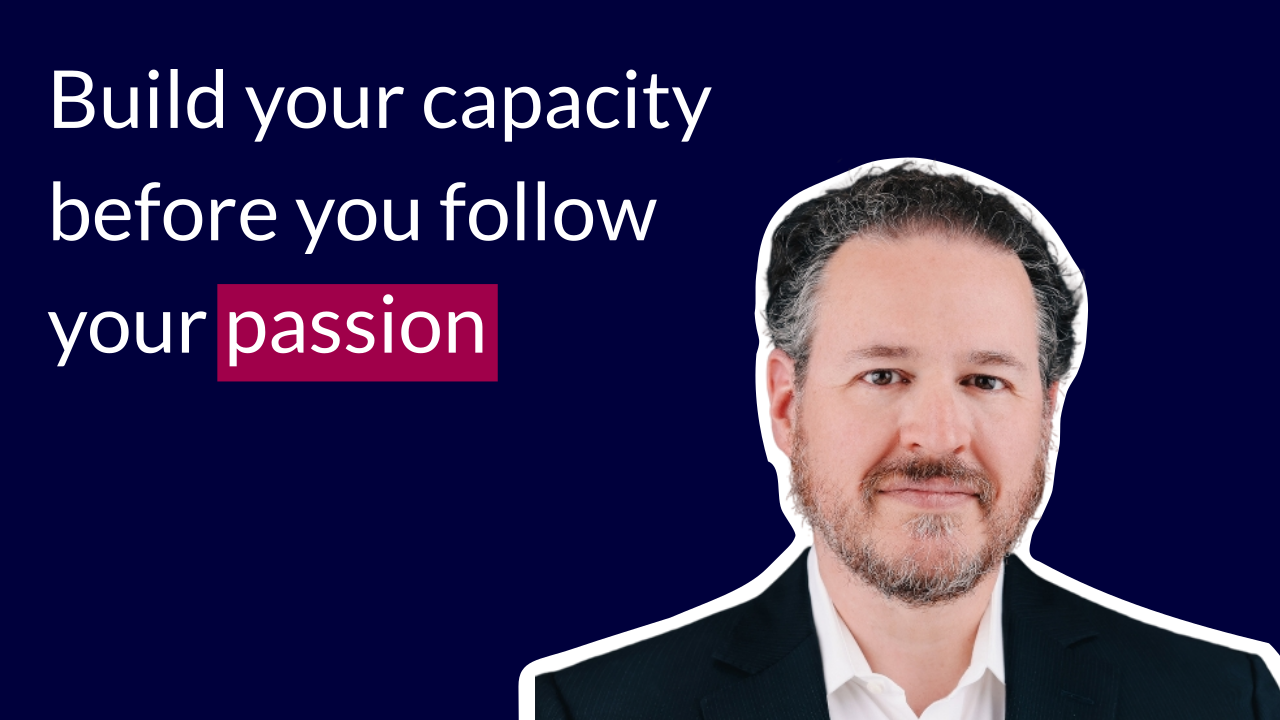
Yeah, look, one ⁓ unconventional ⁓ advice potentially is, you know, students are always encouraged to pursue their passions. ⁓ I do not encourage students to pursue their passions. I think that's a very big mistake. ⁓ And that is, ⁓ you know, very simple. I'll use my own example. As I mentioned, I first came up with a concept of
Minerva wasn't starting a university, but it was a concert on curricular reform when I was 18 years old and it was my passion. In fact, it was my life's mission. But I didn't understand it at that point. Thank goodness because let's imagine what would happen if I did. Let's imagine if I at that point at 18 beginning University Studies realized, wow, my future is going to
be about reforming university education, high school education, etc. What would be my path to get there? Well, first and foremost, I would realize I need to get a PhD. Right? Because who would take somebody without a PhD seriously in higher education? So that means as an undergraduate, I'd have to really study super hard to get those incremental grades and forget
all of the extracurricular activities, forget all the things that I actually wound up doing that helped me grow as a person, helped me understand enterprise, how to manage things, how to conceive things, how to think strategically. But no, I need to really get a PhD, so very high grade point average, do some research, right? Try and get published as an undergraduate, then go into a top PhD program, and then guess what? It's not just good enough to get a great PhD from a great brand name.
You have to get a great position afterwards, right? So you have to do really good research. That PhD thesis better knock people's socks off. So, boy, spend five years really focused on that research just so you can get a great postdoc. And then that great postdoc you have to network, and then you have to get a great associate professorship, right? And then you, or assistant professorship, and then you go through the tenure track ranks, right?
And then you spend seven years, you get your tenure, but you got to get your tenure at a great institution because God knows if you want to lead reform, you can't come from institution that is not well respected. So it's a very small handful of things. then great. Now you're a tenured professor, but boy, being a tenured professor is not enough. So you have to, you know, I don't know, build a public profile, become a public intellectual or become a Dean. And then after you're an associate Dean, you become a school Dean. And then after Dean, a provost, not for provost.
a president, the elite institutions, right? So follow this very, very narrow path and then when I'm older than I am now, maybe I can then quit and start the journey around starting Minerva. Well, guess what? Would never have happened, right? The likelihood that you would go through all of those instances was extremely, extremely low as you pass through those gates and
The reality is that if I was steeped in the higher education system for 30 plus years, my ability to think out of the box would have been greatly diminished. The reality was that I had this passion project, this idea I pursued it while I was an undergraduate, and then I abandoned it because I didn't think I could do anything about it. I didn't have the tools, the skills to create enterprise. And what I did,
was I spent 15 years working in startup enterprises, understanding how you take an idea from an idea and make it a successful large institution, how you also take an idea and try and fail and have it not work. And I've seen both. And when I started Minerva, it was the fourth institution or company that I had run.
So I'd already been the CEO of three other companies before I returned to what I was meant to do in this world. And to me, if I were to give the one piece of advice for somebody young who has something they're passionate about is don't give up on your passion, but don't screw up your passion by doing something when you just have no idea how to scale.
You have no idea how to be successful in life. You have no idea how to lead, how to inspire. Go learn those things. Go on somebody else's dime and figure out how it is that you can get better and better in your personal capacity. And then once you're ready, go and begin what you're really excited about.
Alessandro Oppo (21:40)
This is very interesting. So leveraging our own skills so that we can actually do what we have in mind.
Ben Nelson (21:52)
Correct. And look,
there is a reason why when you think about successful leaders in history, they're not children.
Right. I mean, children, even, you know, college age children, right. But sure, you can find some phenom, right, who became prime minister in their mid 20s and, you know, didn't do a terrible job and somehow learned or some, you know, monarch ⁓ in history that assumed the throne at a young age and somehow had the natural instincts. But by and large, right.
the people who have made significant progress in the world and for the world were ones that have seen a few things. There are ones that had experience and the most intelligent most well-meaning ⁓ most highly credentialed people in the world are usually the ones that make disastrous decisions ⁓ because they simply do not have the kind of life
experience and decision-making experience that prepares them to make decisions that are consequential. And we can see history is littered with figures who have been, people have had high hopes for or not or what have you, but because they were thrust into decision-making ⁓ instances before they were ready, they
lost their chance to ⁓ have significant positive impact in the world. And again, certainly in ⁓ retrospect would have been able to ⁓ have succeeded far greater if they had better advisors around them. And again, this is the same type of lesson that I have seen myself, even though Minerva by
Any account has been a successful endeavor and continues to be.
And even though I took 15 years to build up my skill set and the ability to get it to that point, again, thinking about what I know now 15 years after I started, what I could have benefited from, it's night and day, right? And so where you can work with folks who have
are able to share wisdom, are able to help you along the process after you yourself have built the skills and capacities to be able to lead and take things forward all the better. And that does mean that in today's instant, I'll build anything overnight and blah, blah, to actually spend the time to make yourself
a better human being, to make yourself somebody who is able to rise up to the occasion, to do what you are passionate about, what you care about. It will do service to that thing. Now, you know, if you don't really care, you know, if you're going and selling popsicles, great, go sell popsicles, right? I mean, that's great. If you do a terrible job, somebody else will sell popsicles next to you and they'll sell those popsicles better.
And if you do a great job by accident, hallelujah, you'll sell a bunch of popsicles, you'll be really successful. That's great, you'll learn a lot in the process, right? So that's all good stuff, right? But you don't wanna do that for something you care about, right? You wanna do that for something you actually don't really care about? You care a little bit, you like popsicles, you like to have people feel refreshed on a hot day ⁓ and provide them a little joy and a little pleasure, that's a lovely thing.
And you can learn a lot by selling those popsicles or really anything that you pursue that has meaning, it moves the world forward in some incremental way, but where it really matters, right? If you're talking about education, if you're talking about our democratic institutions, if you're talking about civic society, you don't really want to take resources, energy, et cetera.
and have a high likelihood of making things worse, right? Because that actually means you don't care about
Alessandro Oppo (26:42)
Yeah, I think about, I mean, civic society, ⁓ politics, mean, democracy and education. I mean, see the relationship is very strong. ⁓
At the same time, I think that people are well-educated and it doesn't mean having a PhD from a well-known university but being able to think and being able to maybe also have a vision and have patience and also think about how to realise to have an impact with those passions.
like honestly I don't really like the actual educational system at least in Italy but I think that also ⁓ in other places yeah exactly so I wonder if this is ⁓
Ben Nelson (27:30)
It's the same all over the world.
Alessandro Oppo (27:38)
You know they say like people that if citizens are not able to think independently they are easier to control. I wonder if there is a tension if it is yeah if this is conscious about having a educational system that
See ya.
Ben Nelson (28:02)
Yeah, it's an interesting question, right? Which is the idea that, hey, know, our governments would like to control us and therefore they want to keep us stupid. ⁓ I think that's a little bit conspiratorial. ⁓ You know, I have never found ⁓ people on any side of the political spectrum that are, A, thinking that long term.
Right? To say, oh, let me make sure that the seven-year-olds and nine-year-olds today are kept really, really stupid so when they vote in their 50s, they're going to be easily manipulated by my children. I've never met anybody who thinks that long term. So that's a little bit of a challenge.
But I think the other thing is that the culprit, I believe, is just much more straightforward, which is it's all they know. It is.
I can look at the Minerva journey as a great example. We really have a fundamentally different and now provably superior approach to education. And the people who helped me start Minerva, right? I'm the only founder of Minerva, but I had early employees. And those early employees truly believed in what I was...
trying to do. They believed in my hypothesis, they looked at the scientific literature, they saw there's a lot of support for it, etc. And sure there were a couple of people who were just there for a job, they didn't last very long and we kind of got rid of them quickly, but the vast majority of people really were believers. And almost nobody understood it. Because the implications of
Believing and understanding what a real education is, as we define it, broadly means that these massively certified people with PhDs and degrees from the top institutions in the world are uneducated. They don't have an education. And that is too hard for people to understand. And it's something that I often tell Minerva students.
I tell others people as well, which is, I am the founder of Minerva, but I do not have a Minerva education. I understand that I have intellectual shortcomings that my own students do not. Because they've gone through a system that is able to get them to understand the world in a
fundamentally better way than I can understand it. Now, I have some age and some experience and some wisdom under my belt that they may not yet have, but they will. And that is ⁓ just a ⁓ really important element to understand. And therefore, the system perpetuates because it's all that we know and
Alessandro Oppo (31:15)
Yeah.
Ben Nelson (31:39)
By and large, the people in power have benefited from the system as it stands. Right? They went to the best universities. They got the quote unquote highest degrees. They may be very stupid. They may be making disastrous decisions. They may even be pretty bad people. But the system helped get them to where they are now. And so the idea
that the system is fundamentally flawed could potentially get them to look like they don't deserve to be here because they took advantage of that system to get where they are. And so it's a rare individual that has gone through that system and has been able to look at it and say, wow, this is a really broken system and it doesn't bring the best and brightest of the positions.
that should be and it doesn't prepare those that are those positions, whether they are among the best and brightest or not, to be in those positions. And that's ultimately why education and democracy are so inextricably linked.
Alessandro Oppo (32:55)
Yeah, my question, no, I didn't want to be a conspiracy question. It was because I saw many contradictions in society. many times I thought, I remember, in the economic history book where they were saying that people that invent new things, or most of the time, they studied. ⁓
And so then, yeah.
Ben Nelson (33:21)
And 100 % autocratic
regimes, autocratic regimes absolutely control the narrative in education to keep people not only stupid, but to keep them to understand a worldview that gives legitimacy to that autocracy. But in the democratic society, that breaks down very, quickly, right? In that, in that
Alessandro Oppo (33:49)
Yeah.
Ben Nelson (33:50)
It just there is no structure in a democratic society to perpetuate a rule for generations where you want to keep generations ⁓ in that kind of check. Now, the reality is in democracies, you have many people who wish to transform them into autocracies, right? ⁓ Or theocracies. And those are
dangerous, dangerous elements that undermine the institutions that were built to ensure the thriving of democracy. But that's a separate conversation.
Alessandro Oppo (34:32)
Talking about Minerva, I know there is a platform. How does this platform work also in relation to the educational system used?
Ben Nelson (34:46)
So if you remember at the beginning of the podcast, I talked about three elements that make a Minerva program a Minerva program, a curriculum where learning objectives are interwoven throughout the program, where you are assessed on the same concepts and habits and how you deploy them across multiple types and multiple varieties of learning experiences. A pedagogical model that ensures that students are deeply engaged in their learning.
and retain what it is that they've learned in an assessment model that measures how broadly and how effectively you can apply what it is that you've learned. Now, to do this in an effective way, when you have many professors teaching many students who are going to take random paths through that process, or not totally random, but their own paths through that ⁓ learning journey, you've got to have a lot of data.
You gotta have a lot of data that the student and learner can use in order to navigate their learning and that the institution can use to evaluate and assess and nudge that student around that learning journey. collecting data without technology, the ability to guide students without technology is impossible. It's not even.
an attempt and I'll give you a very simple example. Let's say that an institution were to say, you know what, it's vitally important that our students understand that when they hear a claim, they need to look at the source of that claim to see whether or not it's credible because there's misinformation happening all over the world and
Every student needs to understand source quality and the university will gather all of its faculty and they say we have a national crisis, an international crisis, that people do not check the quality of a source and you all have to change your courses to ensure that you're assessing students on how they evaluate the quality of their source material. Now, all the faculty will broadly agree with that. That's not a controversial statement. It's a good thing to educate people.
Yet half the faculty will ignore that directive completely. They'll say, yeah, I couldn't be bothered. I'm not going to change my class. A quarter of the faculty will say, yes, I'm going to change my course and I'm going to value students, but they're going to do so in a very bad way. And it's not going to be effective at all. In fact, they're probably teaching the wrong things. But a quarter of the faculty will probably do it well. Certainly 16 % will. That's kind of historically what you think about as really good, engaged professors.
And, you know, a student is taking, you know, 30 courses, 35 courses in their journey and roughly a quarter of them, seven to eight courses are ⁓ effective at assessing that and they see it from different contexts, they will have had a pretty good exposure and gotten good feedback on assessing the quality of the source that they use to cite information. Great. Now imagine that
Another institution we gather as faculty and say we a ⁓ crisis in society, don't know how ⁓ to participate in democracy, don't know how to be sovereign in their own country. And we've outlined these 80 things that you have to underpin all of your courses with, evaluate them on, to make sure that they can be effective citizens. And understanding the quality of the source is one of those 80.
Go and change your courses to accommodate that. Good luck. No one would do anything. It's literally an impossible task to ask of a human to do for their own course, let alone to provide any coherent type of education for ⁓ a learner that goes through that process. And so that is why you require two things. Number one, a central perspective, an institutional
perspective on what those things are and how you embed them throughout the learning journey. And the second is a tool to make sure that that actually occurs, and that's technology.
Alessandro Oppo (39:21)
and like more on a practical level like how this platform is working like
Ben Nelson (39:29)
So
the way it works again is to look at the three things that ⁓ I talked about. The first is that it embeds the lesson plans, what happens on a minute-to-minute basis in the class within the technology. So when a professor starts a class and says, hey, you've done some homework, you've done some reading, ⁓
Here's a novel question that you should answer. ⁓ Please type two sentence, three sentence answer to that. You have two minutes. Presses a button and the question comes up. Right, because it's embedded within the platform. And it allows you to look at the entire curriculum and make sure that no matter what pathway the student goes through, they have sufficient exposure to each one of these dozens of different learning.
outcomes that show up sufficiently in that learning journey. The second is that the tools to engage the student are built into the platform so that the professor doesn't talk, they don't lecture, they'll talk two or three minutes, but they facilitate. And the tools that are built into the platform, like answering questions, taking polls, engaging in debates, simulations.
⁓ in ⁓ working collaboratively on documents and questions and problem sets is all built in to the platform to ensure that the pedagogical philosophy is actually expressed effectively. And the third is an assessment platform to then make sure that the students are getting assessed in such a way where the core unit of assessment is not the course, it's the tool, it's the skill.
and I'm going to get feedback from 20 different professors across four years on my application of the same tool. Right? And I'm going to see how I applied in all of these different contexts and across all these different vectors of transfer. And that's what the technology ultimately does. So what the technology does is it's a digital learning environment that enables both the building of the curricular infrastructure, the facilitation,
of learning as it's happening and the assessment of that learning after it happened. And that's what Forum, which is what our technology is called, does.
Alessandro Oppo (42:04)
It seems very cool and I wonder if it can be tried or tested also.
Ben Nelson (42:10)
It can by any
institution that builds manoeuvre programs with us. it is because the power of forum is not what happens in a given class, even though classes are very engaging and they're very exciting. The power of it is how it makes academic programs coherent and cohesive. And so when an institution builds a manoeuvre program with us,
they get to utilize FORUM to be able to ensure that those programs are delivered effectively.
Alessandro Oppo (42:44)
I was curious because before you said that you had an idea when you were 18 or very young, I wonder like you had some experience related to school and education. I mean, did you like school?
Ben Nelson (43:07)
Oh, I love school. School is fun, right? School is an enormous amount of fun. And what's interesting is when I came up with this idea, it was for a class about something completely different. It wasn't about education reform class. It was about how a university relates to its community. But as part of the class, I...
Benjamin Franklin's ideals were highlighted. Benjamin Franklin, one of the founders, if not the initial founder of the United States. ⁓ And his ⁓ philosophy on what a Western liberal democracy needs to look like in the education system that's necessary to ensure that enfranchised citizens learn the various disciplines or arts to be free or have liberty. The idea of a liberal arts education
was to ensure, in Benjamin Franklin's words, that citizens had the practical knowledge, we'll refer to today as transferable knowledge, to be able to be a merchant one day or a senator the next day, or be a farmer one day or a judge the next day, right? To be able to serve your country and to have the ability to choose those elected representatives. And that was...
a philosophy that, again, the class has nothing to do with that. But I realized by reading ⁓ that text that to say, my God, the foundation of a Western liberal democracy is an education system that teaches transferable systems thinking to its citizens. And our educational system doesn't do that. And that means that our democracies are fragile. And that was the hypothesis I had.
in the early 90s, which very much came to be. And at the time, it had been about 25 years since America effectively abandoned its attempt at a liberal arts education. And so the generation that was in power at that time was still educated in a flawed but in a somewhat effective old system. And what replaced it was a system which was flawed and massively ineffective.
And that's effectively the system you have in American higher education today, but frankly, a system that exists in higher education in many parts of the world and still does, ⁓ which is just a bad anti-educational system where at best you learn something very narrow. You learn a field, right? You're to study one thing and that thing only. And the idea of actually centering education on practical knowledge, as Franklin called it, useful knowledge, as Jefferson called it, ⁓ was effectively extinct.
And so to me, the urgency of bringing that back to life was in order to be able to establish the foundation of what an effective liberal democracy could look like. But sadly, that it's taken very long time. So it may be another generation before that's the case. But the reality is that it's not.
the liberal democracies, it's for the modern world, right? Because even in non-democracies, the idea that you want your citizens to do the same job for the rest of their lives is absurd, right? You want a dynamic economy. You want ⁓ your citizens to be able to transfer their skills from one career to another, right? And so the modern condition necessitates the kind of education that Franklin initially envisioned.
⁓ and that really we are the only proponents of that remain anywhere in the world.
Alessandro Oppo (47:11)
It's a long-term project, especially all projects related to education. Do you have a message for who is working on a similar project that could be innovating in democracy, could be innovating inside the educational system?
Ben Nelson (47:33)
My message is do not shy away. In fact, you must embrace complex thinking. ⁓ If you have an idea that can fit in a slogan or on a post-it note, and that's as deep of thinking that you have done, you are going to do enormous harm in the world.
And you need to be able to take that idea and be able to write a multi-hundred page book full of details around what would make and animate that idea into reality, thinking through unintended ⁓ consequences, thinking through second and third order effects, thinking through what that concept means.
to be able to be successful and what the pitfalls of it if you are not. And if you are not able to do that, then you need to work on preparing your mind to be able to complete that exercise or spend time actively answering those questions. It took me a solid 18 months.
before I could raise the initial funding for Minerva, going through that process, and an additional four months before I started building the team. Right? So it took a long time for me to be able to be in a position to animate people around and then harness their thinking to put the finishing touches and the details on the system. And again, with 15 years of experience operating it,
learning so much more as to how to make the system even better. So this is a long-term deep project, but you've got to be able to articulate enormous levels of detail ⁓ behind that idea. And if you cannot, go back and figure it out. And if it changes your idea, good, right? Because if you just think it fits on the Post-it note and...
And you say ⁓ I'll get the details to fit the post-it note. You're doing it the wrong way, right? Don't be afraid to modify what it is that you're thinking given your analysis. Don't modify it because somebody else doesn't get it. Don't modify it because it's easier. Don't modify it because well, it compromises the mission, but then it'll bring this other constituency around and
I'll get them along somewhere. That's the mistake, right? But understand that a coherent idea needs to be able to generate a system that will be perpetuating it, as opposed to a system that will be compromising.
Alessandro Oppo (50:43)
Thank you a lot, Ben.
Ben Nelson (50:46)
Thank you for having me.
Alessandro Oppo (50:47)
Yeah.

Member discussion: