Automatic transcription, there could be errors.
Alessandro Oppo (00:00)
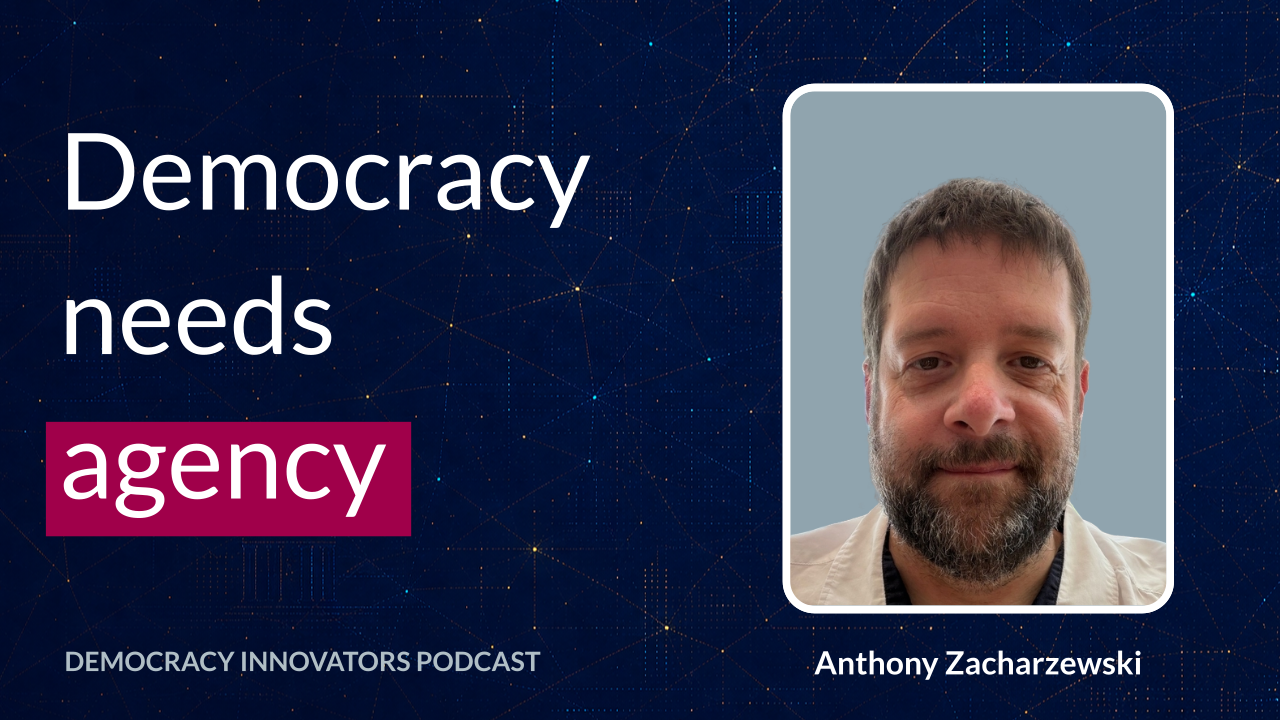
Welcome to another episode of the Democracy Innovators Podcast and our guest of today is Anthony Zacharzewski. I'm sorry for the pronunciation. So thank you for your time and as a first question I'd to ask you how did you start in your journey and also what is your background?
Anthony Zacharzewski (00:09)
Totally fine.
Well, thanks very much first for having me on. It's really great to be here. My background is in three different ways part of a democratic story. So from when I was quite young, as you can probably hear from my voice, I grew up in the UK. I was always really interested in politics. I had an uncle who was very involved in politics in my hometown. And he convinced me that it was really important to make politics part of your life and to do things that moves the world forward.
And I didn't always agree with him, but I took that away from that part of my life. I also studied Athenian history at university. I studied classics, which is the term in the UK for Greek and Roman history and culture. And so I studied about the Athenian democracy and participation really early on in my academic life. And finally, I was at university from 1992. So I was very much in the early wave of like e-democracy conversations online.
The web came on stream in my first year at university and because I was at a university that had a very advanced technical lab quite close to where I was based, I had high speed internet in my college rooms from 1994 onwards. So I was able to be really online a lot earlier than lot of other people. So I saw some of the changes that that was going to bring about. So my starting point was a combination of politics, participation and technology.
When I went to work for the UK government, was a civil servant for 10 years in the centre and 4 years in local government. I took a lot of that with me. Some of the organisations that people may have heard of, like My Society, I was not involved in that directly, but I was in the same group of friends and other organisations that worked in that kind of area. So even though my job wasn't participation and democracy in government, I worked on all sorts of things. I was always interested in the
participation element. I was always interested in how did government keep up or more usually not keep up with the way that society was changing. And so when my work in local government came to an end with a new chief executive in the organization I worked for in Brighton on the south coast of England, I decided to take a little nonprofit. I'd started with some friends a few years before called Democratic Society and try and make a go of it, try and do some of the work that I wanted us to do or I wanted to be done.
And so from that point on, which was February the 1st, 2010, we've been working as an organization, initially just me and now a team of around 20 all around Europe, and now based in Brussels as well, to try and make some of those conversations better, to try to create more democratic spaces and just to build different approaches to democracy that are more in tune with the networked world.
Alessandro Oppo (03:11)
And so now with the democratic society, which kind of project are you working on? Or have you worked on?
Anthony Zacharzewski (03:23)
So it's been an interesting journey. So we've been officially going for 20 years because we started in 2006, but really from 2010 we've been doing proper project work. And I think what we've seen in that time is our own organization has changed. We initially started doing practical projects, citizen assemblies, participatory budgeting, when it was still very experimental.
But over time, partly because of my background in government, but also because that's where the interesting conversations are, we've moved towards a more institutional innovation space. So we're thinking about how do you design participation? Still, we do design for events. But also how do you design government and government organizations to make them more responsive, to make them more open, to help them work better with citizens, but also to help citizens understand more easily.
what's being asked of them, what government should do, and try to build that kind of more constructive long-term conversation between them. So I would say now we're more like a democratic infrastructure organization. We try to build those pieces that connect up the system more than we are an organization that runs individual democratic participation events. But our big work is still advising and supporting organizations. So we have a...
piece of work with the European cities mission. 112 cities have committed to reach net zero as fast as possible by 2030 ideally. And we're working with all of those in one way or another on democracy and governance advice. So with the lead for democracy in that group of European organizations working on that. We're also doing some work on information security, the kind of enabling conditions for democracy, good information, common understanding of truth, common understanding of participation.
which is just being kicked off next week in Madrid. And also we have a strand of work building networks of practitioners and trying to connect up some of the other work that we're doing around climate, around democracy and around social change through a collaborative of 27 organisations based around the world, all of them working on those systemic changes around climate, democracy and social justice.
Alessandro Oppo (05:41)
So a lot of things and I was wondering, would you like to share some, I don't know, like you mentioned that you are supporting organizations in relation to participation and also government practices and I wonder like what could be like some best practices in regarding to this and...
Anthony Zacharzewski (05:43)
Lots of things. Yes.
I think where my starting point is, is always that the government and civil servants, politicians are often operating in the dark. They don't necessarily know what people think about what they're doing or about where things are going. You have opinion polling, which is useful in some ways. Politicians will often go and meet voters at events, on the marketplaces and go from door to door and they'll get a perspective as to what those voters think about.
But there is still a real kind of lack of information. I say this as someone who was a public official for 14 years. There's a lack of information as to what the public want, but also where the public want to take action themselves and how government should be enabling that. So one of the big questions for us is how do we create those more productive conversations, not just around a single decision or around a single space, but over the long term. And to do that, you need, I think, a set of skills within the decision-making organization, whether it's a
council or a national government, but you also need skills within society. You need people who are able to engage with what's going on. They need to be confident. They need to be included in the conversation. They need to know that they have access routes into those conversations. And that's a really important role for civil society organizations, not necessarily at our level, working at largely kind of across the European space, because it needs to be local, it needs to be trusted, it needs to be rooted in local communities.
But we do need to understand how those organizations, many of which do not see democracy as their key job, how we can bring those together, how we can connect them more effectively. And that's one of the reasons why I often talk about democratic infrastructure, because a bit like infrastructure, it needs to be there for the long term. It needs to be reliable. It needs to be safe. But also it needs to be inclusive. It needs to reach everyone rather than just the people who always talk. And similarly within government,
You do need a set of skills that's maybe a little bit different from the traditional skills that government officials have had. So when I started in the civil service in the United Kingdom in 2000, sorry, 1996, I wasn't able to have an outward facing email address, like an email address that members of the public could email without having special permission from a head of unit. All of the emails were internal. And that's a good symbol, both of how technology has changed, but also how expectations of what government is have changed.
Nowadays, you would never have a civil servant who is totally unreachable by the outside world. They may not be big figures, they may not be public figures, but at the same time, you would know who they were. They might be like in the European Commission on a public database. And all of that is because people are expecting a different level of engagement and a different level of openness from government. Where I think the skills in government are falling short still,
is that there is still a desire always to look upwards to what the political level is saying and an unwillingness to engage in conversations that might be challenging or difficult with members of the public because, and I understand this because I've been in the same position, because you don't feel you have the right to make any changes because you're responsible to deliver what your minister has asked you because the minister is a democratically elected person. That's absolutely legitimate. I'm not criticizing civil servants for not being
for being a little bit worried about those kinds of spaces. But all of the experience that we've had introducing civil servants into high quality, well-facilitated democratic conversations is that they come away inspired and fused, really aware of what citizens can offer, more than they feel worried. So it's a real education on both sides. I've got a few people who I've seen go from quite sort of, you know,
bureaucratic or quite small scale mindsets and being exposed to some of these participatory practices and being exposed to some of the ways that these change behaviors, actually really then taking a step forward in their career and thinking about how government is changing, how their organization needs to change, really having their mind opened. as a person who cares about efficient and effective government policy, as well as democracy, I'm a policy person at heart, an institutions person at heart.
It's also really important for me that civil servants who are taking decisions have access to the widest possible range of views and hear from real people how they're going to be affected by things. Because if you don't do that, then you end up being ready to fall into groupthink or ready to fall into situations where people are just telling you something and you're listening to it and assuming that they're speaking on behalf of a huge audience when in practice they may just be speaking for themselves. So I think it's really important to give the
skills to communities but also to build the skills within government to be able to manage democratic participation well.
Alessandro Oppo (11:02)
This tension between the duties of a public officer and the output of participatory deliberatory process like a citizen assembly, it's something that many times in the conversation in the podcast came out and I wonder what are your thoughts about this and if this can be sold because I can understand as you explained both
like that.
No, please,
Anthony Zacharzewski (11:36)
Yeah,
so I think there is less of a tension than I think there sometimes seems, as long as you understand that you have to reframe the way that government decisions are taken as things that are set strategically by the results of elections, but delivered in detail by participation. So I think it's really important to understand that there isn't, I think, a world in which you can have everything done by citizen assemblies. I know there are some people who argue for that. I don't agree.
And the reason I don't agree is because citizen assemblies are by definition not of everyone. And voting is available to everyone in a way that a citizen assembly could never be. And although one can say our citizen assemblies are very representative, they're designed in a way to maximize the number of voices that are heard, and all of that is true. And we do design them as well. I'm not criticizing the model. It can't be something that you use for everything because people want participation on the things they care about.
So you need to both match the random selection element of citizen engagement with the people voting or talking on the basis of the things they care about, which is the standard electoral process that we have today. So where that tension exists, I think it exists in spaces where people are not being given permission to be open or to be flexible on the ways in which things are done. If you vote for a party or if you vote for a candidate, you're not saying to them,
you now can do absolutely everything you want for four years without ever coming back to me. You're saying to that person, here is, you're the person or you're the party that I think broadly speaking is aligned with my philosophy. And when something happens, you're likely to be the party who would most be like I would be in terms of taking those decisions. You're like closest to me philosophically. But that's not to say that you can have no disagreements with them. Like party members have disagreements with their own party, let alone just voters.
So it's important also to create the systems of flexibility that ensure that you aren't creating too rigid a system, that you aren't creating a system where the minister says we do this, the civil servants say, yes, OK, we'll do this, and then it just happens. I do think that the people are moving away from that model. I think it was the model in the past very much. I think there's an understanding you need to open these systems up. I I'm based in Brussels and the European Commission, which I think many people would say is not.
the reputation of being the most local, close to the ground organization in the world. Even they are doing a lot of work with citizen panels and with different sorts of democratic thinking. And to be honest, I think they're ahead of some national governments and certainly of some municipal governments, just in the level of the thinking that they're doing and in their willingness to experiment. All of that is to say, that we do have to create those systems that allow for the flexibility.
So I used to be a civil servant in the finance ministry. And one of the things in the finance ministry that's like a real pattern across all of these institutions around the world is that the money is kind of put in at the top and it filters down and it gets chopped up into budgets and into allocations to local areas. And all of these things happen in quite a rigid way. And the reason for that is it's taxpayers money. So you have to be very careful with it. But also because the accountability for how that money is spent has to be really tight.
it has to be really close. But that doesn't necessarily mean it has to be inflexibly delivered. There are plenty of opportunities, like in the UK, there's a scheme called Total Place, where there's flexibility around the budgets that are delivered in a place. Not as much as there could be, but if you can open up some of those flexibilities, then people can say, actually, in our neighborhood, in our area, we think the service should be delivered like this, or in our area, we think the priority for spending should be this rather than that, and that government spending should
be able to flex in those ways. At the moment, it's still too much driven on a top-down, kind of machinery, Ford-based, Fordist kind of model, which is about delivering efficiency of output and action at the expense of responsiveness to citizens. And my argument would be, it will be much more efficient in the end if you are responsive to citizens, because you will then much better understand the impact of the policy choices that you're making and the impact of the services that you're delivering.
So for me, it's not a cost to involve citizens. It's actually a benefit. will be the first to say it's very difficult to do hard research on that because so many factors affect the output of social processes. But at the same time, I think there is evidence, maybe partly circumstantial, partly natural experiments, that it is more effective and more efficient to involve citizens in the decisions that are being taken.
in terms of the quality and the cost effectiveness of the output.
Alessandro Oppo (16:30)
I'm thinking now about the future. Let's say that participation became a practice in population. How do you imagine the political system? How can it work? Because now we are living in a representative democracy. so I wonder if this can also change. I don't know if...
could be something more like toward direct democracy but also something else we don't know and I wonder like what are your thoughts about?
Anthony Zacharzewski (17:05)
I
I don't want to predict where the future will go because there are all sorts of different paths. I think the challenge of direct democracy and a kind of referendum model like you have in Switzerland is that you sometimes replicate the dynamics of an election campaign, which is where there's like one or two issues, or in the case of a referendum, just one issue, which doesn't have a connection into other policy areas and loads of money gets put into it by interest groups. And in the end, people are kind of just
trying to vote a very difficult issue, a very complex issue with a simple yes and a no. And if you imagine that as one piece of data from each citizen, that's not enough to be able to understand why they made those choices. You see it in the Brexit referendum in the UK, 52 % of people voted for Brexit, 48 % of people voted against. What sort of Brexit did those 52 % of people voting for it want? We don't know. We only have one piece of information that they voted for it.
So direct democracy in that way can create very complicated, fragmented politics where it's only really about one issue at a time, whereas actually what government is and what creating the world is, particularly in the moment of digitization and the challenge of climate change, is really understanding how things fit together. So for me, I participatory approaches that are more deliberative and are more inclusive and are based more on longer term conversations.
are better suited to a world in which we are needing to build resilience and robustness and build long-term change across multiple different areas. Now, how that turns into reality, I don't know, because I think you do have this challenge of people want to be involved where they want to be involved. They want to be involved on the issues they care about. But by definition, because they care about that issue, they're not a representative sample of the audience of the citizenship as a whole.
So we will need to find, I think, a balance between representative and deliberative approaches and between participation through deliberation and participation through voting. And I think where we will end up is that the end point of that will depend on which country you're in because so much of it depends on political cultures. So I live in Belgium. I'm Belgian now, but I come from the UK. And those are like, if you sort of step back to Africa or to Southeast Asia,
those look very similar countries. They're like Northern European countries. are like, you're very, they're wealthy. They have like colonial history, you know, for all of the kinds of things that one would, would think of as like a regular European country. They can't be that different, but actually the political systems are really different and the political cultures are really different because the UK has a tradition of like two big parties of like an election being like you've won the election. Then that's you in charge, a strong
tradition of parliamentary sovereignty, so the parliament is in charge of things and can overrule the courts, can overrule everyone. Whereas in Belgium it's a really complicated system of language groups, regions and of the federal government, plus lots more autonomy at local level because local government is created in a different way rather than just the subject of parliament. So I think these are the sorts of differences that drive the way in which we will see a more participative approach.
For example, in Belgium, we are currently in the middle of a campaign. We're not directly involved, but our friends at G1000 are. To replace the Senate, which is the upper house of the Belgian parliament that's on the point of being abolished, rather than to completely abolish it, replace it with a standing citizen assembly that can do two or three big discussions over the course of a year that would bring in lots of people as a wider conversation around Belgium and would be decided by 100.
Senators who are elected by lot on a proportional basis. I think that's a really good idea And it works very effectively in the Belgian context because Belgium is such a complicated country with lots of different communities and different political and media spaces that don't always talk to each other Building that space in Belgium is really really useful Would it be the thing I would invest in in UK democracy? Probably not. You know, I do think the House of Lords, which is the equivalent of the Belgian Senate
needs reforming, but actually the work that's needed in the UK is strengthening voice at local and regional level because that's where there's a democratic shortfall the most. So I suspect that this development will happen driven by national priorities, but also driven by national cultures and political cultures. And we will also see what happens at the European level because to some extent, Europe is the most distant from the citizen because it's dealing with directives and these very long-term, high-level questions.
But at the same time, you're seeing now, if you look at opinion polling, that the public are expecting Europe to do more. There was a poll the other day, and I don't have it at my fingertips, so I can't tell you where it came from. But one of the top issues that people wanted Europe, that European citizens wanted Europe to handle, was social security, employment, and jobs. Now, the European Union can do a lot about some aspects of the economy, but has no responsibilities for social security at all.
That didn't mean that all of those people wanted a European social welfare system rather than national one. But Europe is being asked to do a lot of things it doesn't really have the power to do at the moment. I think there is a positive pathway where it can involve and engage people more and support a multi-level governance deliberation like working at local, regional, national and European levels together that can really help dissolve some of those hard boundaries between different policy areas and enable us to work in a much more
consistent and coherent way to achieve social goals.
Alessandro Oppo (22:53)
Before you mentioned some possible issues on participation, I was wondering which kind of issue do you see at the moment in the participatory field? I also read some of your articles
That was about rethinking participatory participation practices. So, yeah, what are your thoughts?
Anthony Zacharzewski (23:25)
Well, think I've got two main thoughts. The first is that the participation world that we have been in up till now is really fundamentally changing. I think it's changing for a few reasons. The first is we're moving out of the space where we were kind of the interesting experiments around the edge. And it kind of didn't matter too much about what we decided into a space where participatory approaches are
really important and are making an impact on decisions that create millions, tens of millions, billions of euros of expenditure. And in those situations, we need to be much more robust in the processes that we design to ensure that we aren't being manipulated by people who want the outcome of those decisions to go one way or the other. And it isn't, I think, pure paranoia to say,
that as soon as large amounts of money or big political decisions get involved, is easier or it is a natural thing for attempts to be made to corrupt those processes or for attempts to be made to warp the decisions that are taken in favor of particular organizations or particular interests. And I think we have not focused enough on that. I think the sector has been very keen on like methodological discussions, which are interesting and important, but I think we have not yet thought
Partly because it's a very hard question. How do you strengthen those processes against inauthentic behavior or against corruption? And how do you ensure that if we are talking about processes that are affecting huge amounts of spending, that we put the resources into those processes to secure them that is necessary? If you think about a parliament, like the European Parliament down the road, it has an office that deals only with declarations of members' interests.
deals with the Office for the Fight Against Fraud, OLAF, which is a whole European institution. All of these democratic bodies have lots of money spent on securing their processes, on ensuring that their processes can't be corrupted. sometimes they don't work, but a lot of the time they do, but it's an investment. And I think that if you look at the sector as a whole, democratic institutions and democratic organizations like ours are always short of money.
20 people, that makes us comparatively large for an organization specializing in participation and democracy. If you think about organizations of that size, all of whom are seeking funding all the time, the amount of money that we have to invest in the design and the robustness of the processes is far too low. So that's the first challenge. The second challenge is actually what's being driven by the political headwinds and things like the AI revolution enabling a lot more AI slop or a lot more
negative commentary driven by bots and driven by artificial intelligence online. So you've seen this in the UK over the last few days where a terrible tragic case of a student who's been murdered is being turned into this absolute political frenzy driven by the far right, driven by Elon Musk and by the algorithms on X. And it's a real concern for just being able to hold onto the concept of shared truth and shared reality.
Which is one of the reasons why we're focusing on that in one of our new projects, you know How do you create and maintain a shared concept of truth and shared reality? What I think that means for us is that we in the participation sector need to be a little bit less a Little bit more focused on the nature of power I think there is sometimes a feeling when I'm at these sessions that I'm in a gathering of herbivores talking about how to deal with the carnivores
And you know what happens with herbivores and carnivores is the carnivores eat the herbivores. So there is a real question for me about the level of attention that we pay to power and the level of attention that we in our sector pay to politics. Because part of my critique, and it's an affectionate and a positive critique I hope, of the organizations in our space is that occasionally we have seen politics as the thing we've been trying to get away from. That politics is kind of
the nasty polarizing, difficult to handle stuff. And ours is democracy, and democracy and politics are different. But I've really fundamentally challenged that view, because politics is the only way in which we can control the power of the state, which in itself is the only thing that has the ability to act against some of the commercial and the bigger actors that are going to be a real challenge to the achieving of democracy if we let things run as they are.
Alessandro Oppo (28:16)
And because you mention power, what is power for you?
Anthony Zacharzewski (28:24)
Well, what is power for anyone? Power is agency. It's the ability to make things the way that you want them to be. And at the moment, it is being highly concentrated in a very small number of people who are able to drive online conversation and who are able to drive an enormous number of business and other commercial initiatives because they have a huge amount of resources. There are different sources of power. The state has power. In the classic definition, it has the
monopoly and legitimate violence in its territory and states still do have power if you want to understand that look at what's happening in China with the internet but at the same time individuals have power you know you have the power to go to a protest march or to not turn up to work and go on strike but those powers at local the power and the agency of the individual and at local level are much easier to use as soon as you get into these higher levels they become much more difficult one of our one of the purposes of democracy is to give people
Agency and power like its democracy demos kratos the power of the people is the collective power of the people But it's also the power of the individual to affect that collective will and I think this is one of the areas where we risk Individualization creating a huge number of people who have zero actual empowerment But are being told you can you can vote online you can participate in this March or whatever it is being controlled being
Influence so strongly by people behind the scenes that their agencies is not effective It's useless and people need that sense of agency They need that sense that they can make the world better because otherwise you end up in a totally In a place of despair where you just feel like you have nothing Nothing you do can change the situation you're in nothing you do can change the world in any way And that's a very negative place to be
Yeah, there's a there's I think it was Napoleon who said that if you want if you tell him some the world as some world as it was when someone was 20, he would tell you what their political views were. Although I think that's not 100 % true. But when I was 20, the Berlin Wall had just fallen. And democracy was spreading around Europe. Europe was uniting. was like the Maastricht Treaty, all of these great things were going to happen. And my kids are 20 now. And they see Trump
and environmental disaster looming and the war in Ukraine. And yeah, understandably, their vision of the world and their vision of democracy is much more pessimistic than mine. I don't think that's just because they're 20 and they haven't grown up yet. I think it's because of the world that they see around them. We have to give people of my kid's age and younger the ability to change the world. And that starts from the knowledge that they can.
And if we don't have those, if we don't have the agency, if we don't create the systems for sharing that out more widely, then I think we end up with a very negative future.
Alessandro Oppo (31:20)
Absolutely. And I was thinking, going back, because before we mentioned, like a digitalization, and there is this interesting, let's say, paper that is about the agentic state. I don't know if you saw it. yeah, I don't know.
Anthony Zacharzewski (31:47)
This is by, I think, my old friend Tiago Pesciotto. Yes.
Alessandro Oppo (31:49)
Yeah, exactly. And
we also interviewed him and also Simone Maria Parazzoli, that is another guest of the podcast he worked on it. And yeah, I wonder what are your thoughts about it and also regarding digitalization in general. So what could be the pros cons?
Anthony Zacharzewski (32:11)
So I will be the first to say that I'm not an expert in AI or in these kind of technological shifts. I'm trying to keep up with an enormously rapidly developing field. But you know, I also have like a family and a football team to support. I can't do it 24 hours a day. The work of Tiago, I really respect and have done for a long time.
I think the work on the agentic state and what that can lead to is really challenging and inspiring. think it's pointing out some real benefits and some huge potential in the way in which new technologies can work. I think there's a distinction for me between the state as a provider of services, like the state as the guarantor and the state as the state. So if you imagine...
the state as the state, the of what you call in French the regalia principles, like the things that adjust to the state, like defense and tax raising and foreign policy and things like that. I think digitization affects those only indirectly by creating different routes for people to influence the conversations that happen in the political spaces where those are decided. At the other end of the spectrum, I can totally see how digitization of government provided services can really create a lot more flexibility. So I was talking earlier.
about the importance of flexibility and the importance of people being able to make things different as they feel able to, I think able to make a change. I think that through some digitalization opportunities, you can make some of the services more flexible, more responsive, more personalized, and that can make a huge difference. I think we've already gone, even before we reached AI agent territory, we've already moved from a system where you kind of got what you were told.
20, 30 years ago from public services to one that is trying to be more responsive, more linked to what people need. I know in the UK, for example, there is a thing called the team around the child. So if a child has difficulties or a family has multiple difficulties like unemployment or disability or whatever it is, services will try to come around them in a format that works for that family or that works for that child.
rather than having the family or the child needing to like talk to 15 or 16 different government organizations, each of which is structured in a traditional hierarchical way. I can see the agentic state and the agentic models really helping to accelerate that personalization and accelerate that responsiveness of services. But of course, those are much more about the individual's relationship with the state. The state almost, the individual almost is a consumer of state services rather than as a citizen. Because to be a citizen is to be a consumer and
John Alexander, another friend, has been talking a lot about this. They're quite different things. And you can be a consumer of government services, but you also are a citizen of the government that provides those services. And this is where I feel like there's some really interesting areas to explore in the middle. I think we've spoken for a long time in our sector about digital tools for democracy. And they've always fallen short for a couple of reasons. The first is that they aren't profitable. There isn't a model where you can make
Democratic participation tools profitable because fundamentally like every government thing you have to reach everybody It's not difficult to make a kind of mailing list tool profitable or a campaigning tool profitable nation builders being profitable But to try and reach literally everybody including those people who are less online who don't speak the local language You all of these things those that's where your costs occur And if it's going to be truly democratic it has to reach all those people. So so plenty of democratic
tools have been started and plenty of them have failed. And the reason I think they fail is first, it's not a service that people pay for, so you can't pay, you can't take money from the consumer. Government is a very poor procurer of these sorts of services. It buys them short term, it buys them occasionally, it doesn't have the long term ability to spend, and it also doesn't have the budgets for these sorts of services.
that they need to develop properly. However, the agentic state or the agentic model, I think does provide some opportunity to join up some of these conversations and to create more participative spaces. The thing I think we've got to be careful about though, is remembering that when you're a citizen, you are in a particular persona. So, you know, I often use the example of my online shopping order. If an agent was doing my online shopping order,
It might buy what I've been buying previously. It might buy the things, it might know that it's the World Cup. And when it's the World Cup, I eat lots of crisps because I'm sitting in front of the television watching football. Now, maybe I don't want to do that. Maybe I feel like actually I've put on a few kilograms, it's time to lose a bit of weight. I'm going to focus on healthy food. Now, obviously I can tell the agent that, but the automaticity of it is to go for what's happened in the past. It's like it's backward looking.
Whereas citizenship and democracy are inherently forward looking. They're expressing what you want from the future, not what you've done from the past. And so I think it's really important that in this kind of agentic state model, we retain people's citizen personas as things that are them making choices about the world they want to see in the future, not mere representations of what they've been in the past. And this is certainly true in the, I've seen a few startups which have promised a kind of deep citizen,
like a sort opinion poll without having to ask people questions, if you can imagine what I mean, that they just read off the behaviour of millions or billions of data points and that from that they draw a perspective of what people want. But my point about about politics and citizenship, is if you took all of it, if you had perfect vision and you took the decisions and the choices of absolutely everyone in the world, that still wouldn't be their politics, because politics is an expression of the future.
And people are hypocrites, right? don't get me wrong. I'm not saying that it's impossible to read off from everyone's behaviour what they are doing now, what their revealed preference is in the jargon. But that's not politics. Politics is about what you want to be in the future and what you personally want to be in the future as well. And I think it's a denial of that possibility of change and a denial of that agency and the potential for optimism.
if all we do is just poll people on what they've been doing so far, because you then hide all the possibilities the future is away from.
Alessandro Oppo (38:54)
Interesting. like, yeah, sorry for the randomness of the question, but I wonder like, which kind of open question do you have in your mind now, like something that maybe you are thinking and...
Anthony Zacharzewski (39:00)
No, totally fine.
I think the biggest, so there's a couple of things. I think the first question is, and they're related, the first question is, what does the future of politics look like alongside participation? You I think this is really interesting to me because I've always been like someone who's quite political. I've been a member of political party or, you know, of a political tradition in different countries for 30 years. So it's always been something that has been important to me.
But equally, I've seen the contradictions and the tensions between my day job and participation in democracy and my kind of life as a political actor, as a member of a political party. I think we do need to understand how these come together. I think it's important for us to understand where in the participation space are we making a claim that is kind of a political claim? Where is participation a political act? Because it doesn't have zero political value.
You know, there are people in the political space who do not believe in participation. They do not think the citizens should have a voice. They think that the leader or a religious text or whatever, whatever, should be directing society. And, you know, that's the end of it. So to some extent, those people are not accessible to the sorts of processes that we create. But if you turn that picture around, we are also expressing what I hope is a majority view, but is a
political view about the way the world should be in the future. I think we haven't yet worked out how do we balance the need for us to reach a very wide audience with those sorts of processes, with the need to understand or the need to defend ourselves as a political project, as a project for a particular way that the world should be. I think, you know, I forget who it was who said, you know, a liberal is a person who won't take their own side in an argument. And I feel that sometimes we don't take our own side in the argument.
And I wonder how we do that without polarizing further and turning off the people who might be convinced by what we have to say as a kind of local community conversation, but who are really turned off by language around kind of community and participation because they see it as like left-wing or green or a political tradition that they don't belong to. So that's my first question. And my second question is, how do we make this work at scale? I think if you look at all of the things that we've done through participatory work,
and we've done loads. I mean, not just EMSOC, everyone. It's still quite small scale. I was listening to John Alexander, who I mentioned before. He was talking at a Harvard event I listened in to the other day. And he said, there's been over 1, 000 citizen assemblies. And it's like, well, OK, on one level, yes, great. But even if there's been 10, 000, if each one of them involves 100 people, that's just a million people. In a continent of 450, 000 people, that's not very many.
you've got a one in 45 chance of having participated in a citizen assembly. I don't think we are yet at the scale where we can understand how these things interact. And this is the bit of me that is a government official still rather than a participation worker. The other problem is that one of the ways in which government works and one of the ways in which political parties work as well is they take different positions and they make them work together. So they, example,
they build a road in a particular place. It doesn't stop at the boundary and then start at one local authority and then start at the other boundary because they have to do something that's connected, like a road has to connect with other roads. Railways have to work on standards, those sorts of things. And I think that we sometimes haven't worked out how do we create synthesizing spaces beyond the individual issues that we're talking about. So if you're asking citizens about issue X,
How do you demonstrate the connections with issue Y, issue Z, issue A, issue B without confusing them too much and giving them far too much information to take in in the relatively limited time we have? So we need to understand scale of practice, but also scale of question. And I think that there's a project called Scale Dem, which is being, I know you had Antoine from Musi en Public on the other day, and they're working on that project. How do you scale?
I forget exactly what it is, out, deep, up, all of these sorts of questions. But the fundamental question is scale, not because we need to seek scale, but if we're going to operate at governmental level, if we're going to operate on the scale where whole governments are involved in these kinds of questions, then both the organizations that are running those processes and the citizens need to have a lot more resource, a lot more capability to make that really effective.
Alessandro Oppo (44:00)
Interesting questions. I have some thoughts regarding them. I don't know the future of politics how it will be. But I'm thinking if this digitalization, the process will continue and they can imagine yes, then I don't know if we're following the lines of the agentic state or something similar.
An open question that I have in my mind is what could be the role of political parties because I can imagine that also them will have to maybe in some way to adapt and I wonder if like if political parties could be like a sort of they can mediate between let's say the agentic state and the citizens in regarding to participation
in regards to participation. But yeah, it's still an open question to me. I don't know.
Anthony Zacharzewski (45:01)
It's really fascinating question. And I think on the political parties point, political parties are really a very simple thing in a political system. They're a group of people who rep a group of interest groups or group interests or group group built around a philosophy or philosophical position that is internally coherent, that is competing against other political parties in the same in the same political space.
So for example, in the UK and in the US, you have a very small number of large parties because the electoral system privileges large parties. So the Labour Party, which is the party that I belonged to when I lived in the UK, the Labour Party is an internal coalition. There are some people in it who are more to the left, some people who more to the right, some people who are more communitarian, participatory, others who are more, you know, directive, who want the state to take control because that's the best way of guaranteeing equality.
And all of those questions are dealt with internally. And then the Labour Party candidate is on the ballot. And if you're a Labour Party member or if you're a supporter, you vote for them. And the Conservatives have a different internal coalition, but they still have an internal coalition. And that's how that happens. It will be hard to say for the Labour Party, for example, that there is a single political tradition that's represented by it. There are some people in the Labour Party who are like classical Marxists, know, real sort of
It's all about the, not exactly the sort of the revolution, but it's certainly about a class-based structure. And there are others who are much more kind of liberal, left liberal in their perspectives. And those traditions coexist within the Labour Party than they always have. If you look at somewhere like the Netherlands, where they have a really pure political, a pure proportional representation system, huge numbers of parties exist across a wide range of spectrums. So,
You would say on the left you have Denk, you have Pévende A, and you have the Es Pé, all of whom in different ways represent those kind of traditions. And similarly on the right, you have Jain and Twente, you have Pévévé, you have to some extent the Vévédé, which is kind of on the right edge of the center. You saw right edge of center right. And then you have Févédé. And they all represent the different kind of electoral bits of coalition on the right.
So political parties in the Netherlands are, there's far more of them, but they're much narrower. And I can imagine that's probably the future of political parties in a more digitized age, that they become not so much broad tent parties like Volksparteien, mass parties, but they become much more focused on particular interest groups. And then the synthesis that you have to do comes within government.
I think the challenge that we have is that there are some parties, and I'm thinking here about Rassemblement National in France or Alternatief für Deutschland, which are protest parties and based on a core of right-wing politics. A lot of the people who vote for AFD, Vlaams-Berlin in Flanders, Rassemblement National, are voting not because they are ideologically aligned with the positions of the party.
but because they are the protest vote, because they're the party that wants to shake things up, that wants things to change. And that's a pretty significant part of the population, like 20 to 30 % in most countries. In fact, there's quite some great research on this. And the rest of the political spectrum is maybe 70%, 80%, but it's split into multiple parties. So you end up with a situation where the far right look like they're in the lead because they're the...
a single electoral block because people are not particularly driven by policies. And what happens is that they then start driving the narrative because they're the biggest party. And the fact that all of the other parties in the democratic space are occupying far more of the political, are voted for by far more of the electorate than the far right doesn't make a difference because they're all arguing with each other. And I think we do have this risk that the narrative control of the far right is going to just create an atmosphere.
in which parties of anywhere from the centre right to the left are unable to manage a collective position. So we may see, I don't know this is definitely going to happen, but we may see the development of what you call block politics, where actually there are multiple parties in a right block and multiple parties in a left block and some maybe in a centre block and they switch votes between them, but it's very rare for people to switch across from block to block and the strength is
The strength of the block is what matters and there's like standing alliances between those parties. If that happens, I think we might end up with what looks like quite a traditional political party system, but rather than being based on a set on a socioeconomic axis from like more redistribution to more free markets, it's based on a cultural access, axis rather, of like stronger border controls, less immigration, more ethnic purity to more liberal, more open policies.
If that happens, I suspect it will be one of the frames in which the agentic state operates. The agentic state will take on a lot of the socioeconomic and the practical and the service delivery elements. And the political system will be focusing on the broader kind of cultural and life issues. The thing I think would break that is if there is a big crisis, either a climate disaster or mass unemployment from AI.
That I think would drive us back into a kind of socioeconomic service delivery access for politics and that probably favors the maintenance of the existing left-right party split.
Alessandro Oppo (50:51)
And do you have, maybe as a last question, also if you want to add something else, feel free. Like if you have a message for the people that are working in the field, building prototypes, finding new ways for participation.
Anthony Zacharzewski (51:11)
The first thing say is thank you. I think it's really important. mean, the fact that people are dedicating their lives to this issue is absolutely essential. I spent 20 years working on it. I don't think I'm so amazing or so essential, but it's a commitment I've made because it's what I believe in and I respect the other people. I respect others who are doing that. I think the second thing I would say is don't give up. There is an enormous amount that needs to be done.
And we are in a time where sometimes it feels very hard to get out of bed in the morning because you see what's on the news. I think that what we are doing in our sector is building the slow alternative infrastructure or the slow alternative mechanisms to some of those kind of high speed algorithm driven, influencer driven mechanisms that are creating the rather poisonous politics we have at the minute. So don't give up. But the third part is I think we need to join up.
I think there is a lot of NGOs are very bad at this, right? This is not a kind of, yeah, I'm not saying we're so wonderful. In general, NGOs are terrible at mergers because they don't have assets. don't have, scale is not quite the same thing when you're dealing with a think tank or a service as it is with the service industry. But still, I do think we need to form a more united front. And it's really interesting to see in the European context that the European Commission has talked about creating a stakeholders forum.
or stakeholder platform rather, to support democratic organisations or democracy supporting organisations with common tools, with research, all these sorts of things. It's still very vague exactly what it's going to look like, but I know that there are conversations going on about shaping it up and turning it into something real, either for next year or for 2028. I think I would definitely encourage people to spend a little time watching for that conversation, taking part in it to make sure that what is created is something that is really meeting the needs.
of the democratic innovation sector that we have.
Alessandro Oppo (53:07)
Thank you a lot, Anthony, really. Thank you.
Anthony Zacharzewski (53:10)
My pleasure.

Member discussion: