
This episode was automatically transcribed, there could be errors.
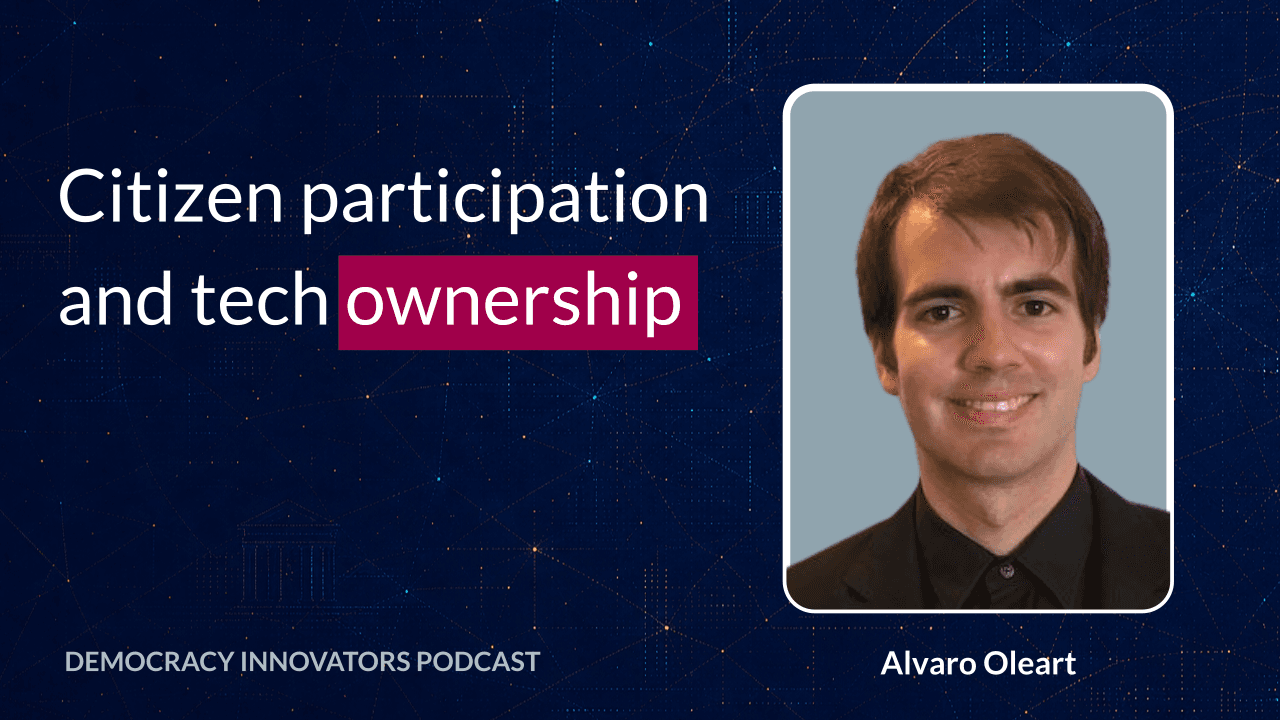
About Alvaro Oleart
Alessandro Oppo00:00Welcome to another episode of the Democracy Innovators Podcast and our guest of today is Alvaro Oleart. Thank you, Alvaro, for your time.
Alvaro Oleart00:08Thanks, Alessandro, for the invitation.
Alessandro Oppo00:10Would you like to tell us something about you, your academic background or also your personal background?
Alvaro Oleart00:18Yeah, so I am an academic researcher based in Brussels at the Université libre de Bruxelles and I have worked a lot on social movements. did my PhD on the TTIP contestation and debates, the EU-US trade agreement that was negotiated about 10 years ago by the EU with the US. So I was very much interested in the relation between conflict and democracy. And more recently, I worked a lot on
the participatory practices of the EU more concretely looking at European Citizens' Initiative, the Conference on the Future of Europe or the European Citizens' Panels.
Citizen-washing and EU participation
Alessandro Oppo00:55OK. And what have you discovered while you were working on these topics?
Alvaro Oleart01:02Yeah, well, mean, I am quite, I mean, maybe disappointed is not the right question because maybe I was not necessarily expecting a lot from the EU in regards to participation. But it remains quite shocking the citizen-washing practices that the EU mobilizes in regards to participation. So how there is a very strategic deployment of so-called democratic innovations.
to basically whitewash the policies that are mostly decided beforehand. And in this kind of process, there's actually not really much possibility of shaping the underlying philosophy with which these processes and policies are built.
Alessandro Oppo01:46But where do you identify like the main issue? in the, because I can see the fact that just a few people are involved in citizen assemblies or maybe also the fact that the commitment. the output of a citizen assembly not always become, let's say the input of a policy.
Alvaro Oleart02:09So I think that there's a problem with the process, not only with the output. I know that there's a lot of colleagues that have been making the argument about how, for example, citizens' assemblies need to be sort of like the output needs to be binding, right? And if the outcome is binding, then this will improve the democratic legitimacy of these processes. I am really not convinced about this because the process itself and underlying philosophy with which citizen assemblies are conceived
I think is problematic because it's in most of the cases, beginning from a very depoliticized conception of democracy that sidelines the actors that I think are central to any democratic process, which are collective actors, trade unions, mass political parties, and mass politics more generally. And I think in most of these citizen assemblies, and I have studied primarily the ones taking place at the European level,
So I know that the citizen assemblies taking place at the national level, sometimes there are some specificities that make them a little bit more legitimate. Like I'm thinking, for example, about the French Convention, Citizen Convention on Climate, that actually triggered quite a lot of public debate. And I thought that was very interesting. So to me, the assembly itself was good in so far, it was able to have an impact in public debates.
But in most of the cases, these citizen assemblies go completely under the radar of public debates and are simply used by institutions to legitimize their positions, which I find very deeply problematic.
Intermediates and descriptive representation
Alessandro Oppo03:42And so how can be this problem fixed? Because you mentioned that the process is the problem. so connecting the Citizen Assembly maybe to some social movement, you mentioned, I don't know, maybe political parties, maybe...
Alvaro Oleart03:59Yeah, I am not particularly favorable to the idea of citizen assembly, so I am not sure that the fix is how to connect better citizen assemblies to social movements. I think to begin as thinking that citizen assemblies are the solution is part of the problem. And I think, okay, what are the real or what are the kind of causes that we have in which
We see that democracy is at risk or that we have democratic regression. What are the causes? Is the cause that there are no citizen assemblies or that there are no more citizen assemblies? I am not really convinced about that. Is the cause more related to, for instance, the political infrastructure of political parties, of trade unions? I think that is where I start seeing a little bit some of the problems.
Therefore, of course, the kind of structural racism, structural sexism that operates, and of course, the role of private kind of corporations that are clearly playing an important role in democratic regression. Are citizen assemblies able to kind of address any of those things? I am really not convinced. And actually, the argument that I have been making is that actually, citizen assemblies have the potential to make it worse.
especially on the first point, because a lot of citizen assemblies are based on this sort of disintermediation. So basically, it's an attempt where institutions often relied on intermediary bodies to connect with citizens, right? So, you know, there was not a direct relation between citizens and public institutions, but there were many intermediary bodies, trade unions, mass political parties, civil society organizations.
that play this intermediary role, right? And with the citizen assemblies, there's an attempt to kind of construct a more direct relation between public authorities and citizens and basically sidelining all these mediators and say, you know, we don't need them. They don't represent, trade unions don't represent people. Civil society does not represent people. Let's just construct a direct relation and let's use sortition as a way
to basically get what they call descriptive representation, which I think is deeply problematic among other things for this reason. And in doing so, it actually weakens the legitimacy of these intermediary actors that are not only not invited, they're just not even considered to be part of the discussion. in some ways, think citizen assemblies may be
more part of the problem than of the solution. So that's a little bit the kind of starting point from which I kind of see them.
Democratic practices and the role of technology
Alessandro Oppo06:38And you see some other participatory practice that can be used. Like I'm thinking technology can be used in politics. And also like it's also what we mean with citizen assembly thinking. Because if it is a citizen assembly organized by the EU...
and there are, I don't know, just 100 people randomly extracted, then of course it's not very significant. I'm thinking which kind of practice can be used in relation to technology and politics to understand what citizens want.
Alvaro Oleart07:09Okay.
So there are two things in your question. The first one is what about the practices? But of course, when I think about democracy, democracy is not just kind of a set of best practices, right? It's also the possibility to contest the foundations of society. And to me, then it is not just about sort of what are the best.
practices, but what's the end game? What kind of society do we want? And these type of debates, of course, there are some forums that are better suited to have these debates. But I think it is important to have these debates and not to have them as individuals, like me as Alvaro or you as Alessandro, but to have them through collective actors.
we as workers in a trade union, we as people that share particular ideology and so on. So that's the starting point to me is the importance of collective actors in challenging what we think our society, how our society should be organized. Because often the best practices is a way of kind of narrowing a lot of the discussion. It's like, OK, let's have a
you know, citizen assembly about, like for example, the European Union organized the commission on food waste. Let's, you know, have some very concrete recommendations about food waste. Yeah, but if you do that, you're taking away, you're depoliticizing the process by taking away the possibility of asking some fundamental kind of questions. And basically you end up with, okay, you know, how best to, you know, recycle as individuals and how best not to, you know, you know, this literally a suggestion from by someone.
that was part of the expert group of the European Commission on the Citizen Panel on Food Waste that basically recommended to go to the shopping store with shopping lists because if you have a shopping list then you don't buy more than you need. Therefore, it's this very individual perspective. So the first part is about, okay, we need more collective actors. I can already tell you I don't have a very concrete institutional proposal about how best to kind of organize participation.
And then the second dimension of your question was about technology. And I find this really interesting and this way we have also, I have also worked with some colleagues on this. So notably with Perrine Petit, we wrote a paper on the citizen-washing of EU tech policies by the EU in which we looked at the panels that the EU organized in regards to technology. So basically technology as an object of deliberation.
And then I worked on another paper with Nicolas Palomo on basically how technology is increasingly seen as a way to improve deliberation. So technology as an instrument that might help to get deliberation, right? And in this context, I find problematic to see first technology as necessarily a positive kind of solution to something. It's like, well, OK.
We first have to diagnose what the problem is in order to then find a solution When technology is used as as a means to improve deliberation? We don't or you know the the the organizations that are mobilizing kind of This logic I think have a very technocratic understanding of deliberation, you know because they say okay, you know you know AI can help us to you know, take notes and you know make a
you know, moderation easier and things like that. you know, the problem is not just the technocratic one of, know, solving some kind of things that organizers deal with, but there's a more fundamental problem. And then there's a deeper question about technology, which is, okay, who is controlling technology? Because technology is not just a neutral kind of tool, but has a philosophy embedded in it.
And here is where I think the role of big tech companies is very relevant because they are increasingly being precisely part of the problem, right? And we see the role of tech oligarchs that are having an increasingly important role in democratic regression, supporting far-right parties everywhere, and shaping a lot of the conversations. So that's why I like to see as well technology both as an object of deliberation but also
as a means to improve deliberation. And when looking at that, we really need to look at the underlying kind of political economy of technology and the political economy of society more broadly and question it.
Who organizes citizen assemblies?
Alessandro Oppo11:52I think the problem can be the fact that the citizen assembly is not organized by the citizens. Because I'm thinking if, I don't know, like in a town, citizens could organize a citizen assembly by themselves, choosing the topic and so on, or like also, I don't know, in different cities to propose something to change the law, then...
maybe could be different.
Alvaro Oleart12:19I mean, I am not convinced either about the possibility of citizens organizing their own, but I do think that as you're already hinting at, there is an important question in analyzing who is organizing citizen assemblies because we are also seeing a massive increase of the industry of participation. So there is increasingly basically private companies that are whose job is to organize citizen assemblies. you know, even if
many of them have this kind of rhetoric and discourse about improving democracy and so on. Ultimately, they are also private consultancies and companies that their products, the products they sell are citizen assemblies. This is what's happening. And we cannot disentangle this from also the relation they have to, for example, in the case of technology, with some private companies.
and private tech companies more concretely because it's not by chance that there's a lot of tech companies that are increasingly interested in citizen participation precisely because they see their objects of they are blamed for lack of democracy and so on. Obviously that's obviously accurate. But we see for example in the US the Stanford Deliberative Democracy Lab.
that is, I think, was headed by James Fishkin, a well-known academic in the field of deliberative democracy, is increasingly making projects with Meta. I remember one on AI agents that I think was last year. Or there are also some other colleagues that have cooperated with OpenAI. I am thinking here of Helen Landemore that I think...
was part of the grants program of OpenAI, I think in 2023 or so on. So, you know, there's a very close entanglement between some of the organizers of some of these citizen assemblies with some of the companies that are providing some of the infrastructure, the tech infrastructure, right? So it's not by chance, for instance, in the paper we wrote with Nicolas, we also looked at the Habermas machine.
that was created by Google DeepMind. And of course, they think that AI can be super helpful to find and create consensus across different groups. So I think it is important to look precisely at, OK, these processes are not just neutral processes. They are led by some very specific groups and interests. And while I'm not discarding the idea that deliberation is important, like, OK.
who is organizing this deliberation and who is deciding how this is organized. So, yeah.
Taking into account risks of technology
Alessandro Oppo15:01A lot of things and Big Techs are in some way an issue. I'm also thinking that maybe it could be something that can be done step by step. now we are experimenting and using technologies from Big Techs. Maybe in the future some open source models can be used.
But also, I'm thinking regarding what we were saying before, like if we really need technology in politics, because actually I also think that we do not need it. mean, also without technology, there are a lot of improvement that we could do in politics. Then what I'm thinking is that technology maybe could allow, let's say, direct democracy without technology would not be possible. Or maybe yes, I don't know.
What do you think?
Alvaro Oleart15:56Yeah, so I'm not against technology. I think that it needs to, we need to be clear about what sort of technology we're using and what the purpose of that technology is. And I think there is a risk in further normalizing. So I think already, unfortunately, you know, all these different AI applications have been largely normalized across society in multiple ways.
And I find that deeply troubling for many reasons, like the labor exploitation that is required for AI to be possible, mostly with labor in the global south, the environmental costs of this, the increasing amounts of data centers being built everywhere. So I think that is very troubling that we, even in the field of democracy, I I remember there was the like.
for example, a citizen assembly, I think was in Finland on energy, where they were using AI. Let's do a citizen assembly on energy efficiency. And at the same time, let's use AI to help deliberation. I mean, even in that sort of context, there's, I think, little awareness of the dangers of it. Now, that said, think technology, it is important to, you
both communicate and organize. So I think that there is a point in having technology. And I would not make an argument that we should just get rid of all technology, but we should democratize it. And this does not mean democratizing AI to just make it wrong by the state, but make technology first publicly controlled or public democratically controlled.
So far, it's just private companies developing whatever they want. And second, we would have to see what sort of applications we want to use. mean, with the ChatGPT or things like that, there's no democratic legitimacy to simply throwing all these tools to society. And I mean, no one has been asked whether ChatGPT was a good idea to begin with, right? They just launched it there.
and then suddenly millions of people started using it. And now it's very difficult to roll back, right? Because once you roll something in, it's very difficult to roll back. But rolling it in in the first place is also a political decision, right? A political decision that has been taken by a private company. So I think we would have to see what sort of technologies and means we need in a democratic society. And that's why I advocate for kind of strong
collective actors that are able precisely to take into account the various risks that exist when normalizing or integrating new types of technology.
Specific vs. general-purpose AI
Alessandro Oppo18:29Also controlling the technology, I think, is something very hard. Unfortunately also because there is no way to know what is running on the server. Like I'm thinking also about open source software. You can check maybe the GitHub repo, you can check the code, but then you don't know if the code on the server is modified or not. And so I'm a little bit skeptical sometimes about
The regulation that cannot be made. not against regulation. It's something just in relation to technology that sometimes is not because sometimes you you say, okay, we regulated and we're happy. then it doesn't mean that something is happening in the black box.
Alvaro Oleart19:10guess the question here is not so much about regulation, although there is a dimension of it, but about, for example, the introduction of some of this new technology. say that now we have AI tools, like chatbots and things like that, that basically are able to do almost anything. So it's like general purpose.
this I think creates a very important problem because they are general purpose. These companies say, well, in order to develop this general purpose technology, we need as much data as we can. Because without as much data, which by the way, there are a lot of problems with the ways in which they took the data to train their AI models to begin with. But that's a different question. But OK, now.
If you were to say, no, but at the same time, AI is very important because that's how we are able to cure cancer or identify cancer and so on. It's like, maybe we could think of ways to, OK, we want a technology that is targeted and specific to cure cancer or to identify cancer. Well, OK, maybe that's great.
And then we only need data that is specific to that purpose. And this is the exact opposite to what is happening now. That we have AI models that are, for example, all encompassing. They just take all the data that there is in order to be able to try to do sort of almost everything. And I think this creates a very big tension that, yeah, I think instead of having the new level that you have the AI Act, which is like a risk-based
approach, but maybe it would be kind of like the opposite logic of saying, okay, you you want an AI application, show me what the purpose is, and then maybe, you know, we can develop and maybe it should be publicly developed. And in the case of deliberation, that is the case, you know, there are some actors are just taking AI because it saves them a little bit of time. And I think are making deliberation even worse.
to be honest, in addition of this logic of, you know, they are trying to, okay, can we really use the master's tools to dismantle the master house to like quote Audre Lorde, like can we use the very same technology that is developed by those actors that are responsible for democratic regression in order to counter democratic regression? I'm not sure you can be both the problem and the solution at the same time.
Collective discussions about technology
Alessandro Oppo21:31Let's say open questions. mean a lot of issues and...
I think so. You that. I is also a political tool, something like that. And so it should be. And I basically a private company decided to release a tool to the people. mean customers and also people that are giving away the data because then there are.
retraining the models. And so if the state has to actually authorize or deny if a new model is released, because right now it's not working in this way. So this is what you're suggesting. So that there is a, let's say a more collective decision.
Or is it the state that decides, okay, this technology is good for society or not good for society, right?
Alvaro Oleart22:30Yes, well, at there should be some, you know, collective discussions about these things. And of course, there are also problematic uses of AI by the state, you know, and, you know, it's clear that, you know, the states are not innocent in a lot of these things. I mean, we see how, you know, increasingly states are making deals with companies like Palantir or, you know, also with OpenAI or, or Anthropic and so on. So
Yes, states are not innocent and they are not just the only, they are not just the solution, right? But precisely, I think that we need some democratic legitimacy and collective decision making to decide about these technologies in the first place. I don't have a very concrete kind of recommendation about the process of how that should work. And I would not want to get entangled in very technocratic kind of logics. But I think that's definitely the case. And a lot of
actors within the deliberative democracy community on the grounds of, you we need to scale democratic innovations, you know, on those grounds, they are very, yeah, problematically just normalizing these types of technologies without, I think, necessary reflection about the embedded philosophy in this these technologies.
Control over technological infrastructure
Alessandro Oppo23:51Okay, because I agree about the collective discussion so that we understand if something is positive or negative for society. But then I wonder how to make it happen, let's say, without technology. Because I see maybe in this I have some faith that maybe technology could be helpful.
to actually do what you are suggesting because it is easier sometimes to, I don't know if we are thousands and thousands of people to vote on an issue and decide if we want something or we do not want something else.
Alvaro Oleart24:34No, yeah, I agree. I mean, there's some excellent work by colleagues like Rafael Grohmann, who has worked, for example, on cooperatives, like organizations that use technology and that develop technology as cooperatives. So I do think that technology is some potential, and I don't want to situate myself as necessarily anti-technology.
But I am certainly anti certain types of technology that are entrenching certain political social relations that I find deeply problematic. I think it's I mean, technology can be a source to organizing and so on. But we can also, you know, I think that look at social media. mean, social media started 2010, 2011 Occupy, Arab Spring, Indignados Movement.
And Twitter was a very common space for these kind of logics, right? And develop narratives that countered governments and so on. But what I think, or Facebook, very few people or some people, but not a lot, maybe did not analyze as well the political economy that was operating at the time. while these spaces were being used for organizing and activism.
These companies were extracting all the data that was later used to basically first to Target ads because that's how they make money and that's how I Expect AI to make money. They would just input ads into ChatGPT, know So you will be doing something and they will just because they know everything you like So if you understand like football you will get football ads And so
technology is necessary and these spaces are necessary. I think a space like what used to be Twitter is helpful. The question is, okay, who is in control of these? What is the structure of these processes? And I have little hope that these spaces, if controlled by a political economy that is dominated by a few corporations, can ultimately, I mean, they can just switch it off. They can shadow ban people.
So we need to think as well of alternatives.
Alessandro Oppo26:46Yeah, mean, absolutely. think that Big Tech represent a problem. Also, like in Italy, a couple of days ago in a municipality, there was a mayor that basically put an AI agent as part of the municipality.
I'm interested in the experiment. the same time, I wonder if they use some technology, let's say open source technology hosted inside the municipality, or if they are using, I don't know, ChatGPT or Claude, because that means, okay, one, let's say politician in Italy that is using open AI is not a problem. But then let's say that there is one or more in every Italian municipality and then maybe inside the parliament.
then as you can see they can switch it off and
Alvaro Oleart27:39Yeah, I think they are these tech companies are increasingly making us dependent on them. I mean, now, if you look at, for example, universities, they most of them have agreements with Microsoft, right? And it's not just for AI is like for outlook, like emails and words and stuff like that, right? And now they just integrated copilot within it. And what is happening is that increasingly more sectors of society are integrating
these technologies in their day to day. Initially, I would imagine for not a lot of money, but the moment that they become very dependent, then suddenly they can just raise the prices as much as they want because it would be very difficult to move away from them because you just become dependent, you just integrated in your daily work. If I would start...
now writing with ChatGPT. What would happen is that in two years time, I would just not know how to write or it would be very difficult, you know, and like this is happening a little bit in a lot of sectors. So this gains them, gains these companies a lot of leverage towards public authorities, towards other companies and towards citizens in general. So that's why I think, yeah, keeping an eye and especially when we think of democracy and how to improve
deliberation and so on. We also keep in mind as well the infrastructure upon which deliberation devices are built.
Alessandro Oppo29:04Absolutely. I am in also relation to this. I mean that university are using Google and Microsoft. I remember then I was at the University of of Milan. And I think it was during COVID times that or just after that they switched from let's say self hosted email from so they were hosted inside the university or like something like that.
to and it has to Microsoft and actually interviewed the leader of the technical department and he explained me very well how before the war like I don't know five people that were managing the email accounts and so it was way cheaper to give it Microsoft but then of course you're also giving the data and in the long term I think is not cheaper.
I'm
No, sorry. And then another thing is that if the infrastructure of the university run, let's say on Microsoft Teams, then I wonder what is then the university because then Microsoft will just add, I don't know, some classes there and then Microsoft became the university.
Alvaro Oleart30:25there's increasingly involvement of Google and Microsoft in educational processes like in schools and universities and so on. yeah, and indeed what you're saying is really accurate in the sense that there is a cost to it that is not just economic, but it's also a democratic one. And the more spaces that rely on these companies, well, the more leverage these companies will have and the more power they will gain in society.
So yeah, and that's why I'm quite critical of the idea that technology can be a solution for lot of democratic deliberation. Because it's a very technosolutionist kind of logic, where you think that technology is the solution, but then you identify the problem in sort of very small kind of ways. It's like looking at the trees instead of looking at the forest.
And then, OK, I have this small thing with the moderator. Maybe if I use technology, then I can sort it out. But we lose track of the forest and the more systemic kind of problems that may arise from it.
The agentic state and dehumanization
Alessandro Oppo31:31I don't know if you have seen like the agentic state initiative. Okay. I will describe briefly the concept that is citizens now are used to services that are very fast and efficient. So let's say I order something on Amazon, it arrives in some hours.
or I do something on Google and it's free and they provide it in a, let's say efficient way while the state is slower usually. I mean, way, way, slower. And so basically the concept is if the state doesn't become efficient and fast as private companies are, people will just use private companies and the state will
not exist anymore. This is more or less what I understood.
Alvaro Oleart32:24Yeah, but it is so scary. mean, because all this, especially the agentic kind of AI logics, it's a very dehumanizing process because we are increasingly where, I mean, with the emergence of the iPhones and smartphones and so on, we have already, you you go, I don't know, public transport and most of the people is with their phone, right? But now this is just...
get a new step in this kind of dehumanization and individualization logic where you're just having a relation to other people through the technology. instead of, mean, here, of course, it's paradoxical that we are doing this through Google Meets. in some ways, OK, you can say, OK, at least we are having a direct conversation.
You're not an AI agent, I am not either. But what is increasingly happening is that this is taking place. you will stay. I mean, it's already the case, but it will be multiplied by a lot. You go to do a shopping in the store, and you don't even speak to the cashier because either it will be straight inputted or you have this kind of self-checkout, where you're not even talking to anyone.
And this is the same logic with the state. Like, OK, you don't go to talk to people in the union to say, OK, what about these unemployment documents or so on? You will just face an agentic AI. And this is happening across kind of dimensions. Like, even I saw that there are some romantic AIs, like AIs that do therapy. So this is increasing.
our individualization and dehumanization by making us dependent on the technology that is at the same time separating us from other people and other humans. And if for me technology is helpful, it's precisely as a way to connect to other people. Whereas here it's used to do precisely the opposite, being used to disconnect people from other people. And increasingly we think of us as uniquely individuals, not as part of bigger groups of
as workers, parts of a bigger community.
Alessandro Oppo34:34Yeah, I think also like without technology, we will not be able to talk and probably we would have talked with someone near us. And so is the disconnecting but also I think connecting on the...
on the longer
Alvaro Oleart34:53Yeah, but here's where you can see, what sort of technology is contributing to connect people and what sort of technology is contributing to disconnect people. And I think, you know, to me, it is very clear that a lot of these AI chatbots are, mean, to me, they should be banned because they are precisely really used to disconnect people, to make us, you know, enter into much more individual ways of thinking about the world.
Whereas there are other technologies, like the one that we're using to talk to each other, that can be helpful. And there is a point in having video conferences and having phones to connect. mean, of course, that can be helpful. But that's why we should make an analysis. OK, what technologies? What is the philosophy embedded with some technologies? And how can we promote
the uses of one and restrict the ones that are contributing to make our society more individualistic and less connected.
Societie's future
Alessandro Oppo35:55And if we think about the future, let's say, I know, in 10, 20 years, how do you imagine society if it goes in the way it is going now? And then also, how it could be society if it goes in a different way, so something more like something that you wish maybe.
Alvaro Oleart36:22Yeah, look, I don't have a clear imaginary of how it should look like, but I do think that a key element in building a more democratic future is to try to understand the connections that exist between different but related struggles. And by this I mean, okay, you know, the question of technology, which I think is central to a lot of the questions about democracy,
needs to be connected to, for example, anti-colonial movements like we're seeing in Palestine, where Israel is using technology in the violence that they are exerting, but it's also used, for example, in pursuing sexist violence, right, through a lot of, you know, social media, vitality, reproducing kind of stereotypes, and so on.
It's also clearly used for discrimination and racism. We see that, for example, technology is being used to discriminate against migrants. Frontex is using lot of drones and other types of technology to basically make it as difficult as possible for migrants to enter the EU in the first place and so on. So that's why we need to see
trace the connections and only by tracing these connections, I think we can build a better future together. So I'm hesitating to give you like a very, you know, okay, what's me as Alvaro, you know, think of the future, but I'm thinking of the ways in which we can collectively imagine a more democratic future. And I think this begins by acknowledging the structural inequalities and injustices that exist in our society.
and doing something about it together. And I don't know, for example, in terms of technology, it is interesting that some content moderators that were working for Meta, not directly, but through a contractor in Kenya, sued Meta because of unfair labor conditions. And this triggered as well that they unionized together with other content moderators, most of which are based in the global south, like Madagascar, Philippines, Venezuela.
So they created a global union of content moderators. I don't know how far it will go, but I think it's good starting point to think as well about the workers' rights dimension. Also the environmental struggles. So my pledge would be not so much about a very concrete type of future, but at least about how to think about imagining about the future.
And if we want to think about that, we need to think about political economy. We need to think about the miners that are extracting the lithium in Bolivia, Chile and Venezuela. We need to think about the content moderators. We need to think about oppressed peoples, mostly in the global south, et cetera, et cetera. And only by seeing and tracing all these different communities that are affected, among other things, by technology, we will be able to imagine
and deliver a better future, a more democratic one.
Targeted uses of technology
Alessandro Oppo39:26Absolutely,
because this all those...
It's visible to the citizens, to the user that use the platform. So just use Facebook and they seems nice. Then we are not aware of all the people that maybe have to see horrible videos and check it or approve it or deny it. I don't know because I think that
There is maybe a sort of tension. As I said, we do not need technology. There are lots of political innovation. are lots of... Also, let's say that technology do not exist. I mean, the technology that we know now, that we are used to use. We could do a lot for everything you mentioned. We could try to make the world a better place to make...
in a way that people do not suffer or die or are exploited.
And actually, as I said, maybe I have a little bit of faith because if I'm not sure, it means that I am faithful. And so it's also maybe a sort of way similar to religion has also ideologies could be. That maybe technology could help in...
coordinating maybe in terms of coordination.
Okay.
Alvaro Oleart41:01I agree. think it can help in terms of coordination, it needs to be clear. think that technology itself is not the solution to almost anything. It can be a means or it can help to coordinate. But that's why I am advocating for a kind of targeted usage of technology and targeted thinking of technology. I think there's a problem with this kind of...
general purpose logic with which technology operates. Let's just use technology for everything. I think there are some uses that can be helpful for democracy and I think we should foster them, but I think technology by itself will not be the solution to almost anything.
Alessandro Oppo41:46Absolutely. So it could be, mean, not a, not the solution. I wonder like you mentioned self-check in supermarket. Do you see them as something, let's say positive because, so a human doesn't have to stay there doing something that now a machine can do, or do you see it as negative because it, let's say, steal, the job to a person.
Alvaro Oleart42:13I I guess it depends. I don't have a direct answer on that specific kind of example. What I notice is the kind of bigger trends of individualizing society by preventing or making it more difficult to make connections between different people. I think there can be problems with
with self-checks, but not just because of that. there's here, and I don't want to insist too much, but I think it's a reality. also have to look at also the political economy of most shopping stores, the Carrefour's and the, you know, so the problem is not so much whether I think this is, you know, there are cashiers or they are not cashiers. The problem is, okay, it's again, who is controlling, you know, is this accountable?
So this, for example, I find very interesting and I haven't looked too much into it, but I would like to. Zohran Mamdani, the mayor of New York, I think promised and I think he delivered creating a publicly owned shopping store. And I found that really interesting. And I think there might be some interesting solutions. And beginning from that, maybe you can have interesting conversations around
OK, should we have cashiers? If so, in what role? And so on and so forth. So I think this is much bigger conversation that this is not just, OK, the machines are replacing humans, because it's not entirely true. What is happening is that other humans are replacing humans. So for example, you might have less cashiers, but you know what you have more? You have more people hired.
in Madagascar, for example, doing video surveillance, like at a distance, you know. So you may have less, you know, workers there, but you have more. So, you know, it's a complex kind of thing that I think the only way to solve it is not just by saying, OK, I have this very specific solution, but think, OK, first, what is the political economy, you know, who is controlling and have collective discussions about how should we organise it otherwise?
So it should not be up to me to decide, okay, you know, it's better to self-checkout or not, but more, okay, you know, what's, you know, how do we work to organize these stores? And not just leave it up to Carrefour to decide whether, you know, they would have self-checkouts because it just saves them money.
Democratizing collective actors
Alessandro Oppo44:33I absolutely agree about having, let's say, collective discussion. This will be very important. And I think that...
So in some way I'm also skeptical as I say regarding two small citizen assemblies that are done, I don't know, one time and the topic is decided by someone that maybe has some interest and so.
But I wonder, because I see that a lot of people do not participate in politics, in their political life. Also, if they have something in their small town that doesn't work, they could, let's say, send an email to the mayor. They could, let's say, organize a very small movement of 20 people. But they don't do it. I mean, there are movements. There are people that send emails.
But I will say that maybe they are just a small minority. wonder if these maybe, let's say, citizen assembly, but then it depends what we mean with citizen assembly. Or like other things could be maybe a sort of a sort of exercise to actually understand how people could have power. I don't know.
Alvaro Oleart45:47Yeah, I my suggestion would be to not think so much of citizens as individuals, that they should be sending emails to the mayor. But how can we democratize collective actors? How can we democratize trade unions? How can we democratize political parties so that more people are part of them? And instead of, you know, me as an individual sending a letter to the mayor,
that I am part of a union and then there is an issue with something and then I can raise it to the union and the union or you know a political party or civil society or you know an activist social movement group would be the one that would be sort of having this more direct relation with the public authorities because I think it's not just about the relation of individuals to public authorities but more the relation of
collective actors to public authorities that I think matters crucially for democracy. Of course, there are important individual rights that have to be respected, but I think that ultimately when we have had advances in democracy, it's because people organize collectively. It's because people, know, how did women, you know, get the right to vote because
women organized? How did workers rights get 40 hours weeks? Because they organized and they organized protests and they organized demonstrations. And if we do not organize collectively and raise these things in this way, it will be very easy for states to divide and conquer. And you should just think about yourself as an individual.
instead of thinking of ourselves as part of bigger groups and operate politically.
Alessandro Oppo47:30That is hard to do it as a group,
Alvaro Oleart47:35But that's
why, rather than thinking about citizen assemblies, I would rather advocate, how can we think of democratizing collective actors? Why instead of just organizing a citizen assembly about food waste like the commission did, or AI or whatever, why are we not pushing for having bigger unions with more members, but that they are also more democratic?
It's true that there are some undemocratic tendencies in most unions or political parties. So they are, of course, not absent of some authoritarian dynamics. But I see more hope in trying to democratize them and mobilizing and organizing with people that are like-minded to do that rather than, OK, just to me,
What Cristina Lafont says in that sense is correct in the sense that a lot of citizen assemblies are a shortcut. It's like, OK, you know, it's very difficult to organize and so on. Let's just do a citizen assembly and then, hey, we have the democratic legitimacy. But that's a shortcut that is, in my view, actually quite undemocratic.
A message for democratic innovators
Alessandro Oppo48:37And do you have a message to the people that are working in the field of democratic innovation, maybe also on citizen assessment, maybe on different things regarding democratic innovation? yeah, if you have a message to them, for them.
Alvaro Oleart49:00Yeah, mean, my main message is, yeah, let's focus on collective actors. Let's focus on those actors that have historically been able to make democracy better. And we have not done that quietly. We have done that by making noise, by organizing, by going to protests.
and by building strong collective movements that have been able to represent wide constituencies rather than focusing uniquely on a small group of individuals. So that is sort of my plea and yeah, let's make the connections that exist and try to connect those struggles that might be different because I do not have the same struggles as some migrant women might have. But nonetheless,
my struggles are also connected to people that are struggling in different ways. And we should find ways and spaces to discuss those struggles and act politically together as much as it is possible.
Alessandro Oppo50:03Thank you, Alvaro. And I don't know, should like to add anything else?
Alvaro Oleart50:08No, I'm not sure I have anything more to say. yeah, thanks a lot, Alessandro. It was really a pleasure to have this discussion.
Alessandro Oppo50:17Thank you. Also for me.
Discussion
Continue the conversation
Loading comments…